Ramoji Excellence Award 2025: Other Languages Are Weighing On Our Tribal Identity, Says Sathupati Prasanna Sree
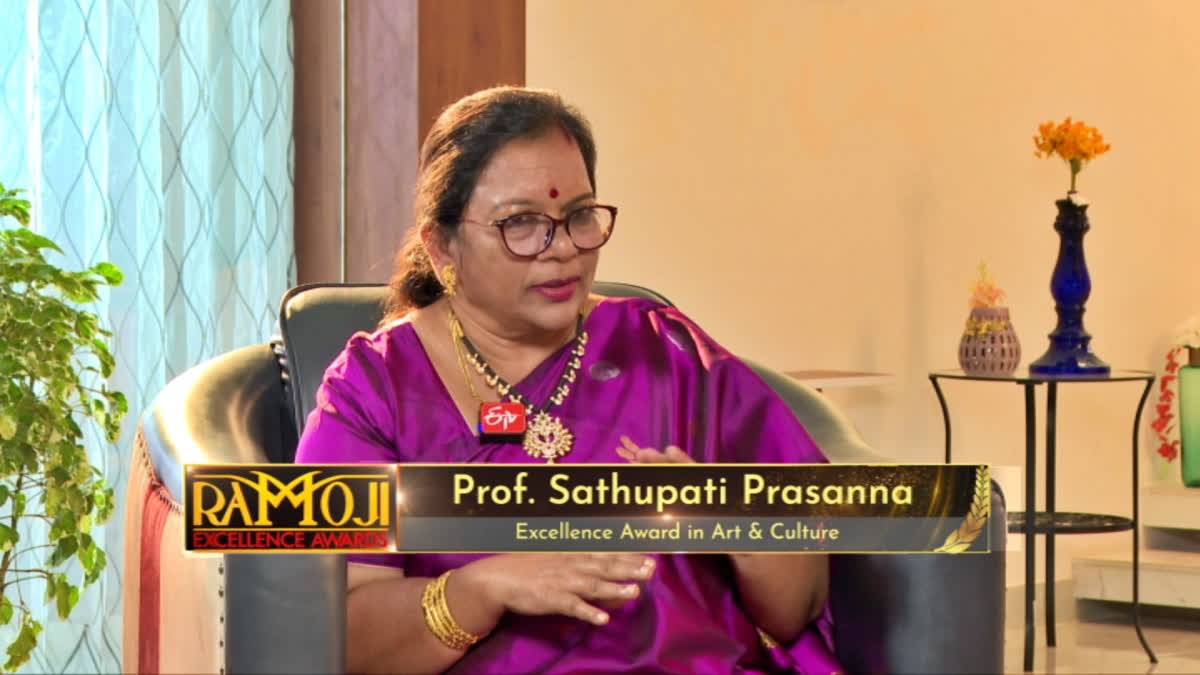
Ramoji Excellence Awardee, Prof. Sathupati Prasanna Sree speaks to ETV Bharat about her groundbreaking work in preserving tribal languages.

Published : November 17, 2025 at 3:09 PM IST

Hyderabad: Prof. Sathupati Prasanna Sree, one of India’s most influential linguists and the first tribal woman to serve as Vice Chancellor in Andhra Pradesh, has spent her career fighting for the dignity and identity of tribal communities through the preservation of their languages.
From documenting endangered tongues to creating scripts for languages that existed only as oral traditions, her work has given cultural and intellectual visibility to groups long pushed to the margins.
As she receives the Ramoji Excellence Award in the Art & Culture category, she speaks to ETV Bharat's Siddharth Rao about her unconventional journey into linguistics, the emotional and social realities that shaped her mission, and why she believes language remains the most powerful anchor of identity.
Excerpts from the interview:
Siddharth Rao: What are your memories of the journey from Stuartpuram to where you are right now?
Prof. Sathupati Prasanna Sree: Most people take it for granted that I am from Stuartpuram; in fact, I am not. My grandfather was a teacher, and the headmaster of a school. My father started his journey at 14. He came to Visakhapatnam. Since he worked in the Railways, we had to move to various places. It was my grandfather and not my father who was from Stuartpuram.
SR: We tend to see a unidirectional way of study in our country, either to study to be an engineer or a doctor. What drew you towards languages or linguistics in the first place?
SPS: It was not a planned journey. I was almost forced to take it because of a series of issues that harass you and chip away at your inner peace. They disturb the very emotional fabric of your mindset. When that distraction sets in, and when a fellow human being doesn’t recognise you as a human being, it automatically pushes you into questioning things.
That’s when I started looking into “Why am I not treated properly?” It’s not that I am inferior and someone else is superior. They are who they are. Hum bhi ek hai (We too are someone). These disparities, emotional harassment in the social fabric… when I have all the (desired) qualities, why am I being disturbed and distracted? That was my thought.
I realised it’s not just me. Thousands and thousands of people, my ancestors, were mistreated and harassed simply because their identity was tied to a place like Stuartpuram. Fundamentally, it shouldn’t matter whether someone belongs to Stuartpuram or Bengaluru. The point is, these are tribal groups. They may not have formal education, but they have emotional and psychological intelligence. Their brains work beautifully. But they don’t have an identity of their own, especially in the sense of having a scripted language.
When you don’t have that kind of identity, people make you feel you’re not on par with them. That your identity is beneath theirs. That you must sit at their feet. So education makes a huge difference. A script makes a huge difference, because when you’re cultivating the harvest of academics. If you are not ahead in the race, people automatically push you down.
SR: You were talking about languages as identity and language as a way of treating somebody. Is that what drew you towards these endangered languages and working on creating these scripts?
SPS: When I initially wanted to do this, I was carrying myself forward without any real destination in mind. But when I started taking control of the situation, I understood the enormity of the problems around me. And then I realised it’s not just me, there are so many people who have never seen this kind of light in their lives. Their parents weren’t educated, and they themselves weren’t educated.
When I thought about all this, I remembered that nearly 7% of India’s population is tribal. This is the plight of tribals across the country, especially in Andhra Pradesh, Chhattisgarh, Jharkhand, Odisha, Madhya Pradesh. All these states are where tribal communities live in pockets. This is the story of almost all tribals whose languages are not known. They have languages they speak, which we call oral literature.
Overtime, I felt that if you’re able to speak one language in a particular region, then that language has life. But when state-dominant languages come in, or neighbouring languages push in, the original form of your language, its tether, loses its flavour. So you need to have your identity, and with that, you need your language. And your language should have a script.
SR: You said these are oral traditions, oral literature, without a script. So when you take a language with oral literature that has evolved and passed on by word of mouth through the generations, and you decide to make a script, it is something you have to start from scratch?
SPS: Back in those days, tribals lived within their own province, and their forefathers and ancestors passed everything down through oral literature, through what you can call the “family system”. But today, we have the pressure of other languages weighing on our tribal identity. And what happens then is that people slowly stop identifying themselves as tribals.
Once my identity is revealed to the world, that I am a tribal, everyone starts looking down on me. Their mindsets are so fixed that they don’t see me as an educated tribal. They only see the tribe that once lived in jungles, with the old traditional systems. That is the only image they hold. But I say: even those people were intelligent, and they had a special ability to connect with what you might call the language of the universe. And they were able to pass that down, generation after generation.
What you are today, you won’t remember tomorrow. We are dominated by so many influences on our minds, on our lifestyles (in modern times). Under the weight of all these influences, I felt we need an identity that gives you a sense of belonging, that you come from a particular clan, a particular tribe. This is your culture.
Understand this: every one of us needs our own cultural identity. India is a secular state. Why do Americans or Western societies look at us with curiosity? Because our cultural identity is strong. It matters more than whether you’re Malayali, Tamil, or anything else. When you go abroad, no one asks whether you’re tribal or Hindu or Brahmin. They simply say, “You’re Indian.” That’s the identity I want. But here, within our own society, your identity becomes your unique force. You must have your own identity, represented by your language, and by the way you carry forward the culture given to you by your forefathers.
SR: You mentioned that language is central to identity and belonging, often even more than religion or race. Given your work with endangered and tribal languages, where speakers often face discrimination, can your efforts be seen as an attempt to restore pride in these communities’ language and culture?
SPS: Yes, yes, very much. These are the days when people are more and more attracted to the English language, which is not our own. Yet we speak and think in English. But our native feel is our native language. We translate our emotions into a language that is more suitable for everybody to listen.
SR: How has your personal identity, coming from a tribal background, as a woman from a tribal background, shaped your journey? Apart from that, you have won many awards, like the Nari Puraskar Award and now the Ramoji Excellence Award. How does this all tie up for you?
SPS: Because of my background, my forefathers were all conservatives. But my father was very liberal; he believed girls should be educated. When a woman goes into tribal areas in search of her own roots and tries to understand a concept that is completely new to her, it isn’t accepted easily. A woman entering this kind of space was not liked by men, patriarchy was always there, and they treated this whole phenomenon as a taboo. Socially, many people have ostracised me because of my identity. But I never bothered about any of that. Whatever I wanted to do, I did it. And honestly, when I did it, I felt the cosmos wanted me to. God and the heavens wanted me to do this. I am only a catalyst.
Also Read:
- Who Are The Ramoji Excellence Award Recipients: From Gutsy Human Trafficking Activist To 'Water Mother' Of India, Know The Seven Achievers
- VP CP Radhakrishnan Launches Ramoji Excellence Awards, Says Media Should Educate On Truth In Misinformation Era
- Ramoji Excellence Awards Honour Real Heroes Of Society: CMD
- Inaugural Ramoji Excellence Awards Ceremony Marks Sri Ramoji Rao's 89th Birth Anniversary