INTERVIEW | Yami Gautam and Emraan Hashmi On Haq: 'Our Film Not Defaming Any Community, Just Portrays What Actually Happened'
Emraan Hashmi and Yami Gautam say their upcoming film Haq inspired by Shah Bano case, is not meant to "malign" any community or religion.
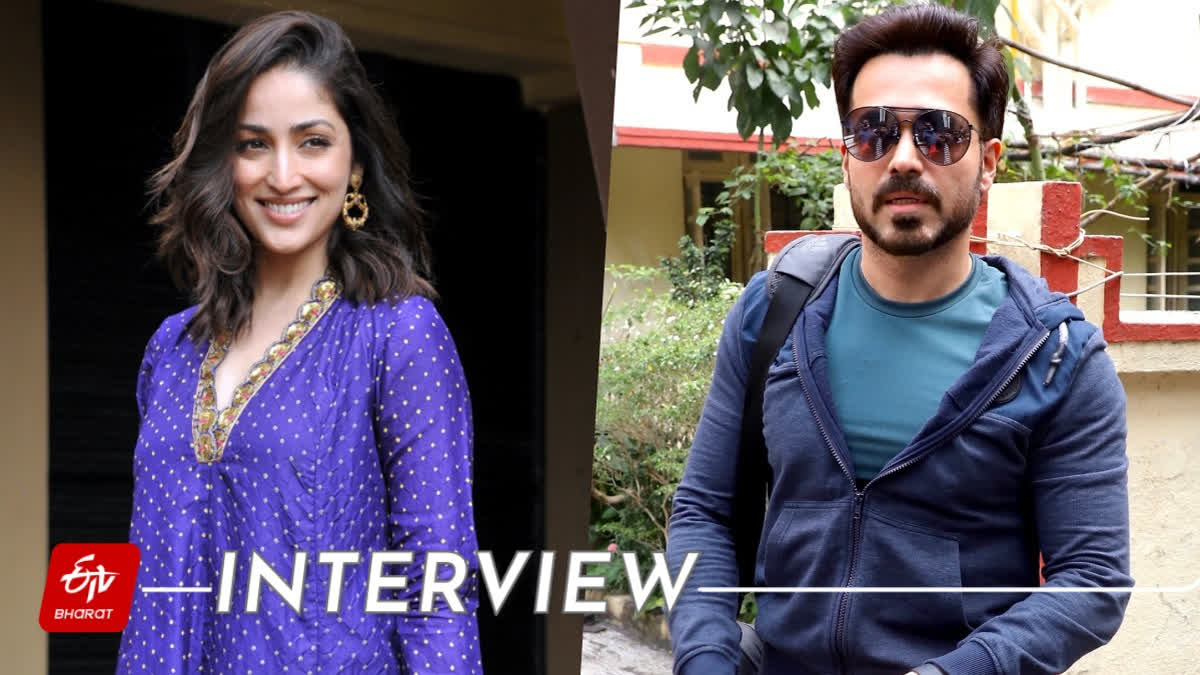

By Seema Sinha
Published : November 4, 2025 at 4:17 PM IST

Emraan Hashmi and Yami Gautam are coming together for the first time in a powerful courtroom drama titled Haq. Directed by Suparn Verma, the film takes inspiration from the real-life landmark judgment of Shah Bano case of 1985, one of India’s most debated legal battles about women’s rights and justice. Hashmi, who identifies as a "liberal Muslim" and views the challenges and intricacies of Muslim personal law through a secular and balanced lens, has addressed this in the context of his upcoming film. “First of all, it was challenging to select this subject, I had to look at it from the point of view of a Muslim. Then, the audience also takes this a bit personally because I am from the same community and I am playing this character. I had to see that the community is not seen in a negative light. But there are credible names behind this film and I knew that before reading the script,” says the actor.
Haq, which releases on November 7, explores the conflict between Muslim Personal Law (Sharia law, in the context of maintenance after divorce) and secular constitutional law that transcends legal boundaries to explore larger questions of belief, equality, and the price of truth. The story follows Shazia, played by Yami Gautam, a woman whose pursuit of justice defies both the system and societal conventions. Her determination to stand against injustice sparks a nationwide conversation on women’s autonomy and faith. Hashmi portrays her husband — a lawyer and her unexpected adversary in court — whose ideological clash with Shazia becomes the emotional and intellectual centerpiece of the film. Their courtroom confrontations unfold not just as legal duels but as deeply personal battles between conviction, love, and identity.
“This film is inspired from the landmark judgment, it is not a biopic,” clarifies Gautam. “Haq is an amalgamation of fiction and reality. I was amazed by her journey, which is heartbreaking, and at the same time it encapsulates in true definition the power of a woman, so much so that even 40 years later we are sitting and talking. After reading the script, I took a few moments to absorb it, and I stuck to my first thought. I never change that. When this happened, I was in high school; your childhood memories are very important. I still remember reading about this landmark case, and it felt very surreal that I was reading a script inspired by that case. I wanted to do justice to the part as an artist. It made me understand how and why this case became what it became. The film is not for any community; it is for the entire audience. It is universal,” says Gautam.
Adds co-star Hashmi, “We have definitely taken the historical fact of the case; the court route is the same, but the film’s nuances have been dramatized. Obviously when you are showing to the theatrical audience, there have to be emotions, songs, romance...and later things go wrong between the couple. We have fictionalised it a bit like we do in theatrical Bollywood films.”
Hashmi states the film presents a neutral and balanced view of the case, focusing on the woman's fight for dignity and rights under constitutional law beyond personal law. He emphasises that the film aims to be pro-women and advocate for equality of rights. The film has faced legal challenges from the Shah Bano family, who allege it misrepresents Sharia law in a derogatory manner, a claim Emraan has denied, saying he wouldn't have done the film if it were biased.
“We are not passing any judgment, we are not defaming or pointing fingers or accusing the community. We are only showing that this is the Shah Bano and Ahmed Khan case that happened and the film is inspired by that. We are just presenting that,” says Hashmi.
“Yes, it is a sensitive topic,” he furthers, “and we leave it to people to decide. We are not showing characters black and white. There is love, betrayal, resilience of a woman, a woman’s right to dignity, a man fighting for his personal faith... It is a very balanced viewpoint. When you watch the last two monologues … I don’t want to reveal all, but you will see both points of view. As an actor, after reading the script, I felt it was pro-women. Now it is for the audience how they view it, what they will pinpoint, and if they will get offended with something now that is not in our control. For me, as a liberal, progressive Muslim, it is a very balanced point of view. The film is about two people who fight for their rights and this woman fighting for her maintenance after divorce fights for financial stability, and the man fights for his faith, religion…what he thinks is right. Both are right in their own way,” says Hashmi.
Gautam has been part of several movies based on real-life events or inspired by them, such as the action thriller Uri: The Surgical Strike (2019), political-drama Article 370 (2024) and A Thursday, says she is very curious about how people would react to Haq. “I didn’t say much when I did Article 370 but now, I want to see the first-hand reaction,” she says. To play such real characters, the actress says understanding emotional intelligence and emotional wavelength is difficult. “Physicality comes later. I haven’t met Shah Bano in real life so I imagined on the basis of the information I had. Even if I was not an actor, forget the script, I thought about what kind of courage a woman had for her and her children in the 70’s and 80’s …you work backwards. There is strength, betrayal, innocence, and at the same time courage. In Article 370 it was different, Zooni had her own journey, she is a specialized officer, that is her job, she is trained. I would do weapon training for hours and then go for reading. It depends upon the need of the character. In this character emotional strength was so different, the rest, like say emotional graph and body language follows. For Haq I just learnt how to use a sewing machine, knitting and of course, diction course in Urdu and English,” says Gautam.
For Hashmi, who was playing a lawyer for the first time, prepping involved understanding decorum in a courtroom and learning a lot of lines “because you have to present a daleel (plea or an argument/proof). Then, like every script, I wanted to know what the writer and director want to say, and what is the film’s tonality that they want to present. It was a new character for me because it is based on historical fact, so, I had to look at the point of view of the research done by the director (Suparn Verma). He was very helpful, he guided me on my referencing,” says the actor.
“I had different ideas before we started, like how we do in typical Bollywood films to make the courtroom scenes look far more dramatic. Here we have kept it thrilling and dramatic, but that respect and dignity of the courtroom have been maintained,” added Hashmi.
In the film Hashmi's character, Abbas, is best described as having grey shades or being a complex anti-hero rather than purely negative. He plays a dual role as the husband of the main character, Shazia Bano, and her opposing lawyer in the landmark maintenance case.
However, Hashmi says that he has never judged his characters in his career spanning over two decades. He noted that the film does not "villainise anyone" and presents an unbiased take, allowing the audience to view the character through their own lens. “I don’t see my characters as grey or negative or black. Abbas is right from his point of view. If you are sitting in a theatre and you may feel Abbas Khan was right here or wrong there. He is a real character and you can say he has shades of grey but I can’t view it that way, it is his narrative, he is the custodian of his tradition and his perception of his faith and he is fighting for that. It doesn’t make him a villain; he is coming from his own point of view. And there is a clash of egos and dynamics of marriage that you will know when you see the film,” says Hashmi.
Gautam believes in taking up controversial subjects without any fear when asked if she was in two minds before giving Haq a nod. “An actor has only one lens, what is the film’s sur, is it to create a controversy or discussion. There is a difference between the two. I don’t believe in creating controversy, but if you don’t discuss and debate then what is the point of doing any film? You like it a lot or you don’t like it at all. There is no scope for average. I hope Haq comes under the category that you like a lot. As an artist I can only go by how I like the script and the first thought is purist. I don’t go outside of that thought. If I think I want to do it, then I definitely will, then I am not scared or have any doubt,” she says, signing off.
Read More