Why Lightning Is Emerging As One Of India's Biggest Monsoon Threats
Experts warn rising temperatures are increasing lightning risk, turning it into a growing climate and public safety challenge, reports Surabhi Gupta.
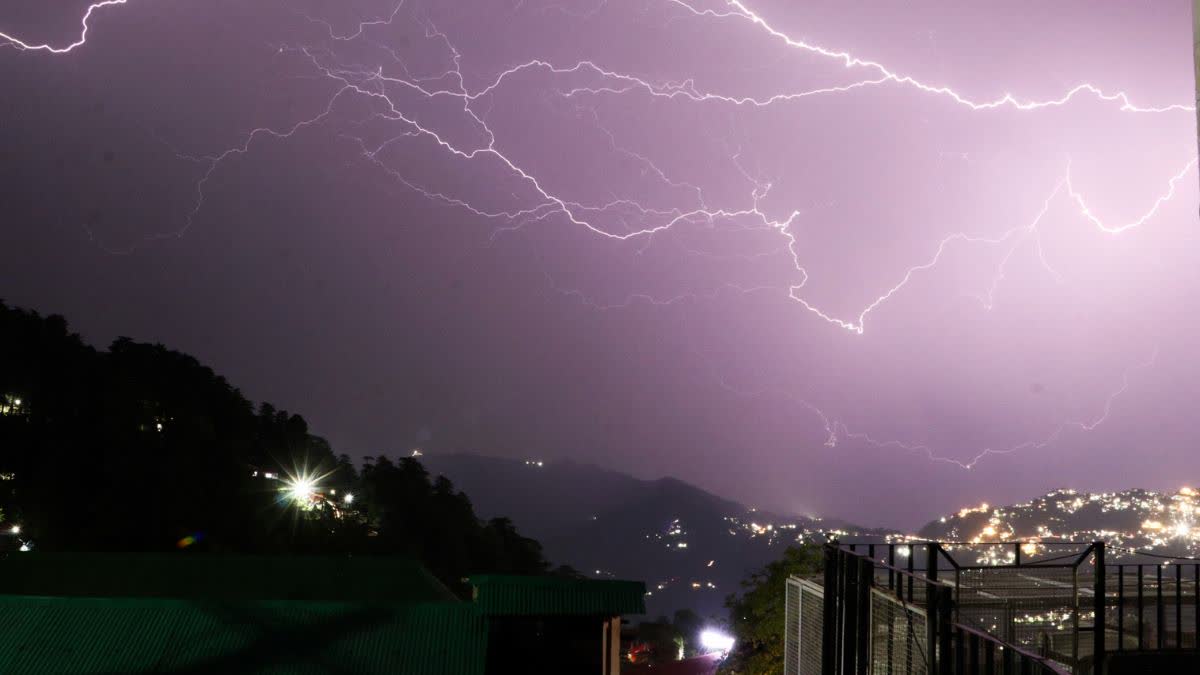

Published : August 4, 2026 at 5:50 PM IST
|Updated : August 4, 2026 at 9:02 PM IST

New Delhi: As the India Meteorological Department (IMD) issues fresh thunderstorm and lightning warnings for several parts of the country amid an active monsoon spell, experts say lightning is emerging as one of India's fastest-growing weather hazards, driven by climate change and rising temperatures.
According to the latest “Lightning Resilience in India” report of the National Disaster Management Authority (NDMA), lightning occurrences in the country increased by 57 per cent between 2019 and 2024. However, despite the sharp rise in lightning events, fatalities have declined by over 22 per cent, reflecting improvements in forecasting, early warning systems and awareness campaigns.
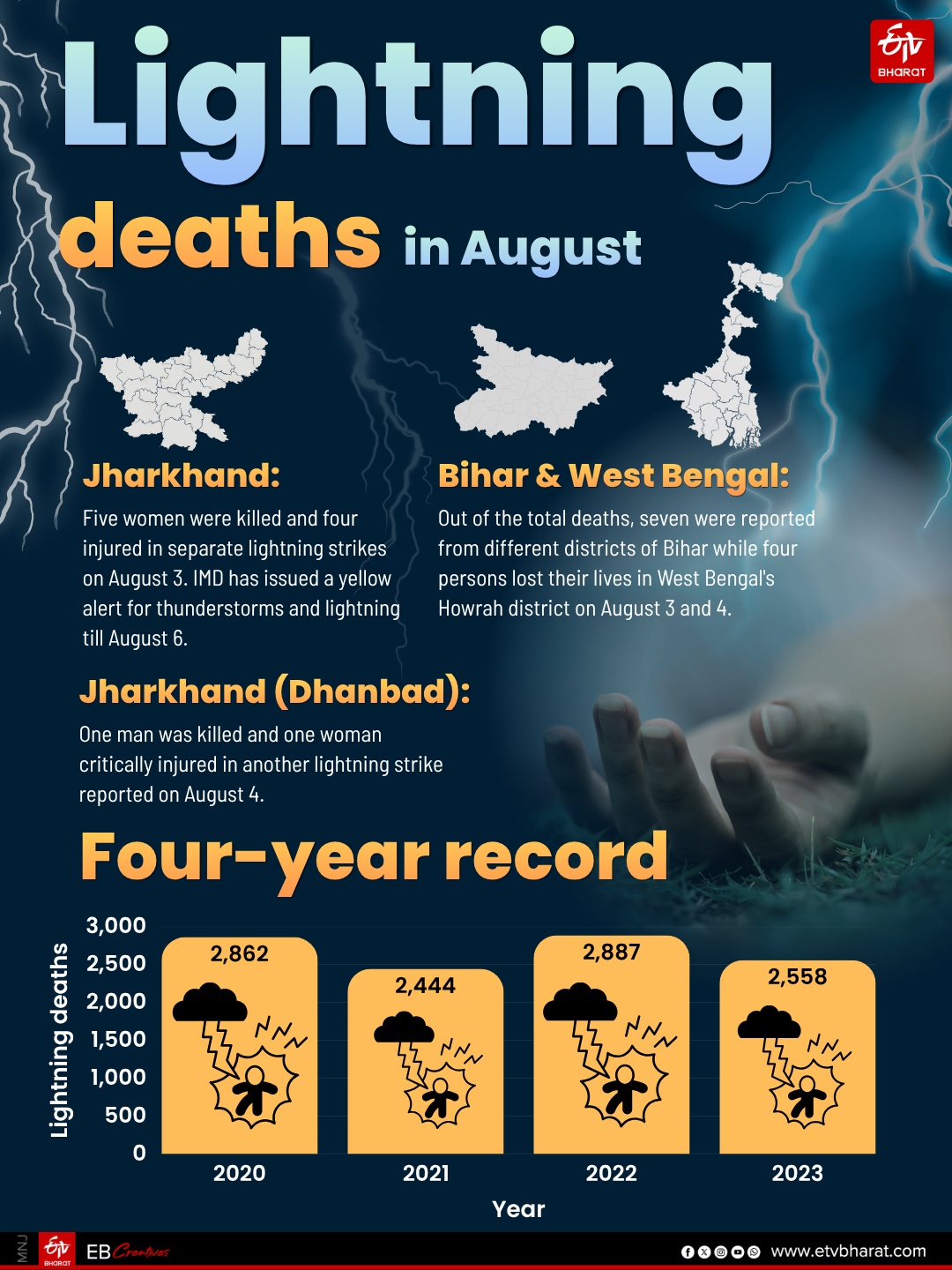
India, however, continues to record more than 2,000 lightning-related deaths every year. Official data also show that over 49,000 people lost their lives to lightning between 2000 and 2021, making it one of the deadliest weather-related hazards in the country. Farmers and outdoor workers account for a majority of the victims, with most fatalities occurring during the southwest monsoon.
The concern becomes particularly significant in August, which records the highest number of lightning-related fatalities as monsoon activity intensifies and millions of people continue working outdoors.
The current monsoon season has already highlighted the risk. In the past week alone, several people have died in lightning strikes across states, including Jharkhand and Chhattisgarh, while IMD has continued issuing lightning and thunderstorm alerts for several parts of north, central and eastern India.
Experts attribute the rising frequency of lightning to climate change and increasing atmospheric instability.
Soumya Dutta, former advisory board member of the UN Climate Technology Centre and Network (CTCN) and trustee of MAUSAM, told ETV Bharat, "Global heating and resultant climate change has increased the lightning incidents in India, but most notably in Eastern India. Globally also there's an increase, but not evenly spread.”
According to him, lightning develops mostly inside tall cumulonimbus clouds that form thunderstorms. Warm, moist air rises rapidly. Water droplets, ice crystals and hail collide inside the cloud. These collisions separate electric charges. Positive charges accumulate near the cloud top while negative charges gather lower down. When the electric field becomes strong enough, it breaks the air insulation, leading to lightning discharge either between cloud and ground or within clouds.
"The stronger the surface heating, the stronger will be the storm's updrafts and the more friction and ice particles present, the greater the potential for lightning. Also, for every 1°C rise in air temperature, the air can hold about 7 per cent more moisture. When this moisture condenses at upper levels, it releases much greater latent heat,” said Dutta. "Thus, greater heating leads to stronger air movement, more friction and static electricity build-up, increasing the chances of lightning."
Environmental scientist Hishmi Jamil Husain said the trend reflects a changing climate.
"The 57 per cent increase in lightning occurrences between 2019 and 2024 is a reminder that our climate system is becoming more unstable. Rising temperatures, increased atmospheric moisture, rapid urbanisation and changing weather patterns are creating conditions that favour stronger thunderstorms,” Husain said. “Lightning is not just a weather event; it is a growing climate resilience challenge that demands better early warnings, awareness and preparedness."
Delhi-based environmentalist B S Vohra described lightning as an under-recognised public safety issue.
"Lightning is emerging as a silent killer and a growing public-safety threat. A 57 per cent rise in lightning occurrences between 2019 and 2024 is a stark warning. With August recording the highest fatalities, alerts must reach people on the ground, not remain confined to weather bulletins. Timely warnings, public awareness and last-mile preparedness can save lives," he said.
Meteorological experts note that while IMD does not publish a separate nationwide accuracy figure for lightning forecasts, the department's thunderstorm forecasting capability has improved.
According to IMD's forecast verification, the Probability of Detection (POD) for three-hour thunderstorm nowcasts has improved to around 92 per cent in 2025, up from about 67 per cent in 2013, while the false alarm ratio has reduced considerably. The improvement has strengthened early warning dissemination through platforms such as the Damini mobile application and state disaster management agencies.
Experts say that while forecasting has become more accurate, reducing fatalities further will depend on ensuring that warnings reach vulnerable communities, especially farmers, labourers and others working outdoors, and that people promptly move to safe shelters when thunderstorm alerts are issued.
Delhi-based environmentalist Manu Singh told ETV Bharat, "August has traditionally been India’s peak lightning month, but the scale and intensity of lightning activity being witnessed today can no longer be seen as a purely natural phenomenon. Human-induced climate change is fundamentally altering the atmosphere."
"Rising surface temperatures, higher moisture levels and increased atmospheric instability are creating ideal conditions for the formation of taller and more energetic cumulonimbus clouds, the thunderstorm clouds responsible for lightning. A warmer atmosphere has a greater capacity to fuel intense convective storms and frequent lightning strikes. In India, lightning already claims more lives than many other natural disasters, making it a serious yet often underestimated public health and disaster management challenge,” Singh said.
"Reducing fatalities requires a two-pronged approach. In the short term, early warning systems must be strengthened, public awareness improved, and people encouraged to respond promptly to IMD alerts. In the long term, cutting greenhouse gas emissions and protecting forests and natural ecosystems are essential to slowing the atmospheric warming that is intensifying severe thunderstorms. Every lightning strike should serve as a reminder that the climate crisis is no longer a distant threat, it is unfolding above our heads,” he said.
Also Read: