Odisha Medical Colleges Lack Advanced Fungal Diagnostics, Study Finds
Researchers have called for urgent investments, following the identification of major weaknesses in fungal diagnostic infrastructure across Odisha's medical colleges, reports Gautam Debroy.

Published : May 30, 2026 at 5:30 PM IST

New Delhi: A recent study has revealed significant gaps in fungal disease diagnostic infrastructure across Odisha's medical colleges, highlighting the state's limited preparedness to tackle life-threatening fungal infections despite India's rapidly rising disease burden.
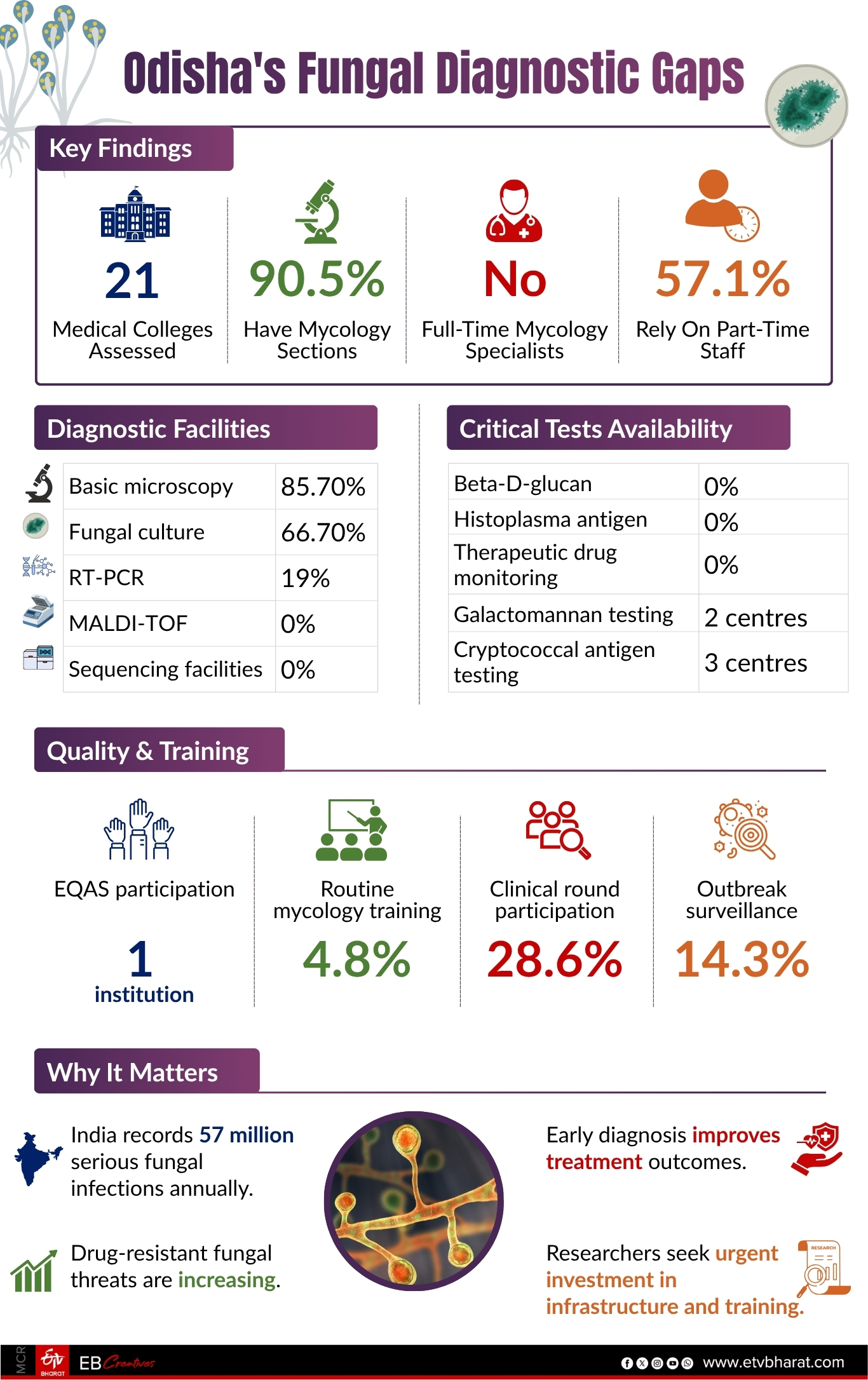
The study, published in the Indian Journal of Medical Microbiology, assessed microbiology laboratories in all 21 medical colleges in Odisha in September 2024 and compared the findings with broader Indian and Asian diagnostic benchmarks. Researchers found that while 90.5 per cent of institutions had independent mycology laboratory sections, none had full-time dedicated mycology faculty or technical staff, a critical shortfall in a field that requires specialised expertise.
The findings come amid growing global concern over fungal diseases, which are increasingly being recognised as a major public health challenge. Worldwide, invasive fungal infections are estimated to cause nearly 6.5 million cases and about 3.8 million deaths every year. India alone accounts for an estimated 57 million cases of serious fungal infections annually, caused by pathogens such as Candida, Aspergillus, Mucorales, and Cryptococcus species.
Researchers said Odisha's predominantly rural and tribal population, coupled with uneven healthcare access, makes timely diagnosis and treatment particularly challenging.
Gaps In Diagnostic Capacity
Speaking to ETV Bharat, lead researcher Vinay Kumar Hallur said the survey highlighted important opportunities to strengthen mycology diagnostic services across the state.
"Our survey highlighted important opportunities to strengthen mycology diagnostic services across Odisha. We found that 57.1 per cent of institutions currently rely on part-time staff for mycology samples, and most centres process fewer than 50 fungal samples per week, which likely reflects under-recognition of fungal disease rather than the absence of need. Basic microscopy was available in 85.7 per cent of laboratories and fungal culture in 66.7 per cent, which is a good foundation to build upon," he said.
However, Hallur noted that advanced technologies such as MALDI-TOF, molecular sequencing and RT-PCR, available in only 19 per cent of centres, remain out of reach for most institutions.
"Bridging these gaps with targeted investment in training and infrastructure would significantly improve patient outcomes and prepare the state for emerging fungal threats," he said.
Although basic microscopy facilities were available in 85.7 per cent of laboratories in Odisha and fungal culture services in 66.7 per cent, advanced diagnostic technologies remained largely absent. None of the medical colleges had access to MALDI-TOF mass spectrometry, fungal sequencing facilities or advanced molecular diagnostic platforms.
The study found that several important fungal diagnostic tests are almost nonexistent across Odisha. None of the surveyed institutions offered beta-D-glucan testing, Histoplasma antigen testing or therapeutic drug monitoring facilities.
Only two medical colleges conducted galactomannan testing, considered essential for diagnosing invasive aspergillosis, while cryptococcal antigen testing was available in just three centres.
Quality assurance systems were also found to be weak. Only one institution regularly participated in External Quality Assurance Schemes (EQAS), and routine staff training in medical mycology was conducted in only 4.8 per cent of institutions.
Odisha Trails National, Asian Benchmarks
Hallur said Odisha lagged behind on 13 of the 24 key diagnostic indicators evaluated against national and Asian benchmarks. According to data from a previous multi-country Asian survey, 55.8 per cent of Indian laboratories overall had independent mycology sections, compared to 90.5 per cent in Odisha.
"Culture facilities were available in 94.2 per cent of Indian laboratories compared to 66.7 per cent in Odisha. Antifungal susceptibility testing (AFST), which helps determine resistance to antifungal drugs, was available in 73.1 per cent of Indian centres but remained extremely limited in Odisha," he said.
India performed better than the broader Asian average in some infrastructure indicators, including biosafety hood availability, fluorescence microscopy and EQAS participation. However, the country lagged significantly behind Asian benchmarks in advanced molecular diagnostics.
Only 5 per cent of Indian laboratories had MALDI-TOF technology compared to 12.3 per cent across Asia. Sequencing facilities were present in just 9.9 per cent of Indian centres, compared with 16.9 per cent in Asia. Beta-D-glucan testing was available in only 3.8 per cent of Indian laboratories compared to 10 per cent across Asia.
Call For Urgent Investment
PCR-based fungal diagnostics were available in only 12.5 per cent of Indian laboratories, while therapeutic drug monitoring facilities existed in just 5.8 per cent of centres nationwide.
Researchers warned that India's fungal diagnostic infrastructure has failed to keep pace with the rise in fungal diseases, including drug-resistant Candida auris infections and difficult-to-treat dermatophyte infections linked to Trichophyton indotineae.
The study also highlighted weak clinical integration and surveillance mechanisms in Odisha. Only 28.6 per cent of centres participated in clinical rounds alongside treating doctors, while just 14.3 per cent were involved in fungal outbreak surveillance. Research activity was limited, with only four institutions conducting fungal research, mostly through postgraduate thesis work.
The researchers called for urgent investments in specialised training programmes, modern laboratory infrastructure, advanced molecular diagnostics and quality assurance systems across Odisha and the rest of India. Strengthening fungal diagnostic capacity, they said, would be crucial for improving early detection, treatment outcomes and preparedness for future fungal disease outbreaks.
Also Read: