India-EU FTA Explained: Significance, Benefits, What It Means For Trump
The EU market accounts for about 17% of India's total exports, and the bloc's exports to India constitute 9% of its total overseas shipments.

Published : January 27, 2026 at 3:09 PM IST
|Updated : January 27, 2026 at 6:52 PM IST

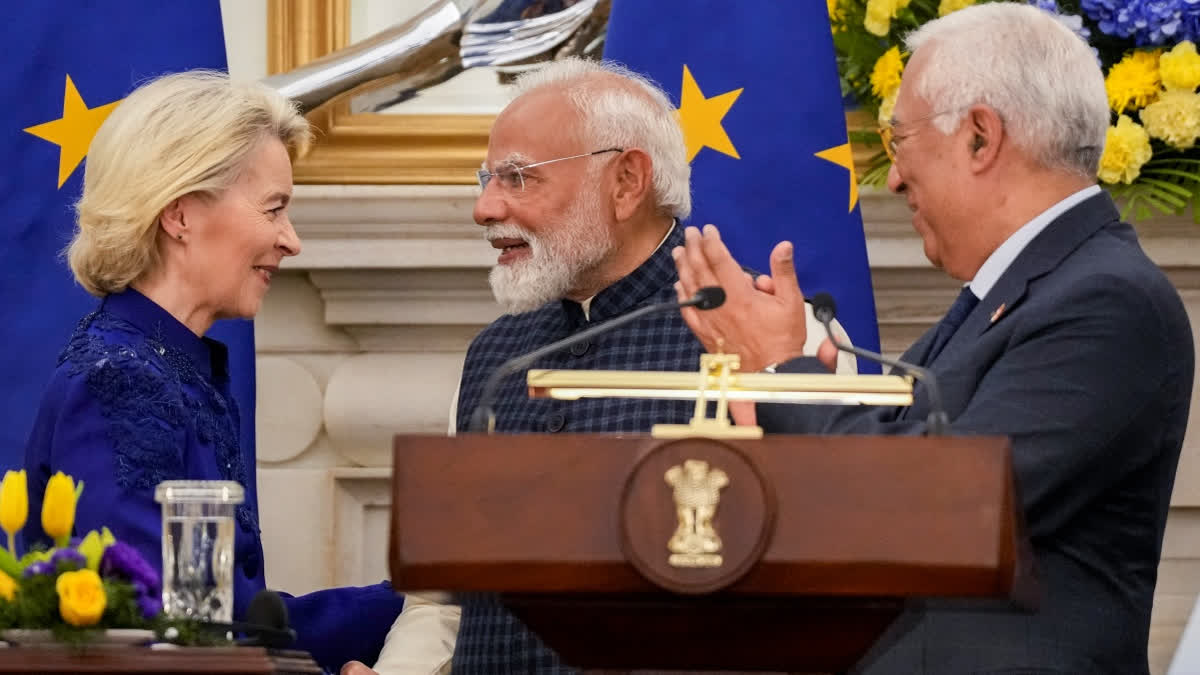
New Delhi: India and the European Union (EU) on Tuesday announced the conclusion and finalisation of negotiations for the proposed free trade agreement (FTA), which will help boost the country's exports to the 27-nation bloc.
Since 2014, India has finalised seven trade pacts -- Mauritius (April 2021 implemented), Australia (December 2022 implemented), UAE (May 2022 implemented), Oman (signed in December 2025), UK (signed in July 2025), EFTA (implemented in October 2025 - Switzerland, Iceland, Liechtenstein, Norway), and New Zealand (talks concluded in December 2025).
India-EU Relation:
India-EU partnership has developed over decades, beginning with basic diplomatic engagements and expanding into a multifaceted strategic alliance that encompasses political dialogue, economic cooperation, security, and global challenges like climate change and technology. Diplomatic relations between India and the EU trace back to the early 1960s, with India being among the first countries to establish ties with the European Economic Community (EEC) in 1962. This laid the groundwork for formal cooperation, culminating in the 1993 Joint Political Statement and the 1994 Cooperation Agreement, which aimed to strengthen bilateral political and economic links.
The India-EU Free Trade Agreement (FTA) negotiations began in 2007. Initially, from 2007 to 2013, multiple rounds of negotiations took place but were hindered by disagreements over market access, intellectual property rights, labour standards, and sustainable development. By 2013, the talks hit a standstill, particularly due to differences over tariffs on automobiles, wine, spirits, data security for Indian IT firms, and public procurement. Despite efforts to revive negotiations between 2016 and 2020, substantial progress remained elusive. However, post-2020, both India and the EU showed renewed interest in resuming talks. In June 2022, negotiations were relaunched for a FTA, an Investment Protection Agreement, and an Agreement on Geographical Indications (GIs). Talks for the GI pact and a bilateral investment treaty are going on. Negotiations for FTA concluded on January 27.
Importance Of FTA:
Pressure for a deal has grown urgent as high US tariffs, reaching up to 50 percent, have disrupted global trade flows. For India, the FTA offers a strategic opportunity to reduce its dependence on China, increase its exports to Europe and cushion the impact of protectionist policies elsewhere. Customs duties or import duties are either reduced or eliminated under FTAs, facilitating market access and regulatory alignment.
Benefits For India, EU:
The India-EU deal is expected to benefit sectors such as technology, pharmaceuticals, automobiles, textiles, steel, petroleum products and electrical machinery. Labour-intensive sectors such as clothing, leather and pharmaceuticals could see their competitiveness improved in the EU market, while Indian exports of services, particularly telecommunications, transport and business services, are also expected to grow.
According to think tank GTRI, the EU stands to gain from increased exports of aircraft and parts, electrical machinery, diamonds and chemicals to India. European services such as intellectual property, IT, telecommunications and business services could also benefit from expanded access.
India is looking to diversify its export destinations as part of a strategy to offset the impact of higher US tariffs, including an extra 25 percent levy on Indian goods for its unabated purchases of discounted Russian oil, bringing the combined tariffs imposed by the US on its Asian ally to 50 percent.
Gains For India:
- Over 99 percent of Indian exports gain preferential entry into the EU, unlocking massive growth potential.
- A total of Rs 6.41 lakh crore (USD 75 Billion) exports poised for take-off, 33 bn USD of exports in labour-intensive sectors like textiles, leather, marine products, gems and jewellery set to gain immensely from preferential access under the FTA.
- Beyond enhancing competitiveness, the agreement empowers workers, artisans, women, youth, and MSMEs, while integrating Indian businesses more deeply into global value chains and reinforcing India’s role as a key player and supplier in global trade.
- Automobiles: On automobiles, calibrated and carefully crafted quota based auto liberalisation package will not only allow EU auto makers to introduce their models in India in higher price bands but also open the possibilities for Make in India and exports from India in future. Indian consumers to benefit from high tech products and greater competition. The reciprocal market access in EU market will also open up opportunities for India made automobiles to access EU market.
- Agriculture : India’s agricultural and processed food sectors are poised for a transformative boost under the India–EU FTA, creating a level playing field for Indian farmers and agrarian enterprises. Key commodities such as tea, coffee, spices, fresh fruits and vegetables, and processed foods will gain enhanced competitiveness, strengthening rural livelihoods, promoting inclusive growth, and reinforcing India’s position as a trusted global supplier. India has prudently safeguarded sensitive sectors, including dairy, cereals, poultry, soymeal, certain fruits and vegetables, balancing export growth with domestic priorities.
- Cutting down trade barriers: Beyond tariff liberalisation, the FTA provides measures to tackle non-tariff barriers through strengthened regulatory cooperation, greater transparency, and streamlined customs, Sanitary and Phytosanitary (SPS) procedures, and technical barriers to trade disciplines.
- Services: India's predictable access to EU's 144 subsectors (which includes IT/ITeS, Professional Services, Other Business Services and Education Services) will provide boost to Indian service providers and enable them to provide competitive world class Indian services to EU's consumers while EU's access to 102 subsectors offered by India will bring in high tech services, investment into India from EU resulting in a mutually beneficial arrangement.
Bilateral Trade:
India's bilateral trade in goods with the EU was USD 136.53 billion in 2024-25 (exports worth USD 75.85 billion and imports worth USD 60.68 billion), making the EU India's largest goods trading partner. The EU market accounts for about 17 per cent of India's total exports, and the bloc's exports to India constitute 9 per cent of its total overseas shipments.
In 2023-24, India exported USD 76 billion in goods and USD 30 billion in services to the EU, while the EU exported USD 61.5 billion in goods and USD 23 billion in services to India. Within the EU, Spain, Germany, Belgium, Poland and the Netherlands are key destinations for Indian exporters.
India's Top Exports To EU:
India’s US$75.9 billion exports to the EU are concentrated in downstream and labourintensive sectors. Refined petroleum products topped exports at US$15.0 billion, led by diesel (US$9.3 billion) and aviation turbine fuel (US$5.4 billion). Electronics exports reached US$11.3 billion, including smartphones worth US$4.3 billion, reflecting India’s role as a scale manufacturing and assembly hub.
In textiles and apparel, exports included garments worth US$4.5 billion, with girls’ suits alone at US$822 million, alongside textiles (US$1.6 billion) and made-ups (US$1.2 billion)—sectors Europe largely exited decades ago. Other major exports were machinery and computers (US$5.0 billion), including turbojets (US$756 million); organic chemicals (US$5.1 billion); iron and steel (US$4.9 billion); and pharmaceuticals (US$3.0 billion). Gems and jewellery exports stood at US$2.5 billion, dominated by cut and polished diamonds (US$1.6 billion).
India’s Top Imports From EU:
India’s US$60.7 billion imports in FY 2025 from the EU are concentrated in capital- technology- and input-intensive products. High-end machinery was India’s largest import from the EU at US$13.0 billion, including turbojets (US$810 million), industrial control valves (US$418 million) and specialised industrial machines (US$343 million). India does not manufacture such advanced capital equipment at scale and depends on these imports to run its industrial and infrastructure sectors.
Electronics imports totalled US$9.4 billion, led by mobile phone parts (US$3.7 billion) and integrated circuits (US$890.5 million). India needs these components to assemble smartphones and electronic devices, as domestic IC and component manufacturing remains limited. India imported aircraft worth US$6.3 billion and medical devices and scientific instruments worth US$3.8 billion, along with medicines worth US$1.4 billion, largely specialised formulations. These are high-technology products that India largely does not produce and must source from advanced manufacturing economies.
Imports of industrial inputs included gems and jewellery worth US$3.0 billion, dominated by rough diamonds (US$1.7 billion); organic chemicals (US$2.3 billion); plastics (US$2.3 billion); and iron and steel worth US$2.4 billion, including ferrous waste (US$561 million) and flat-rolled products (US$249 million). Automotive imports amounted to US$2.1 billion, mainly auto parts 3 (US$1.5 billion) and cars (US$430.6 million).
What India-EU FTA Means For Trump?
The negotiations for the India-EU deal got a new impetus after US President Donald Trump’s strong-arm tactics over tariffs and Greenland. Speaking at a joint news conference in New Delhi with European Commission President Ursula von der Leyen and European Council President António Costa, PM Modi said the partnership with the EU “will strengthen stability in the international system” at a time of ”turmoil in the global order.” Washington is targeting both India and the EU with steep tariffs, disrupting established trade flows and pushing major economies to seek alternate partnerships.
Benefits For Indian Consumers:
- Medical and surgical equipment: Around 90% of optical, medical, and surgical equipment will become duty-free, potentially lowering healthcare costs.
- Wine: Import duties will be slashed from 150% to 75% at entry into force, with tariffs eventually falling to as low as 20% for premium wines and 30% for mid-range wines, making European wines significantly cheaper in India.
- Spirits: Tariffs of up to 150% will be reduced to 40%, easing the cost of imported spirits.
- Beer: Import duties will be cut from 110% to 50%, lowering prices for European beer brands.
- Olive oil, margarine and other vegetable oils: Duties of up to 45% will be fully eliminated over five years, sharply reducing prices of these staple imports.
- Processed foods (breads, pastries, biscuits, pasta, chocolate, pet food): High tariffs of up to 50% will be completely removed, improving affordability and availability.
- Fruit juices and non-alcoholic beer: Import tariffs of up to 55% will be reduced to zero, making these products cheaper for consumers.
- Kiwis and pears: Duties of 33% will fall to 10% within agreed quotas, lowering prices for imported fruits.
- Agri-food products overall: Average tariffs of over 36% on European agri-food exports to India will be removed or significantly reduced, expanding consumer choice.
- Pearls, precious stones and metals : Tariffs of up to 22.5% will be eliminated for 20% of products, with reduced duties for another 36%, benefiting jewellery and manufacturing sectors.
- Motor vehicles : Import duties of 110% will be cut to 10% under a quota of 250,000 vehicles, potentially lowering prices for select imported models.
- Pharmaceuticals : Tariffs of around 11% will be removed for almost all products, improving access to European medicines.
- Sheep meat: Duties of 33% will be eliminated entirely, reducing costs of imported meat products.
- Sausages and other meat preparations: High tariffs of up to 110% will be lowered to 50%, easing import prices.
- Luxury cars: Tariffs on imported cars will be gradually reduced from 110% to as low as 10%, while duties on auto components will be fully eliminated over the next five to ten years.
- Chemicals: Import duties of up to 22% will be eliminated in most cases, making chemical inputs cheaper for Indian industries.
- Machinery: Tariffs as high as 44% on European machinery will largely be removed, reducing the cost of capital goods.
- Aircraft and spacecraft: Tariffs will be eliminated on almost all products in this category, benefiting aviation and space sectors.
India's Challenges In Exports, Imports:
India’s main exports to the EU include petroleum products, electronics (including smartphones), textiles, machinery, organic chemicals, iron and steel, gems and jewelry, pharmaceuticals and automobile parts. However, Indian textile exports currently face tariffs of 12-16% in the EU, making them less competitive than products from countries like Bangladesh and Vietnam, which enjoy preferential access under EU trade deals.
India’s main imports from the EU include machinery, aircraft and their parts, electronics, medical devices, scientific instruments, rough diamonds, chemicals, plastics, cars and automobile components. In the services sector, India exports business, IT, telecommunications and transportation services, while importing intellectual property services and IT services.
FDI Inflows:
India's cumulative FDI inflows from the EU from April 2000 to September 2024 totalled USD 117.4 billion, with about 6,000 EU firms operating in India. FDI from the EU accounted for 16.6 per cent of the cumulative FDI equity inflows from all countries, which stood at USD 708.6 billion.
According to GTRI, India's FDI outflows to the EU totalled about USD 40.04 billion from April 2000 to March 2024. India mainly receives FDI from the Netherland (USD 55 billion) during April 2000 and September 2025), Germany (USD 15.4 billion), France (USD 12 billion), Spain (4.3 billion), Belgium (USD 4.1 billion), Italy (3.65 billion), Sweden (USD 2.8 billion), Denmark (USD 1.44 billion), and Poland (USD 788.75 million).
Also Read: