India-EU FTA Highlights: From Zero-Duties On Apparel and Chemicals To Concessional Access For Cars, Wines
India and the European Union on Tuesday announced the conclusion of negotiations for the free trade agreement (FTA). Here are its highlights.
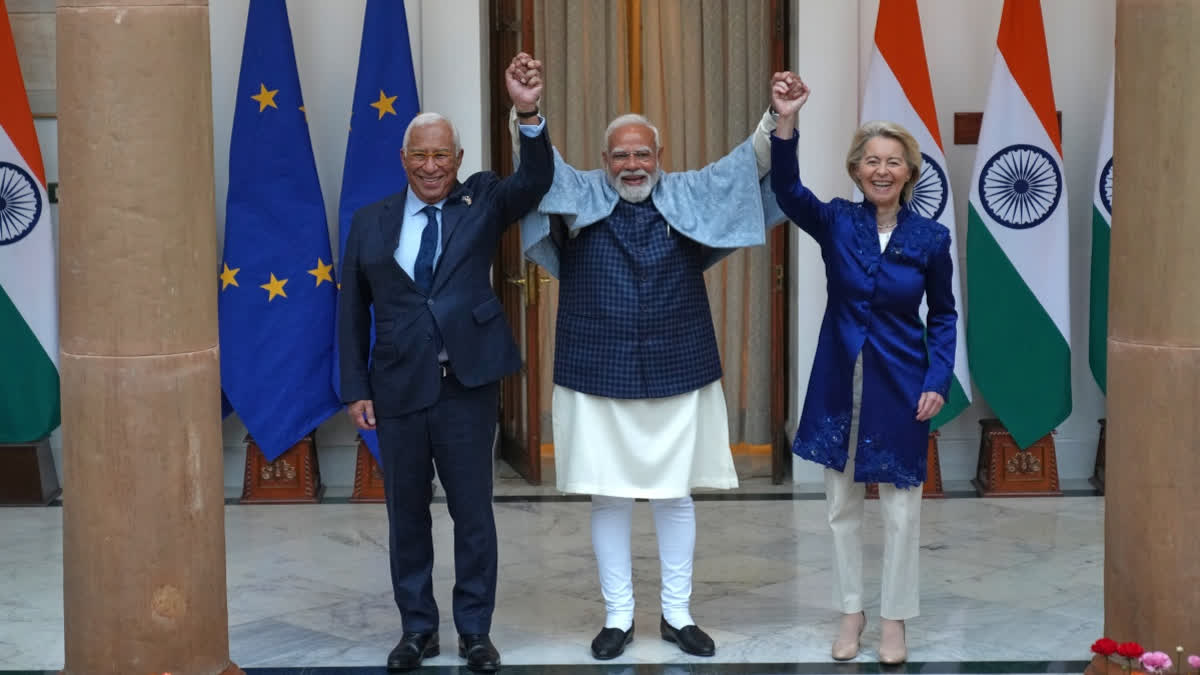
Indian Prime Minister Narendra Modi, center, welcomes European Council President Antonio Costa, left and European Commission President Ursula von der Leyen before their meeting in New Delhi, India, Tuesday, Jan. 27,2026. (AP)

Published : January 27, 2026 at 3:05 PM IST
4 Min Read

New Delhi: The negotiations for the India-European Union Free Trade Agreement (FTA) officially concluded on Tuesday. The pact is likely to be implemented next year. The deal, concluded after negotiations spanning over two decades, has been termed as the "mother of all deals" as it will create a market of about 2 billion people.
India, the 4th largest economy, and the European Union, the 2nd largest economy, comprising 25 per cent of Global GDP, account for one third of global trade, making the FTA significant.
Here are the highlights of the trade deal:
- USD 33 billion of exports in labour-intensive sectors like textiles, leather, marine products, gems and jewellery set to gain immensely from preferential access under the FTA.
- Under the deal, several domestic sectors such as apparel, chemicals and footwear will get duty-free entry into the 27-nation bloc, while the EU will get access to the Indian market at concessional duty for cars and wines, PTI reported, quoting an official.
- Except for auto and steel, almost all the Indian goods (over 93 per cent) from India will get zero-duty access in the European Union (EU), and of the remaining over 6 per cent, Indian exporters will get tariff reduction and quota-based duty concessions (for goods like automobiles).
- The EU will eliminate import duty on 90 per cent of Indian goods on the first day of implementation of the free trade agreement (FTA), which is expected to come into force early next year. On three per cent, levies will be eliminated in a phased manner in seven years.
- The EU will get duty-free access for 93 per cent of its goods over a ten-year period in India. India will remove duties on only 30 per cent of European goods on the first day of implementing the pact. India is also giving duty concessions and quota-based reductions on 3.7 per cent of trade value for the EU. In all, India is giving duty concessions on 97.5 per cent of the trade value for the EU.
- The major Indian sectors which will get duty-free access include textiles, apparel, clothing, marine products, chemicals, plastics, rubber, leather and footwear, base metals, gems and jewellery, furniture, toys, and sports goods. At present, these sectors attract duties ranging from 0 to 26 per cent in the EU.
- India has also liberalised tariffs for EU goods under the FTA. India, according to the official quoted by PTI, will reduce import duty to zero for the EU in over 10 years. "The initial drop-down to zero is limited. On EIF (entry into force), we will reduce to 30 per cent of our trade value. But gradually, we will go down to zero on 93 per cent of our total bilateral trade value,” the official said.
- On the services front, the EU has made one of its best offers to India, opening 144 sub-sectors out of 155, and India is opening 102 sub-sectors to them. In addition to that, there are commitments around students' mobility, the official said, adding "we do have some commitments on post-study work visas also from the EU”.
- In automobiles, both sides have negotiated on a quota-based duty concessions because the EU has a very aggressive demand in this sector. India's auto sector is largely dominated by small cars (retail prices Rs 10 lakh-Rs 25 lakh), and the EU’s interest in that segment is not great. EU will not export those cars to India that are likely to sell below Rs 25 lakhs. Instead, they may manufacture it in India. The Rs 25 lakh vehicles include petrol, diesel, and hybrid. Above Rs 25 lakh, India's market is limited, but the EU's interest is high as they are good manufacturers in this segment. At present, India's import duty on automobiles ranges from 66 per cent to 125 per cent. India will not give any out-of-quota duty reduction. For electric vehicles (EVs), India's quotas will start from the fifth year of the agreement.
- Through CBAM (carbon border adjustment mechanism) provisions, commitments have been secured, including a forward-looking most-favoured nation (MFN) assurance extending flexibilities.
- India to get access to the EU's 144 sub-sectors like IT/ITeS, Professional Services, and Education Services. The EU will get access to 102 sub-sectors offered by India.
- The EU and India are providing mobility commitments to each other for Intra-Corporate Transferees (ICT) and Business Visitors, along with entry and working rights for dependents and family members of ICTs.
Read More: