National Handloom Day 2025: How Himachal’s Sharan Village Weaves, Upholds Legacy And Ensures Livelihood
In Sharan, every home has a loom, every woman is a weaver, and every house prides in continuing the age-old tradition, paving way for self-reliance.

Published : August 7, 2025 at 2:41 PM IST
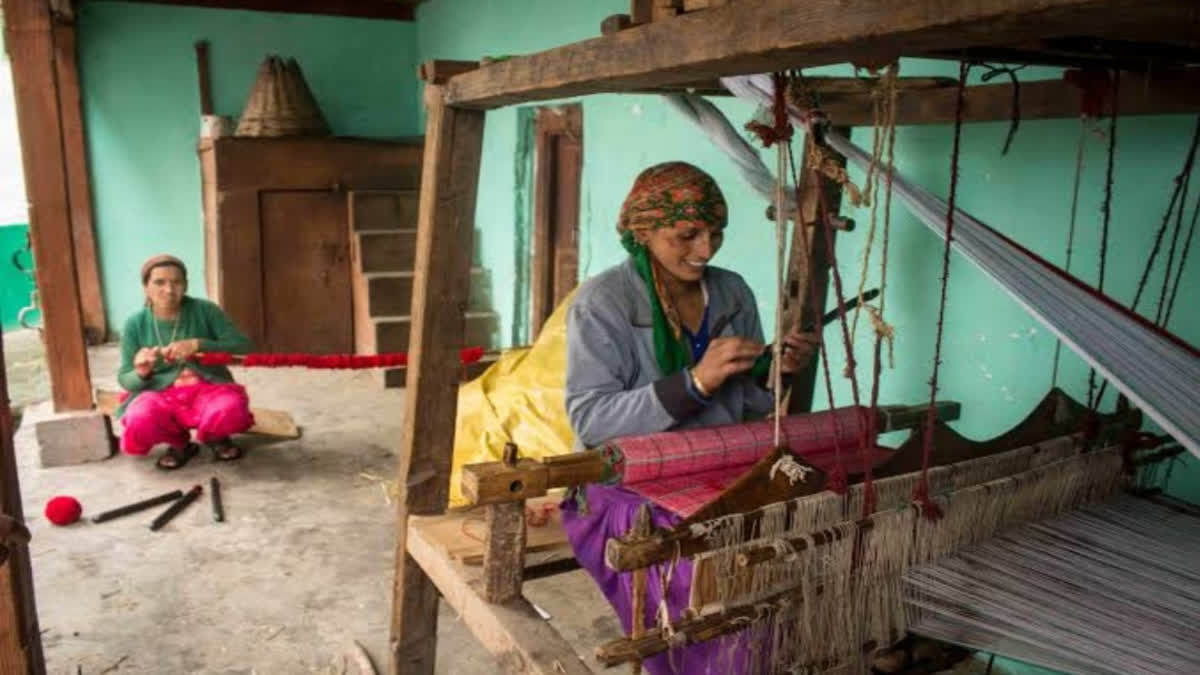
Kullu: In Himachal’s Kullu district, handloom is not just a craft, it is a legacy passed down generations in the form of inheritance. And when it comes to Sharan village, every family weaves to continue the tradition and keep it alive with the hope that the legacy will live on and speak the stories of survival, pride, and livelihood.
National Handloom Day is celebrated on August 7 every year to honour India’s rich weaving heritage and the spirit of the Swadeshi movement.
In Sharan, August 7 is not just a date in the calendar but a reminder that their hand woven fabrics continue to hold sway in the age of power looms and mass production. The GI-tagged Kullu shawls woven here which have a major demand in the local and global markets and are an identity for the state that proudly continues to nurture the hand weaving tradition even today.
And upholding this legacy are the women whose work often goes unseen but who sustain thousands of rural households through weaving. Particularly in the remote villages where options for employment are less, weaving has proved a boon and given economic independence to women who have kept the loom running by remaining rooted to the land and culture.
Sharan village, since 2020, proudly is one among India’s 10 designated Handloom Villages in the country chosen by the Ministry of Textiles, Government of India.
But how did the transformation of Sharan begin? With a survey. When the Ministry of Textiles required villages to meet certain criterion – both cultural and infrastructural to qualify as handloom villages, Sharan ticked nearly every box.
About 95% of Sharan’s houses were built in the traditional ‘Kashth Kuni’, an architectural style made up of wooden beams which are locked with stone but do not use cement. Here every house has a loom and generations of women have been weaving shawls, pattu, dohadu, and woolen caps by hand.
“We work on the khaddi (looms) since we were little girls. A pattu takes us three days to weave and it sells at anywhere between Rs 3,000 and Rs 8,000. For us, this earning is quite enabling and empowering to run our households,” say Kamala Devi and Hira Devi, local weavers.
After getting recognition as a handloom village, Sharan saw more investments coming in and commensurate training, and national attention.
The Weavers’ Service Centre (WSC) under the Ministry of Textiles was established in 2020 and has since trained over 30 locals in weaving and distributed khaddis (looms) and other equipment. Around 17 villagers were provided with Rs 1.2 lakh each to build independent work sheds, and a warp-weaving machine was installed to streamline the production work of pattu and shawls.
“We have also painted 16 traditional Kashth Kuni houses and refurbished six new ones so that we can draw more people to the place. We are seeing a rise in both tourists and young people wanting to learn handloom in this village,” said Bhupendra Arya, junior weaver at the Kullu WSC.
In December 2024, Mandi MP Kangana Ranaut had inaugurated a state-of-the-art, multi-storeyed Handloom and Tourism Complex in Sharan which was designed to offer full handloom experience to both tourists and locals.
While the ground floor houses two looms where tourists can try their hand at weaving, the first floor has a café that serves Himachali cuisine. The second floor has a showroom for villagers to sell their handmade products and the top floor houses a library, which is open to both tourists and residents.
The complex is being run by a village-level committee under the Panchayat.
“People from more many countries come here to buy our products. Earlier, handloom was mostly preferred by elders but now since we have given contemporaneity to the designs, the younger masses are also being interested to opt for hand woven fabric. We are also reviving trends, and it feels like our culture is being reborn,” says weaver Deepa Thakur.
Sharan village has 98 houses with a population of 423. A majority of the women here weave for hours alongside taking care of chores, farming, and childcare. “Every house has a khaddi and women spend hours on the loom. Sometimes they keep weaving till late into the night even though they have to wake up early in the morning to cook,” says Panchayat Pradhan Devraj. “They feel it is a legacy that they need to carry forward,” he adds.
Handwoven fabrics which were once reserved for specific occasions are now being used for everyday wear even by employees in the corporate sector. These fabrics can be fetched directly from the weaving centres or booked online. Weaving has strengthened the village economy and weavers are happy about it.
In a world that waits for automation of everything and anything, Sharan village believes in its tradition of weaving by hand and continues to practice it. “It is a pride for us to maintain the tradition that was passed on to us from generations. When we see the love people have for our woven creations, we know we have lived Sharan’s legacy and will continue to do so,” says weavers in unison.
Read More