Why Do Houses Have Swastik Symbols Near The Entrance?
The swastik symbol costs nothing, but it carries the weight of seven thousand years of human imagination.

Published : September 2, 2025 at 3:05 PM IST

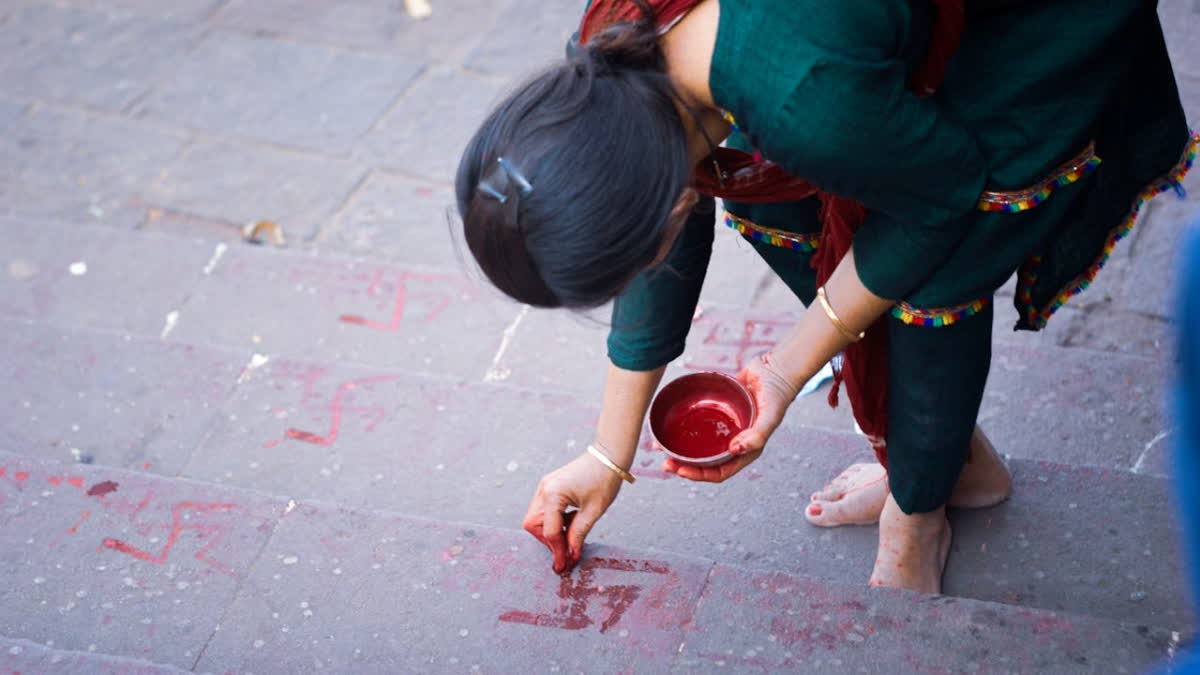
Walk down almost any street, and you will see it: a neat little red or yellow swastik painted beside the door, sometimes flanked by the words “Shubh Labh”, sometimes alongside an Om. It is so common, so ordinary, that most people hardly notice it anymore.
A Symbol Older Than History
The swastik is one of the oldest symbols in human history. Archaeologists have found swastik-like marks on pottery shards from the Indus Valley, from ancient Mesopotamia, and across Eurasia, some dating back at least 7,000 years. Long before alphabets or even money, human beings drew this cross with bent arms. Why? Because it seemed to them a sign of life, continuity, and the mysterious cycles of nature.
In India, the swastik became particularly enduring. Here it did not remain just a decoration or pattern, but a living spiritual marker. It symbolized the movement of the sun, the eternal rhythm of creation, and the four directions that structure space. Over time, it was absorbed into Hinduism, Buddhism, and Jainism, always carrying connotations of balance, prosperity, and divine order.
Why The Doorway?
Every culture has rituals at the threshold. The Romans placed protective deities at their doors. In medieval Europe, people nailed horseshoes above the entrance. In China, red scrolls and guardian lions still stand watch. The entrance is the most vulnerable part of any home. It is where outsiders become insiders, where luck or misfortune may cross over.
As Gunjan Goel, Director at Goel Ganga Developments, says, “In Indian culture, the Swastik is one of the oldest symbols, and its presence on the entrance of homes has significant meaning. It stands for peace, wellness, and good health. Its auspicious presence is best positioned to mark the entrance of the home as it is believed to attract good fortune while repelling negativity even before one sets foot inside.”
In other words, the swastik at the door is not just art. It is a filter, a symbolic firewall. Just as modern houses may install CCTV cameras or security codes, ancient and modern Indians alike have relied on symbols to guard the threshold of their lives.
Colours Of Fortune
You will rarely see a swastik painted in dull grey. More often, it is drawn in bright red, yellow, or turmeric. These are not arbitrary choices. In Indian cultural codes, red stands for life-force and purity, yellow for learning and optimism, turmeric for cleansing and protection. Together, they reinforce the message: this house is a place of vitality, growth, and auspicious beginnings.
As Goel notes, the swastik often appears with other sacred motifs: the syllable Om (sound of cosmic origin), the words Shubh Labh (auspicious gain), or framed by torans, rangolis, and nameplates. “For countless families,” she says, “it marks the onset of something good. In other words, the swastik paints the entrance to the home with optimism and blessings while keeping it culturally rooted.”
From Symbol to Social Glue
Why does such a small drawing matter so much? Anthropologists would say that symbols like the swastik function not just as signs but as contracts. The swastika becomes a social glue. It assures the visitor that they are entering a home aligned with tradition, that here there will be order, respect, and blessings. It assures the family that they are part of something older and larger than themselves.
It is impossible to talk about the swastik without acknowledging its distortion in the 20th century. In the West, it became associated with Nazism, violence, and hate. In India, however, its older meaning endures.
The swastik on a doorway is not just about the past. It also says something about the future. It says: we hope for prosperity; we expect good health; we want peace in this household. And it says this not in words, which fade, but in a visual form that has survived millennia.
Read more: