India's first indigenous hydrogen train to roll out in 2023
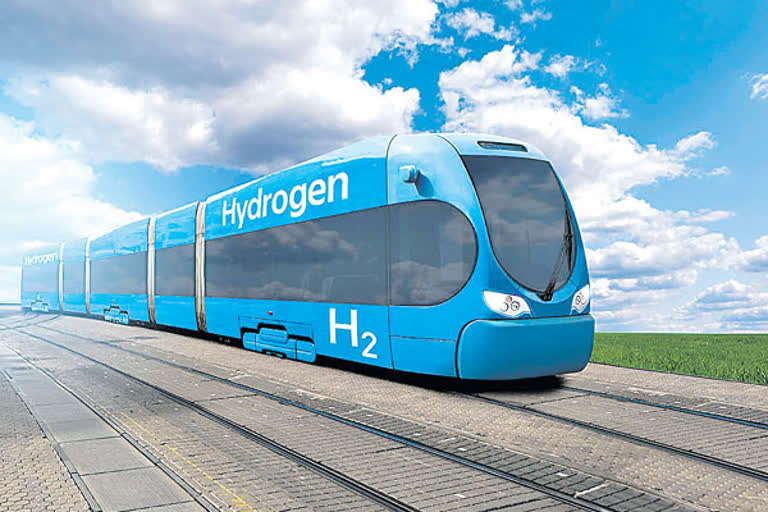
Hydrogen trains are expected to help India to achieve the climate goals under the Paris Agreement. Advantages with hydrogen trains are zero carbon emissions and environment-friendly. One kg of hydrogen can provide energy equivalent to 4.5 kg of diesel.
Published : December 30, 2022 at 8:44 AM IST

Hyderabad: To address climate concerns, the Indian Railways is going to unveil the country's first indigenously made hydrogen train in the new year, sources said. This is going to be introduced as a replacement of pollution-causing diesel engines. Also, the Railway Minister had hinted that the hydrogen train will be smaller compared to a conventional one and it will have only 6-8 coaches.
This is expected to help India to achieve the climate goals under the Paris Agreement. The whole world is scrambling to find solutions to the ever-increasing climate crisis. As part of this, countries are focusing on introducing green fuels like hydrogen in the transport sector. Currently this sector is heavily dependent on fossil fuels.
Compared to road transportation, railway travel is more environment friendly. However, the share of railways in international greenhouse emissions is 1 percent. Its main reason is the diesel engine.
The world's first hydrogen train was introduced in August 2022. It was named as 'Coradia Island'. They are designed by Alstom. Over 14 hydrogen trains run on a 62-mile route in Germany's Lower Saxony region.
Advantages with hydrogen train are zero carbon emissions and environment-friendly. One kg of hydrogen can provide energy equivalent to 4.5 kg of diesel. A boon for rural roads where electrification is not feasible and the services are not running much. These trains do not make loud noises. There is no shortage of hydrogen on earth. It can be collected from sea water.
Hydrogen fuel can be filled within 20 minutes. The Coradia Island trains run on hydrogen fuel-cell technology. No harmful emissions are emitted from these. This will save about 16 lakh liters of diesel annually. As a result, the emission of 4 thousand tons of carbon dioxide per year will be curbed. Once fuel is filled, these trains travel a thousand kilometers.
Hydrogen trains can reach a maximum speed of 140 km per hour. Converted combustion engines can be used for hydrogen trains. But mostly hydrogen fuel cells are used. An electrochemical process takes place in it. Electricity is produced by reacting hydrogen fuel with oxygen. This current is fed to the motor. So the train runs. Emissions from this process are water and steam.
Nearly 37 percent of all trains in India are running with diesel engines now. The share of transport sector is 12 percent of the greenhouse emissions in the country, while the share of railways is 4 percent. Diesel engines are the main reason for this. In the year 2019-20, the Railway Department consumed 237 crore liters of diesel. Hydrogen trains will be of great help to the Railways, which aims to achieve 'net zero' carbon emission levels by 2030.