Proposed Trade Talks with USA and EU: What Should Be India's Stand On Agriculture Produce Trade
The US ranks fifth in India's agricultural imports, while India exports the largest share of agricultural products to the US.

Published : September 21, 2025 at 7:00 AM IST
|Updated : September 21, 2025 at 7:25 AM IST
ByProf P Purushotham
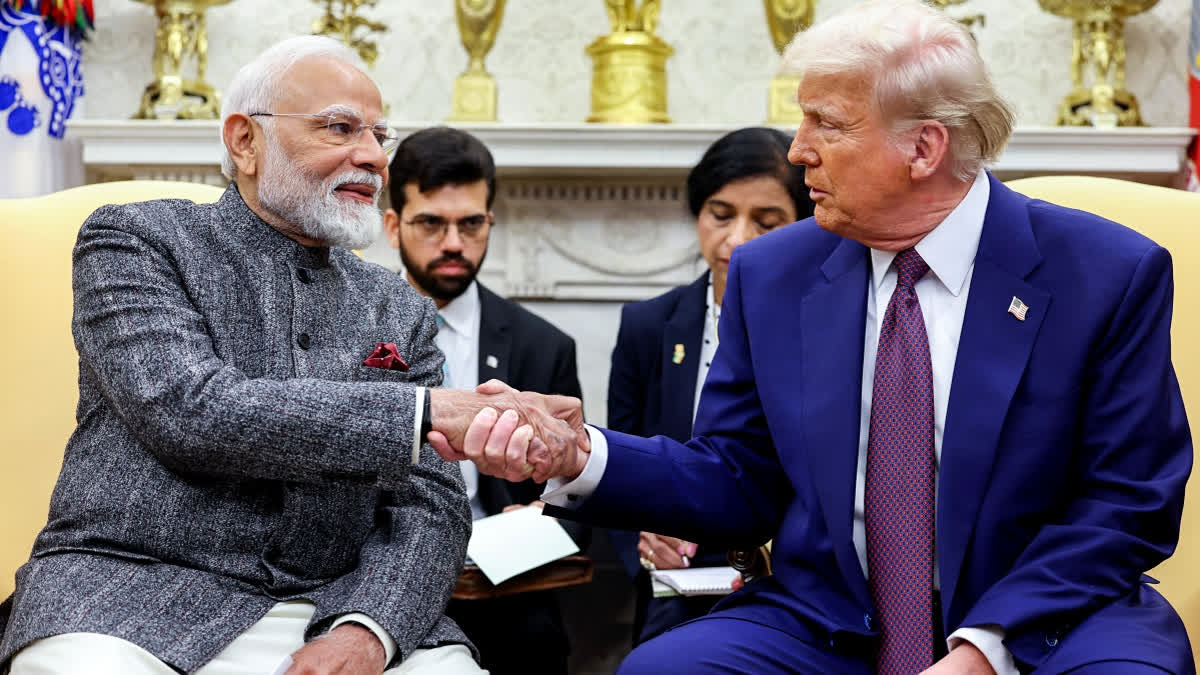
A delegation led by Commerce and Industries Minister Piyush Goyal will visit the United States on September 22 for meetings to take forward the discussions to achieve an early conclusion of the bilateral trade agreement.
The two countries will reportedly once again meet sometime in October-November 2025 to finalise the agreement. The long-stalled FTA negotiations with the European Union have also been restarted, to finalise them later this year. A 12-member trade delegation from the US visited New Delhi on September 11, 2025 and met Piyush Goyal.
Differences in Agricultural Tariffs
Agriculture is a key issue in the India-US trade talks. The US wants India to reduce tariffs on agricultural imports. Under reciprocal tariffs, US President Donald Trump has imposed a 25 per cent tariff on imports from India. In addition to this, the US has imposed an additional 25 per cent tariff as a penalty on goods imported from India because India is importing crude oil from Russia.
India's agricultural exports to the US for the calendar year 2024 were valued at 5.7 billion US dollars. The highest exports were shrimp and prawns at 2.2 billion dollars, basmati and non-basmati rice at 386 million dollars, honey at 141.3 million dollars, vegetable extracts at 399.2 million dollars, psyllium husk at 148.4 million dollars, castor oil at 106.2 million dollars, and black pepper at 180 million dollars.
Last year, India imported 1.9 billion dollars worth of agricultural products from the U.S. This included almonds worth 865.6 million dollars, walnuts worth 24.5 million dollars, Brazil nuts (Brazil nuts are the seeds of Bertholletia excelsa) worth 130 million dollars, pistachios worth 129.6 million dollars, ethyl alcohol worth 439.5 million dollars, apples worth 38.1 million dollars, and lentils worth 64.5 million dollars.
India's Dependence On Agricultural Exports
In 2024, India imported agricultural products worth a total of 38.3 billion dollars, with the US accounting for 6 per cent of this. During the same period, the U.S. contributed 8 per cent to India's agricultural exports. Last year, the United States imported a total of 222 billion dollars worth of agricultural products, with India's share being 2 per cent.
In terms of agricultural products, the dependence between the United States and India is not mutual. The US ranks fifth in India's agricultural imports, while India exports the largest share of its agricultural products to the United States.
The increase in tariffs by the United States negatively affect Indian exports. There are some products where the US holds a larger share of India's exports, but India's share in the total US imports of these products is not significant. In other words, the US imports these products in large quantities from other countries as well. These include shrimp and prawns, natural honey, and bakery products. As the US has already imposed about 50 per cent tariffs, the export of these products is being severely impacted.
There are also some products where India holds a significant share in the US imports, but the US does not account for a large portion of India's total exports of that product. In other words, India exports these products to several other countries as well. This includes products like milled rice and castor oil. The tariff risk for these products is lower because India's exports do not heavily depend on the US market.
The Livelihood Issue for Small Farmers
As much as 46 per cent of the workforce in India depends on agriculture, and among them, about 88 per cent are small and marginal farmers. For them, it's more a question of livelihood than employment. Reducing tariffs on agriculture without caution would be disastrous for India's agricultural sector. Over 700 million Indians depend on agriculture for their livelihood. The increased import of cheap and subsidised commodities, especially sensitive ones like dairy, meat, grains, and pulses, would negatively impact the income of people in rural areas. The situation of villagers is already fragile, and it will worsen further.
According to a report from March 2025, in 2024, there were a total of 1.88 million farms in the United States of America with a total area of 87.6 million acres. The average farm size was 466 acres.
If we look at the general ratio of the announced assistance amount to the number of farmers on Agriculture Day, each farmer in the US would receive by way of state subsidies, Rs 26 lakh. In comparison, farmers in India receive only Rs 6,000 annually under the PM-KISAN scheme. Indian farmers also receive subsidies on fertilisers, crop insurance, crop loans, but comparatively, agricultural subsidies in the U.S. and Europe are much higher.
Farmers in the United States benefit greatly from subsidies and insurance, which often exceed their production costs. On the other hand, most farmers in India have small landholdings and limited resources. They rely heavily on government schemes like the Minimum Support Price (MSP) and the Public Distribution System (PDS). Reducing tariffs will not only affect these farmers but also weaken the food security of millions of poor families.
The United States and European countries already provide significant subsidies to agriculture. Their products are often sold at dumped prices. These countries can afford to do so because their GDP and employment dependency on agriculture is very low. It is not feasible for India to do the same, as half of our workforce is engaged in agriculture. The population of the United States is 340 million, and only about one per cent of that population is involved in agriculture.
Why USA is desperately looking for export market for its agricultural products?
Over the years, US farmers have become increasingly dependent on export markets for their produce, particularly for bulk commodities. This reliance has been driven by US agricultural output outpacing domestic demand for many products, making exports critical for maintaining prices and revenues.
Exports account for a substantial portion of total US agricultural production. On average, the US exports about 20% of its agricultural production annually. For some key crops, like soybeans, wheat, and rice, that share can be 40% or more.
What will be the impact of reducing import duties on Indian farmers?
In India, the demand for poultry is increasing, which uses corn and soybean as feed. In the future, the demand for poultry, corn, and soybean will rise. Currently, corn cultivation is increasing in the country. If import duties on corn are reduced, it will affect those farmers who are shifting from traditional wheat and rice farming to corn cultivation. In recent years, India has become an importer of cotton rather than an exporter. Cotton demand is expected to grow rapidly in the coming years. If large-scale cotton imports from the US begin, it will have a very negative impact on Indian farmers.
Impact of Reciprocal Tariffs
The reciprocal tariffs will have the greatest impact on fish, meat, and other processed seafood. Last year, India exported 2.58 billion dollars worth of these products to the US. The tariff difference stands at 27.83 per cent plus a penalty of 25 per cent.
India exports shrimp in large quantities to the US, but with such a tariff, it will no longer be competitive. The export of processed food, sugar, and cocoa exceeds one billion dollars, and these too face a tariff difference of 24.99 per cent plus a penalty of 25 per cent. An increase in tariffs will make Indian snacks and confectionery products more expensive in the US.
Last year, exports of grains, fruits, vegetables, and spices amounted to 1.91 billion dollars, with a tariff difference of 5.72 per cent. Such a tariff increase could affect the export of rice and spices. In dairy products, the tariff difference stands at 38.23 per cent plus a penalty of 25 per cent. If tariffs rise this much, the export of ghee, butter, and milk powder, worth 18.5 million dollars, could be impacted, and there is also a concern that the market share of Indian products could decrease.
In the last financial year, India exported 19.97 million dollars worth of edible oils, with a tariff difference of 10.67 per cent. Due to tariffs, Indian coconut and mustard oils will become more expensive in the U.S.
FTA Negotiations With The European Union
Agriculture has been a major issue in the Free Trade Agreement (FTA) negotiations with the European Union (EU). The EU has been pressuring India to reduce tariffs on cheese and skimmed milk powder (SMP), while India has used high tariffs to protect its domestic dairy industry. In 2023-24, India exported 4.3 billion dollars worth of goods to the EU and imported 2.5 billion dollars. On average, Indian goods face a 15.2 per cent tariff in the EU, while India imposes an average tariff of 42.7 per cent on agricultural products coming from the EU.
India imported 1 billion dollars worth of agricultural products from the EU in 2024, while India's exports were approximately 3.3 million dollars. If a Free Trade Agreement (FTA) is established, there is a likelihood that agricultural imports from the EU will increase.
The FTA would particularly impact the dairy industry. A reduction in import duties on alcoholic drinks would lead to increased imports from Europe, intensifying competition for domestic producers. As the world's largest milk producer, India's dairy industry would face challenges from the import of cheaper milk products from the EU, such as milk albumin, lactose, and whey. In contrast, the edible oil sector may face relatively less competition. India is heavily dependent on edible oil imports, particularly sunflower and olive oil from Europe.
EU's Non-Tariff Barriers Are a Challenge For India
The EU’s agricultural tariff system is quite complex and has often hindered negotiations between both sides. The EU imposes non-ad valorem tariffs on 915 agricultural products, which significantly increases the import duties on these items. In addition, non-tariff barriers such as sanitary and phytosanitary regulations and Technical Barriers to Trade (TBT) make it difficult for Indian agricultural products to gain access to the European market. Even if the EU reduces tariffs, its regulatory framework will remain a major challenge for Indian farmers and exporters.
Agriculture in India is Governed by Protectionist Regulations
India protects its agricultural sector in line with global trade rules. The World Trade Organization (WTO) allows developing countries to adopt measures to safeguard food security and rural livelihoods. India has consistently advocated for special treatment for agriculture in trade deals, and we should continue to do so.
The challenge is not just about tariffs but also about structural imbalance. Agriculture in the US and Europe receives substantial subsidies and is highly mechanised. In contrast, Indian agriculture is labour-intensive, and farmers struggle to earn a profit. Asking these farmers to compete with heavily subsidised American farmers is like asking a bicycle to race against a train.
What Should India Do?
The demand for maize, soybean, and cotton is set to rise in India. Therefore, we should incentivise our farmers to increase the cultivation of these crops. Efforts must be made through research and development to improve their productivity so that Indian farmers can produce more. If imports are allowed freely, Indian farmers will never be motivated to respond to rising demand, and crop diversification will not take place.
In trade negotiations, India should firmly present its position, citing food security and farmers’ livelihoods. Diversification of exports is also very important. We should move towards exporting processed food instead of raw crops. Processed food offers better prices, and its market is also larger.
India's priority should be to protect its food system, ensure farmers' income security, and maintain rural stability, rather than accelerating trade liberalisation that promotes inequality. Trade negotiations should be based on mutual respect and reality. India should remain open to dialogue, while also staying firm on issues related to farmers, food security, and future concerns.
The impact of reciprocal tariffs from the US and the FTA with Europe will not be the same across all sectors. If the demand for prawns, shrimp, and honey decreases in the US, it can be compensated by increasing domestic demand and exporting to other countries. There will also be less impact on sugar (raw material for the alcoholic beverage industry), grains (raw material for bakery products), and dairy farmers because these products have various uses, and their supply is managed by multiple domestic and foreign manufacturers.
Given the trade in agricultural commodities between India, the US, and the European Union, it is unlikely that these will be excluded from trade talks. India has a diverse range of agricultural commodities, including unique varieties like Alphonso mangoes and Basmati rice. These provide India with significant opportunities.
Yet, the government should promote the export of India's agricultural products so that farmers can benefit from additional earnings. To increase India's agricultural export competitiveness, the nation needs to invest in infrastructure and irrigation, promote agri-tech startups for innovation, ensure compliance with Sanitary and Phytosanitary (SPS) measures, diversify markets and products, adopt consistent export policies, build robust supply chains, and enhance value-added exports through processing and brand development.
Infrastructure and Logistics
Invest in Irrigation and Mechanisation: Expand irrigation facilities and promote mechanisation to boost productivity, reduce wastage, and improve overall farm efficiency.
Strengthen Post-Harvest Management: Improve storage and transportation infrastructure to reduce post-harvest losses and ensure food availability.
Innovation and Technology
Support Agri-Tech Startups:Encourage innovation in the agricultural sector by supporting startups that can develop new technologies and scalable solutions for trade potential.
Adopt Modern Farming Techniques:Implement technologies like precision agriculture and digital platforms to increase yields and improve quality.
Market Access and Policy
Adopt Consistent Export Policies:Avoid sudden export restrictions to ensure stable markets and build long-term trust with international buyers.
Diversify Markets and Products:Explore new markets in Africa, Southeast Asia, and the Middle East, and promote the cultivation of high-demand products like millets and herbal products.
Promote Value-Added Exports:Shift focus from raw agricultural commodities to processed, higher-value products to capture a larger share of the global market.
Strengthen Trade Agreements:Negotiate trade deals that reduce tariffs and non-tariff barriers, providing preferential access for Indian agri-products in foreign markets.
Quality and Compliance
Adhere to International Standards:Ensure compliance with global Sanitary and Phytosanitary (SPS) measures and food safety standards by educating farmers and developing processing infrastructure.
Establish Market Intelligence Units:Set up units to provide real-time data on international market demand, helping farmers and exporters meet global needs.
Farmer Welfare and Supply Chain
Improve Farmer Education and Skills:Educate farmers on best practices, pest control, hygiene, and quality management through cooperatives and Farmer Producer Organizations (FPOs).
Develop Agro-Climatic Clusters:Identify suitable zones for specific export-oriented crops to optimise production and quality.
(The opinions expressed in this article are those of the writer. The facts and opinions expressed here do not reflect the views of ETV Bharat)