After 5 Years And 2.2 Billion Miles, NASA's Lucy Spacecraft Becomes First To Reach Jupiter Trojan Asteroids
Jupiter Trojans are asteroids that share the gas giant's orbit around the Sun and exist on both sides, separated by more than 6 million miles.

Published : November 3, 2026 at 11:13 AM IST

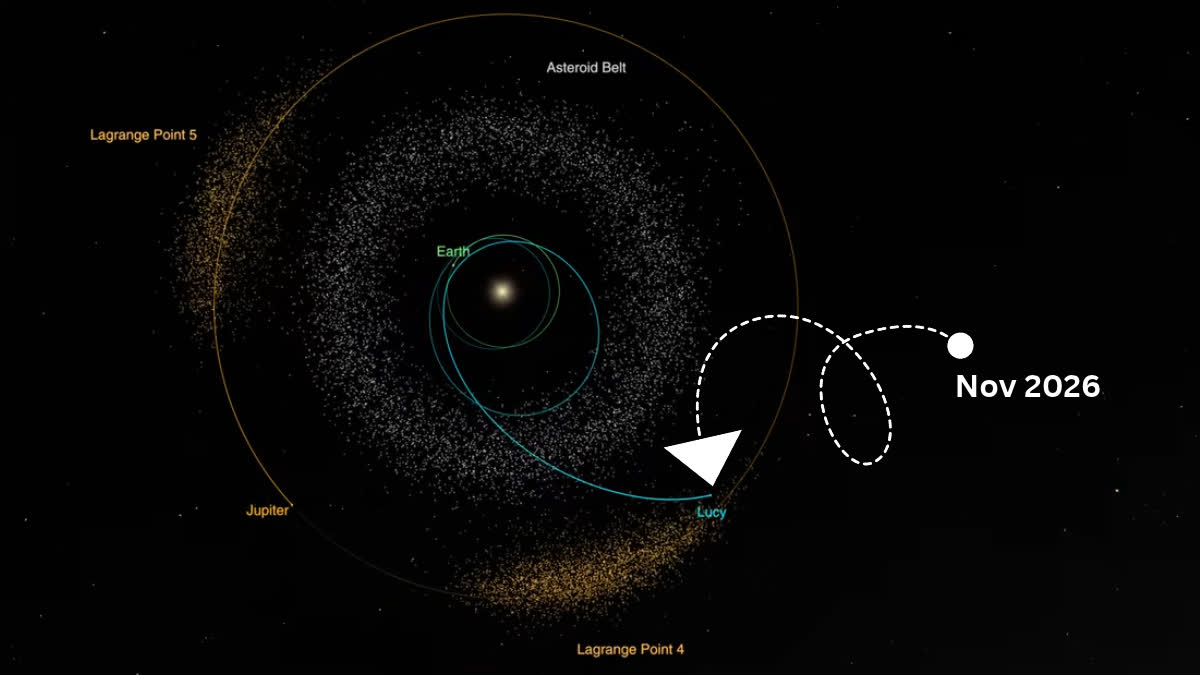
Hyderabad: NASA's Lucy spacecraft has become the first man-made object to reach the Jupiter Trojan asteroids, a region of primitive solar-system bodies that share the gas-giant planet's orbit around the Sun—guided by the combined gravitational pull of the Sun and Jupiter.
The spacecraft took 5 years and travelled 2.2 billion miles (since its launch on October 16, 2021) to reach the region and is approaching Jupiter's Lagrange point 4 (L4). This point is surrounded by a group of asteroids that travel ahead of Jupiter in its orbit. The second group, around Lagrange point 5, trails behind the planet.
Scientists call both of these regions unexplored "islands of stability". NASA confirmed that Lucy will visit asteroids in both regions.
Previously, several spacecraft visited Jupiter and even travelled beyond the gas giant using the gravity-assist manoeuvre. However, none of them had the opportunity to visit the Jupiter Trojans, given their distance from the planet. Notably, asteroids in these clusters are as far from Jupiter as the planet is from the Sun, which is around 484 million miles.
Since Lucy was designed for the mission to explore Jupiter Trojans, it is specifically heading for the L4 and L5 points. Since the two Trojan regions are separated from each other by more than 6 million miles on average, they will appear to Lucy as pinpricks of light moving against a field of stars until the spacecraft bears down on its chosen targets, NASA explained.
The space agency added that Lucy’s first encounter with the Trojan Eurybates will occur on August 11, 2027, following which it will visit Polymele in September 2027, Leucus in April 2028, and Orus in November 2028.
"The spacecraft then will return to Earth in 2030 for a third and final gravity assist, which will send it toward Jupiter’s trailing group of Trojans, where it will explore the binary pair Patroclus and Menoetius in March 2033," NASA said.
Lucy's design is optimised for the region and has adapted to gradually cooling temperatures and dimming light as it cruises deeper into space. The spacecraft and onboard instruments continue to operate as expected even as it is five times farther from the Sun than the distance between the Sun and Earth.
"With less than a year until Lucy’s first asteroid encounter, scientists are busy putting the final touches on the encounter plans. That work includes ensuring that the spacecraft, instruments, and team members are prepared to make the most of the few hours Lucy will spend studying Eurybates up close," NASA said.
Scientists believe that studying Jupiter Trojans up close will help them hone their theories about the formation of our solar system’s planets 4.5 billion years ago as well as how they ended up in their current configuration.