Chhattisgarh's Historic Town Sirpur Makes It To UNESCO World Heritage Tentative List
The town is renowned for its ancient temples, Buddhist monasteries, rare sculptures, architectural splendor, and a unique tradition of religious tolerance.

Published : October 21, 2026 at 8:54 PM IST

Raipur: The historic town of Sirpur in the Mahasamund district of Chhattisgarh has made it to the UNESCO World Heritage tentative list.
This is viewed as a significant milestone for the state. The town is renowned for its ancient temples, Buddhist monasteries (viharas), rare sculptures, architectural splendor, and a unique tradition of religious tolerance.
Earlier on January 1, 2026, Union Minister for Culture and Tourism, Gajendra Singh Shekhawat, visited the historical and archaeological sites of Sirpur and praised its rich heritage.
He emphasised the need for undertaking conservation and promotion efforts and stated that priority would be given to securing the town's inclusion in the UNESCO World Heritage list.
Sirpur was known as "Shripur" in ancient times, and the town has served as the capital of the Dakshin Kosala region during the reign of the Panduvanshi rulers. Situated on the banks of the Mahanadi River, it was a major hub for political, religious, cultural, and commercial activities.
The evidence regarding the antiquity of Sirpur is found in the copper-plate inscriptions of the Sharabhapuriya rulers, Pravararaja and Mahasudevaraja.
During the 57-year reign of the Panduvanshi ruler Mahashivgupta Balarjuna, Sirpur reached new heights of cultural and architectural development and the period saw the construction of numerous temples, Buddhist monasteries , reservoirs, and gardens.
In the seventh century, the renowned Chinese traveler Xuanzang (Hiuen Tsang) visited the region, and his travel accounts mention a flourishing tradition of Buddhism here.
He described the presence of approximately 100 Buddhist monasteries and about 10,000 monks belonging to the Mahayana tradition.
The town has seen the coexistence of Shaiva, Vaishnava, Buddhist, and Jain religious traditions. Although Balarjuna himself was a follower of Shaivism, he generously patronised Buddhist monasteries through his donations.
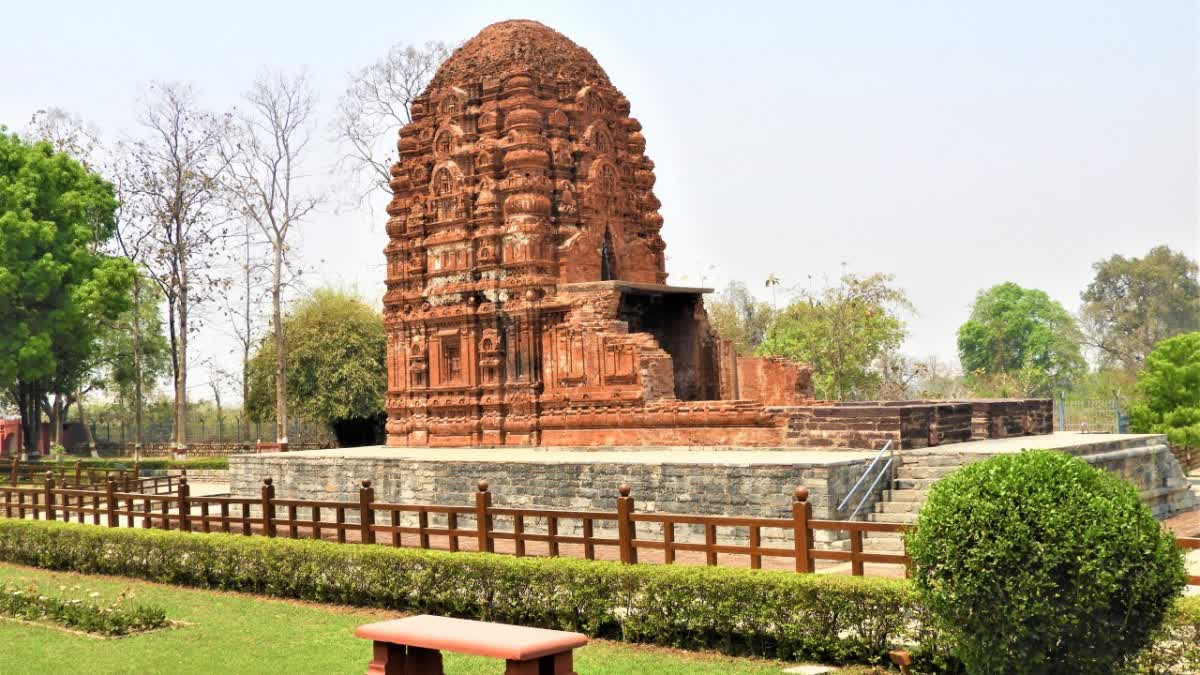
The renowned Lakshmana Temple in Sirpur is considered known for its unique architecture and built around the seventh century, it is one of the finest examples of ancient Indian brick-built temples.
The entrance to the temple is a major center of attraction, and the upper section features an image of Lord Vishnu reclining on the serpent Shesha (Sheshashayi Vishnu), while the door frames are adorned with beautiful depictions of Lord Vishnu’s various incarnations, scenes from the life of Krishna, and other mythological episodes. An image of the serpent king, Nagraj Shesha, is enshrined within the sanctum sanctorum (garbhagriha).
Another attraction is Gandheshwar Mahadev Temple, which is situated on the banks of the Mahanadi River and has remained the center for the religious traditions of Sirpur. Architectural elements from older temples and Buddhist monasteries (viharas) have been incorporated into the construction of the temple. The temple complex has preserved numerous artistic sculptures and archaeological remains.
Sirpur has served as an important hub for Mahayana Buddhism in ancient times. Archaeological excavations have uncovered the remains of several Buddhist monasteries (viharas), which provided facilities for meditation, study, and teaching, and served as the residence of monks.
Among the Buddhist monasteries in Sirpur, the Anandprabhu Kuti Vihara and the Swastika Vihara are the prominent ones.
The Anandprabhu Kuti Vihara was commissioned by a Buddhist monk named Anandprabhu during the reign of Mahashivagupta Balarjuna. The monastery, a two-storied structure, contained 14 chambers for the monks to reside in, and in the main chamber, there is an approximately 6.5-foot-tall statue of Lord Buddha in the "bhumisparsha mudra" (earth-touching gesture).
Also Read
