Environmentalists Red Flag Development Marked By Chopping Of Trees In Maharashtra
The state has lost thousands of trees in name of development which is bound to have a negative impact on its environmental health

Published : December 20, 2025 at 8:06 PM IST

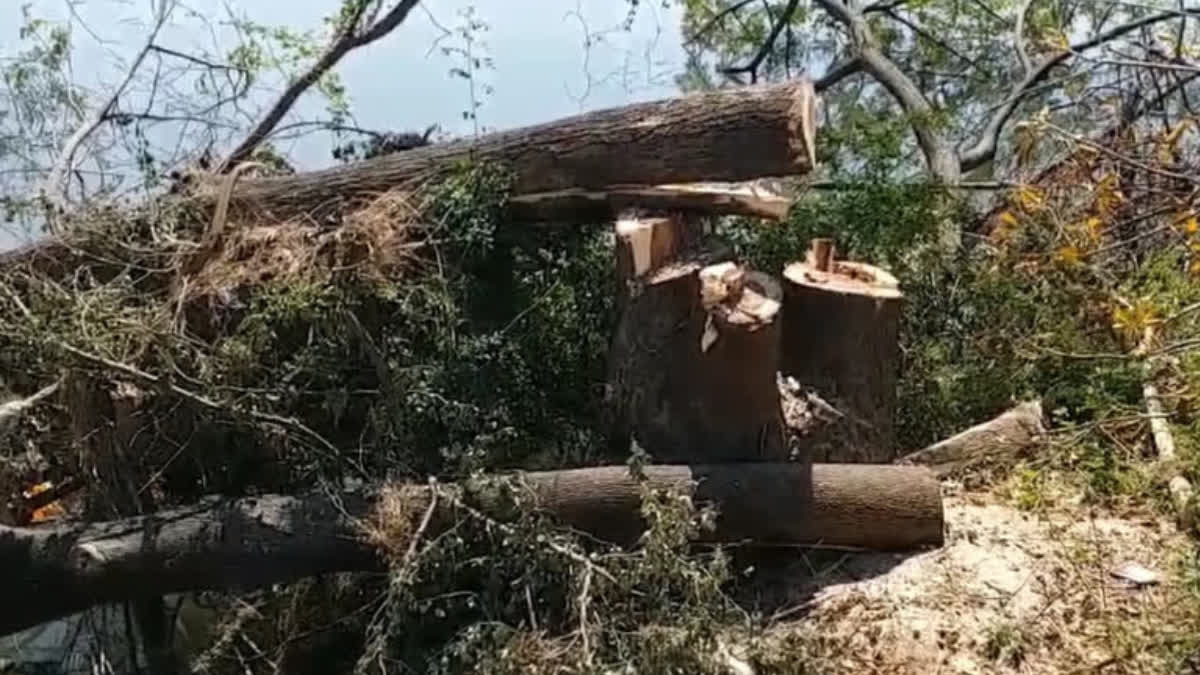
Mumbai: Citizens concerned about the environment in Maharashtra have raised a red flag in the face of a slew of ‘developmental’ projects being announced and executed in the state.
They have been pointing out that development at the cost of the environment is not in the interest of society. As it is, the massive tree felling for executing various ‘development projects’ has taken a toll in terms of climate change, it is claimed.
Presently, concerns are being raised about the Bombay High Court giving permission last week to the Brihanmumbai Municipal Corporation (BMC) to cut 45,000 mangroves that protect the city's coastline, for the proposed Coastal Road (North section), which is from Versova to Bhayander.
It is being cited that on the day the elections for the various Municipal Corporations were announced, Deputy Chief Minister Eknath Shinde announced numerous developmental projects, including the ‘biggest Central Park in the history of an Indian city to date’. A 295-acre open space was leased to the Royal Western India Turf Club. This is the largest green lung in the heart of Mumbai city. The plans are to carve out 125 acres of the Racecourse, while the remaining 170 acres will be drawn from land reclaimed for the Coastal Road.
This plan drew a lot of criticism from environmentalists and citizens on social media platforms. However, politicians have welcomed this decision. It is being claimed that India’s largest 300-acre Central Park at Mahalaxmi will have a 10 lakh sq ft underground sports complex. This is inclusive, sustainable urban planning at its best.
In the meantime, the government has opened the 'No Development Zone' for the rehabilitation of tribals and slum dwellers in the core and buffer areas of Sanjay Gandhi National Park (SGNP) in Mumbai. The government incorporated a new regulation 34 (3.5)(ix) in the Development Control and Promotion Regulations of 2024 for the purpose.
In yet another move, the state government has promised to construct a religious accommodation premises, Sadhugram in Tapovan in Panchavati, where all the priests and sadhus will be staying during the Kumbh Mela of 2027. The Nashik Municipal Corporation (NMC) has decided to proceed with chopping 1825 trees for constructing this enclave.
Since then, the residents have stepped up their protests to protect these trees, many of which are of heritage and medicinal value. Tapovan has contributed to the balancing of the larger ecosystem in not only this area, but also in Nashik city. The residents have been supported by Marathi film actors, and on December 18, the Bombay High Court issued notices to the Tree Authority of the NMC and the state government asking them not to proceed with the felling of trees for the time being.
Environmentalists are aghast at the rate these projects have been sanctioned just prior to the announcement of the BMC elections. It is being stated that by the time the model code of conduct will not comes into effect, these proposed projects will get fast-tracked. The question being asked is, why should development be at the cost of the environment?
Pervin Sanghvi, a Mumbai-based environmentalist, said, "The media plays a crucial role in keeping the conscience of the society alive. It is time journalists filed applications under the Right to Information (RTI) to get information on many of these projects where the details are not revealed to the citizens. People are powerless today, and the might of the government is humongous."
Concerned citizens have been pointing out that fewer trees are being grown and more are being felled. They say that the changing climate can be experienced in terms of rainfall in winter and chilly temperatures throughout the rainy season, which are impacting the lives of the people.
Researcher Owen Mulhern had pointed out in Earth.org in 2020 that Mumbai's sea levels will worsen the effects of severe flooding like the 2005 Maharashtra episode that caused a direct loss of USD $100 million, with many more knock-on costs.
The International Collective in Support of Fishworkers has also predicted that in a few decades, structures near Mumbai’s seashores may be inundated by rising sea levels. “In what may drastically alter perceptions about climate change and its impact on coastal cities like Mumbai, a state government study has predicted a 0.38 metre rise in sea levels across Maharashtra by 2050," the Collective has stated.
Environmentalists claim that global warming has led to an impact on the monsoon cycle of Mumbai, which is evident from the last couple of years.
"There is no doubt that the groundwater in our city is depleting. Along with it, we have been seeing the impact of global warming, due to which the sea levels are increasing. Citizens are at a great risk if plans like the coastal road are not shelved. The entire purpose of alternative modes of transport, like the metro, has been planned so that we don't have such a large amount of construction along our coast," said Sanghvi.
It is being pointed out that the mangroves have been a protective shield of the Mumbai coast, though they are often misunderstood as waste and marshy land. According to the United Nations Environment Program (UNEP), "Protecting mangroves and restoring damaged ones also helps combat climate change through carbon sequestration as they are some of the most carbon-rich ecosystems on the planet, storing on average 1,000 tonnes of carbon per hectare in their biomass and underlying soils." UNEP has been cautioning against the destruction of mangroves the world over.
The concerned citizens point out the examples across Maharashtra that tell about the depletion of rare trees and natural habitat. They say that the National Green Tribunal (NGT) has formulated strict guidelines for felling trees, and time and again, it has been seen that these are not adhered to.
They pointed at the cutting of 1882 trees in Nashik in the last six months in preparation for hosting the Simhastha Kumbh Mela in 2027. The NMC itself has admitted to this tree felling for new pipelines and sewage treatment plants.
Similarly, the Pune Municipal Corporation (PMC) launched the river rejuvenation project in March 2022, under which approximately 6000 trees were to be cut down in Pune and Pimpri-Chinchwad. This was met with strong opposition from environmentalists, citizens and some political parties. The PMC received approval for the felling of 1510 trees, while approval was also granted for the transplantation of 2171 trees. The PMC has stated that so far, 1293 trees have been removed and 7847 new trees have been planted. Environmentalists claim that in some places, the PMC is illegally cutting down the trees without permission.
Trees have been allegedly chopped for numerous developmental projects in Chhatrapati Sambhaji Nagar city as well as the district. The construction of the Balasaheb Thackeray memorial is underway on the City and Industrial Development Corporation (CIDCO) land that has now been acquired. It is alleged that when this land was under CIDCO, there were 12,000 trees, but the local civic body submitted an affidavit to the court stating that there were only 8,000 trees.
Environmentalists claim that a large number of trees were cut down for the Paithan road development project. While 50 of those trees were transplanted, they did not survive. It is being stated that while this road improved transportation, hundreds of small trees were cut. At the same time, work has begun on the expansion of the road from Nagar Naka to Daulatabad T-point, for which nearly 700 trees are expected to be chopped.
It was further related that a staggering 6356 trees have been felled in Nagpur. Amol Chorpagar, an official at Nagpur Municipal Corporation's Garden Department, stated the trees obstructed the construction projects.
"After an application is submitted to the Corporation for cutting down trees that are obstructing construction, a team from the Department inspects the tree and estimates its approximate age. The applicant is then required to plant the same number of trees as the age of the tree that was cut down," he told ETV Bharat.
The concerned citizens also point out the cutting of trees for the construction of the Ratnagiri - Nagpur highway, which will connect Konkan, Western Maharashtra and Vidarbha. This highway, spanning approximately 900 km, is to be built at a cost of Rs 2,750 crore. Since a large portion of this highway passes through the Western Ghats, more than 1600 trees have been allegedly cut down during the levelling work. This includes many rare species of trees. There are over 187 species of reptiles considered rare worldwide, and more than half of them are found in the Western Ghats.
Another example is that of the construction work on the Kolhapur to Gaganbawda national highway that has been progressing at a very slow pace for many years. It is alleged that for this project, 100 to 150 heritage trees have been permanently destroyed. While there is a government rule that five trees should be planted for every tree cut down, in reality, contractors do not follow any government regulations during the replanting process.
The construction of the Samruddhi Expressway has also resulted in the large-scale destruction of forest areas in tribal regions and trees near the agricultural lands in Thane district. On the pretext of reducing traffic congestion, 600 heritage trees along the roads that helped regulate the city's temperature were indiscriminately cut down during the widening of the service roads. At the same time, a large number of trees were also cut down for the construction of the new Thane railway station.
Environmentalists say that the tree felling for the new building of Thane Regional Mental Hospital is particularly alarming. The state wants to push the redevelopment of the Thane mental hospital to make it a modern state-of-the-art hospital, for which there are plans to chop 742 of the 1,614 trees on that premises.
A similar situation prevails in Amravati, where 3100 trees were cut down in 2020 for the widening of the 50-kilometre Amravati-Paratwada road. Nearly 2000 more trees were allegedly felled for road widening on the Valgaon to Daryapur route.
Much before, in 2006, a large number of trees were felled on both sides of the Ahilyanagar-Manmad highway that connects South and North Maharashtra, for its widening. These trees included environmentally important species such as peepal, banyan, and neem. A staggering 3400 trees were cut down along the approximately 100 km stretch between Kopargaon and Ahilyanagar. Sanjay Kale, an activist, complained, "No trees were replanted, though it is mandatory."
In Ahilyanagar, many trees were felled for building the four-lane Pune-Nashik highway. The National Highways Authority of India (NHAI) had submitted documents stating that 36,600 trees had been planted during the interim period. However, an inspection by a committee headed by the Sub-Divisional Officer of Sangamner revealed that only 363 trees were actually present. Many of these trees had also withered due to a lack of water.
"More than 2,300 trees were cut down in Sangamner taluka alone on the Pune-Nashik highway. In return, the NHAI was expected to plant 23,730 trees," said Ganesh Borhade, a member of the District Environment Committee.
Along with this, a large number of trees were cut down for the construction of the Visakhapatnam-Kalyan highway passing through Ahilyanagar. Similarly, many trees are likely to be felled for the proposed Nashik-Chennai highway project. The administration had cut down trees on both sides of various highways in Ahilyanagar district for widening purposes, promising to replant them. However, it appears that this replanting has not yet been completed.
Environmentalists have echoed, “We are not against development. But this should not be done at the cost of our nature. What world are we leaving for our children is something we need to care about."