Why New CAFE 3 Norms Mark A Paradigm Shift Away From Micromanagement And Towards Outcome Oriented Regulation
New CAFE III framework, applicable until March 31, 2032, will replace existing norms and cover new passenger vehicles manufactured or imported for sale in India.

By R Srinivasan
Published : October 2, 2026 at 8:08 PM IST
|Updated : October 2, 2026 at 8:33 PM IST

The third iteration of the Corporate Average Fuel Efficiency norms notified on September 29, 2026, marks a watershed moment in India’s regulatory and policy development environment for India’s booming automobile manufacturing sector.
For the first time, regulatory policy has shifted decisively away from specifying the nitty-gritty’s of manufacturing to manufacturers – who arguably know better – and towards setting broad outcome targets for the benefit of society as a whole, which is what the government ought to have been doing in the
first place.
So far, policymakers – and sometimes, the courts – have been deciding what the Indian consumer needs, constitutes efficiency and even which fuel or technology to use to reduce emissions. India’s small car boom, for instance, was sparked by a tax change introduced in the Budget in 2006. While cars were still considered a ‘luxury’ and taxed heavily, the powers that be decided that the common man ought to get an affordable small car.
But the choice of what car to offer was not left to either the manufacturers or the market to decide. Instead, our bureaucrats decreed that a car which did not exceed 3.999 metres in length, and with an engine displacement of 1,200 cc or less (1,500 cc in the case of diesel engines) qualified as a “small” car, and was given a concessional excise duty rate of 8 percent.
This caused a lot of changes in both consumer expectations and market development. While global car markets focused on the power developed
by an engine, in India, the talk was all about cubic capacity of the engine, although that does not have a proportionate relationship to power at all. In fact, Ford finally bust that myth by launching the Ecosport, an “SUV’ which only measured 3.998 metres in length, and was powered by a 1,000 cc petrol engine which actually developed more power than competitor engines with a bigger cubic capacity!
Subsidies and other concessions further complicated the matter. For long, diesel, considered essential fuel for transporting goods and powering agricultural equipment like tractors, was subsidised and considerably cheaper than petrol. This led to a boom in diesel vehicles, including even small cars and even autorickshaws.
Court decisions introduced further wrinkles. The Supreme Court in 1998, hearing petition on pollution in Delhi, decreed that all public transport vehicles, including taxis and rickshaws, be compulsorily converted to CNG. In 2015, the Supreme Court banned the registration of diesel cars with engine capacity of more than 2,000 cc, on the grounds that they were more polluting, although a modern, well-maintained vehicle with an engine of 2,000 cc or more could actually be less polluting than vehicles with smaller engine capacity but using older technology or were poorly maintained. This ban was lifted after
vehicle makers agreed to pay a 1 percent ‘green’ cess. Later, diesel vehicles older than 10 years were ordered to be compulsorily deregistered in the NCR, even if they were compliant with the emissions protocol (BS IV at the time) in place!
The government further wielded the stick in a bid to cut emissions by jumping directly to BSVI from BSIV emission standards, forcing fuel
refiners and automakers to scramble to reengineer their products, at heavy investment costs.
The common thread to all these developments is that while nominally, the desired outcome was the same – reduced vehicular emissions and
pollution – the approach focussed on not the desired outcome but on unrelated technicalities like engine capacity and choice of fuel.
What has changed now
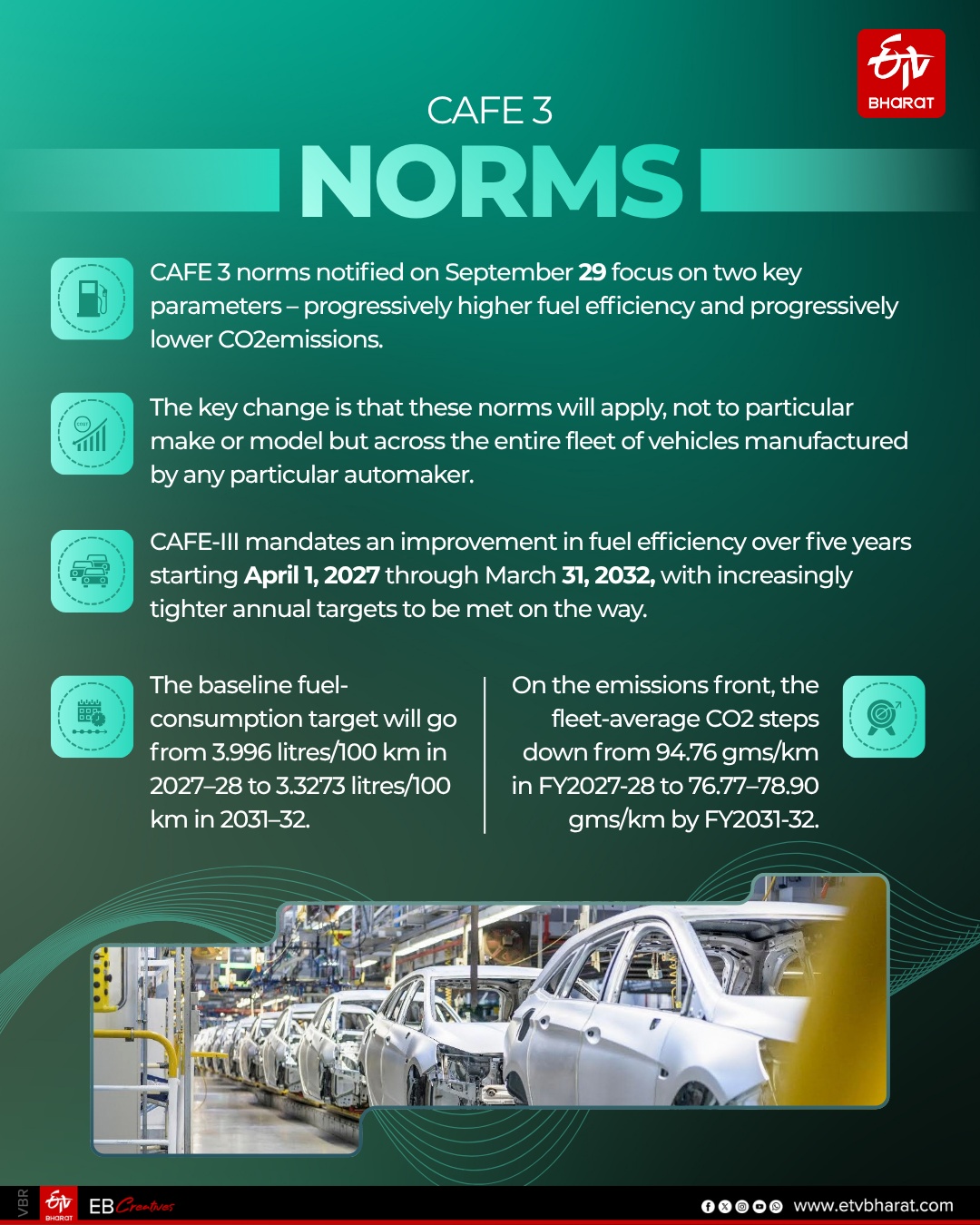
The CAFE 3 norms notified on September 29 focus on two key parameters – progressively higher fuel efficiency and progressively lower CO2
emissions.
The key change is that these norms will apply, not to particular make or model but across the entire fleet of vehicles manufactured by any particular automaker. So, a company like Maruti Suzuki, which makes small petrol cars, larger SUVs, hybrid vehicles as well as electric vehicles, the fuel efficiency and emissions norms will be calculated across its entire range of vehicles.
CAFE-III mandates an improvement in fuel efficiency over five years starting April 1, 2027 through March 31, 2032, with increasingly tighter annual targets to be met on the way. The baseline fuel-consumption target will go from 3.996 litres/100 km in 2027–28 to 3.3273 litres/100 km in 2031–32.
Similarly, on the emissions front, the fleet-average CO2 steps down from 94.76 gms/km in FY2027-28 to 76.77–78.90 gms/km by FY2031-32.
But the story does not end here. While the policy does not dictate fuel or technology choices, it does give considerable nudges towards what are considered to be desirable outcomes.
So, for fleet-wide fuel efficiency, the formula uses vehicle weight as a key factor. So a carmaker who predominantly makes heavier vehicles like SUVs will have a tougher challenge than one whose product mix is weighted towards lighter (and therefore, by and large smaller) cars.
That’s not all. There are other incentives built into the calculation formula, which give a boost to lower emission hybrids or zero emission electric vehicles – and those using relatively cleaner (less CO2 emissions) fuels like CNG, ethanol blended petrol or flex-fuel ethanol.
So, a battery electric vehicle gets a 3X volume factor. One battery or range extended electric vehicle will count as 3 conventional internal
combustion engine-powered vehicles for calculating fleet averages.
Similarly, plug-in and flex-fuel strong hybrids receive a 2.5X factor, conventional strong hybrids a 1.6X factor and flex-fuel vehicles a
1.1X factor. In addition, manufacturers failing to meet targets can purchase credits from those exceeding them – like a pure-play EV
maker, for instance – to balance their average.
What this means
What this does is to leave the strategic decisions on the portfolio of vehicles to be manufactured in the hands of the manufacturer, rather than forcing choice through bans and court orders. So Maruti, which has more small cars in its fleet, can offset relatively inefficient products through the lower weight and higher volumes of such vehicles.
An SUV-heavy manufacturer can adopt a number of possible responses to offset the higher weight and tighter efficiency and emissions targets. They can make more EVs, add strong hybrids or plug-in hybrids, increase CNG and ethanol-compatible models.
Manufacturers can take the conventional route of reducing consumption and emissions of existing petrol and diesel models, re-engineer their products for lower weight, simply withdraw inefficient variants or purchase credits from manufacturers with a surplus in the short run.
The key is, whatever they do, they are driven towards the desired outcome – reduce overall fuel consumption and emissions. Which is what good policy should achieve.
Read More