Paying For The City: The CURE For Hyderabad's Finances
Looking at Hyderabad's finances over the last six years, government grants have not been a major source of municipal revenue, writes Vasu Saha.

Published : October 1, 2026 at 3:27 PM IST

The draft CURE Bill has triggered an understandable question among Hyderabad's property owners: why should we pay more? It is a legitimate question.
The proposed Core Urban Region (Integrated Governance) Bill, 2026 would change the basis on which property tax is calculated in Hyderabad- from the current system based on estimated rental value to one linked to government assessed capital value. This could increase tax liabilities for many property owners.
But there is another question that deserves equal attention: why does Hyderabad need to strengthen its municipal revenue base in the first place? The answer lies not simply in the proposed tax increase, but in how Hyderabad has been financing its growing infrastructure and service needs—and whether that model can continue.
Hyderabad Already Pays for Its City- But It Is Not Enough
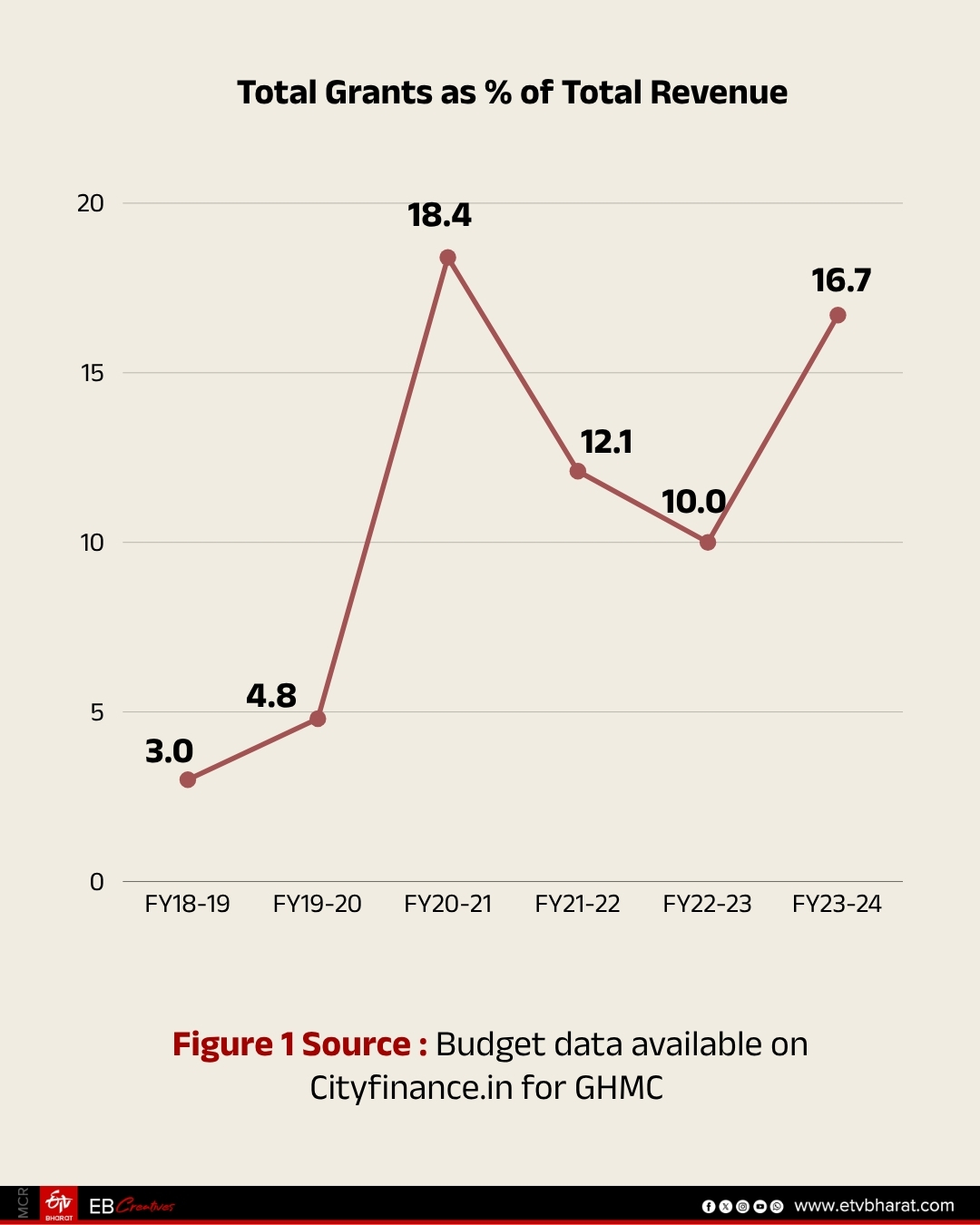
Looking at Hyderabad's finances over the last six years, government grants have not been a major source of municipal revenue. According to budget data, between 2018–19 and 2023–24, grants accounted for just 3–18 per cent of Greater Hyderabad Municipal Corporation's (GHMC) total revenue. In 2023–24, grants amounted to about Rs 1,184 crore against total GHMC revenue of Rs 7,105 crore—around 17 per cent.
The pressure becomes clearer when revenue is compared with expenditure. Between 2019-20 and 2023-24, GHMC's revenue grew a substantial 61 per cent. But capital expenditure grew 234 per cent over the same period, driven by the Strategic Road Development Programme, the Strategic Nala Development Programme, and the Comprehensive Road Maintenance Programme, together worth roughly Rs 10,249 crore, of which Rs 6,390 crore was debt-financed.
Borrowing helped bridge the gap, but it also created a growing debt servicing burden. GHMC's outstanding debt stood at around Rs 6,749 crore in 2023–24, while debt servicing and interest payments were already exceeding Rs 100 crore a month. By March this year, GHMC officials sought State support to clear pending dues or take over servicing of its infrastructure loans, warning that continued delays could affect the corporation’s ability to fund development works. The State has since moved to take over these liabilities.
That provides welcome breathing room. But debt relief can repair a balance sheet; it cannot create the recurring revenues needed to finance Hyderabad’s next phase of growth.
Why a New Property Tax Base, and why now?
Hyderabad faces a choice: keep depending on intermittent state support, or build a revenue base of its own that actually keeps pace with the city’s needs. Grants have never covered more than a fifth of GHMC's budget even at their peak. That makes own-source revenue critical—and within it, property tax is the largest single component, accounting for more than half of GHMC’s own source revenue on average.
GHMC has already taken steps to improve property-tax collection without raising rates, including bringing new properties into the tax net, using technology to improve coverage and integrating property-tax records with other government databases.
These measures are important, but they cannot address the deeper problem: the tax base itself has remained stagnant. Residential property-tax rental values were last revised in 2003, while the corresponding values for commercial properties were revised in 2008, even as Hyderabad’s property values and economy have grown substantially.
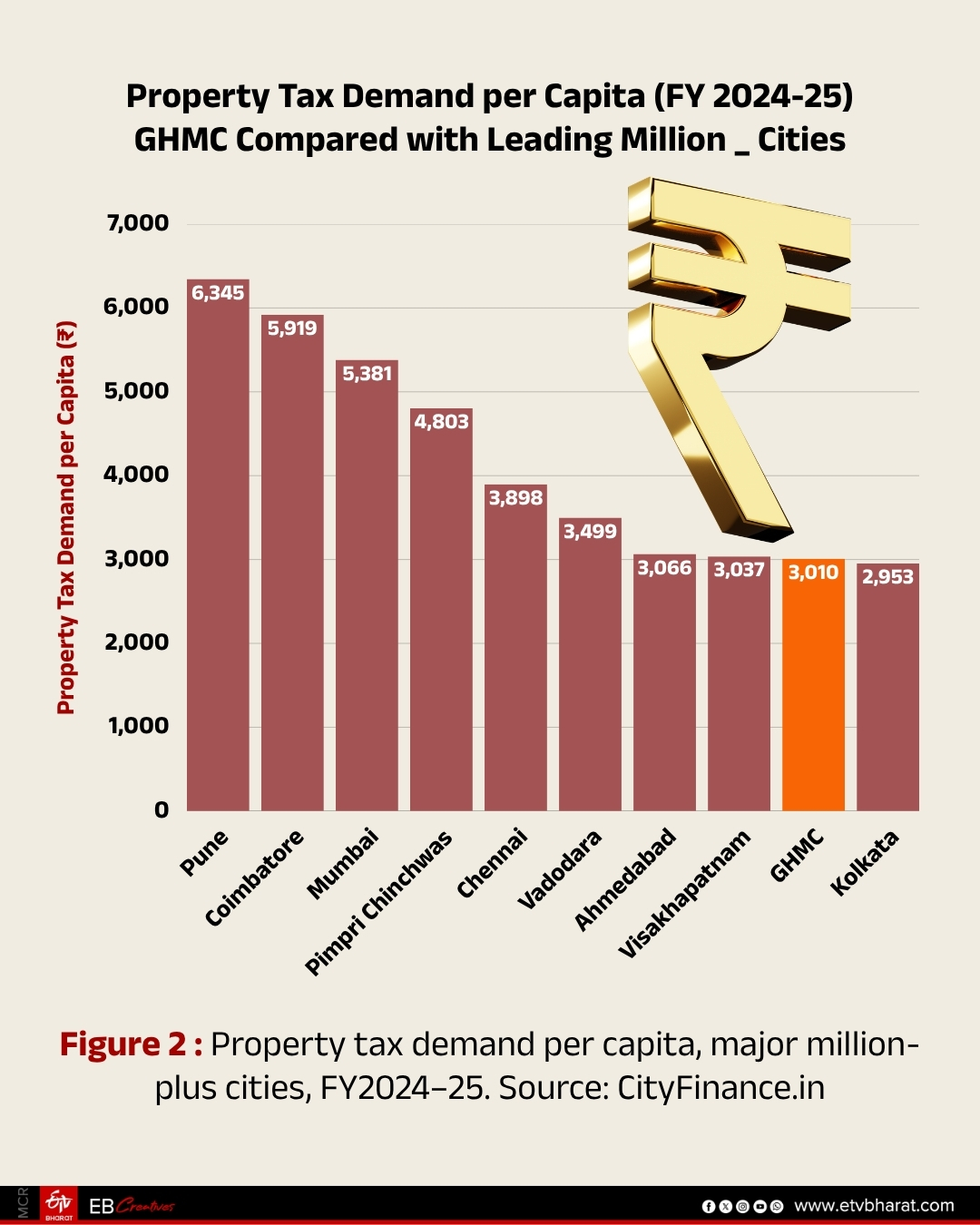
The gap is evident in comparison with other major cities. As per data from CityFinance.in, GHMC’s property tax demand per capita was around Rs 3,010 in FY2024–25, ranking ninth among 10 major million-plus cities. This was less than half the per-capita demand in Pune (Rs 6,345), Coimbatore (Rs 5,919) and Mumbai (Rs 5,381).
This is where changing the basis of property tax assessment becomes important. By linking property taxation to the guidance values maintained by the Registration Department—values that are periodically revised—the system provides a more dynamic tax base than the existing system based on estimated rental values. It also eliminates the need for ULGs to undertake periodic market-rental surveys to determine property values, making the basis of assessment more transparent, predictable and easier to administer. Nor is this an untested experiment.
Telangana adopted the capital value-based approach through the Telangana Municipalities (Assessment of Property Tax) Rules, 2020, and ULGs across the state have already transitioned to it. GHMC remains the notable exception. Andhra Pradesh, Jharkhand and Karnataka have also adopted similar models. CURE now proposes extending this to the integrated urban region, comprising Greater Hyderabad, Cyberabad and Malkajgiri.
But Higher Taxes Need a Better Bargain
Two concerns are likely to lead to public resistance: a sudden increase in property-tax bills, and a more fundamental question—if residents pay more but see no visible improvement in their neighbourhood, why should they pay more?
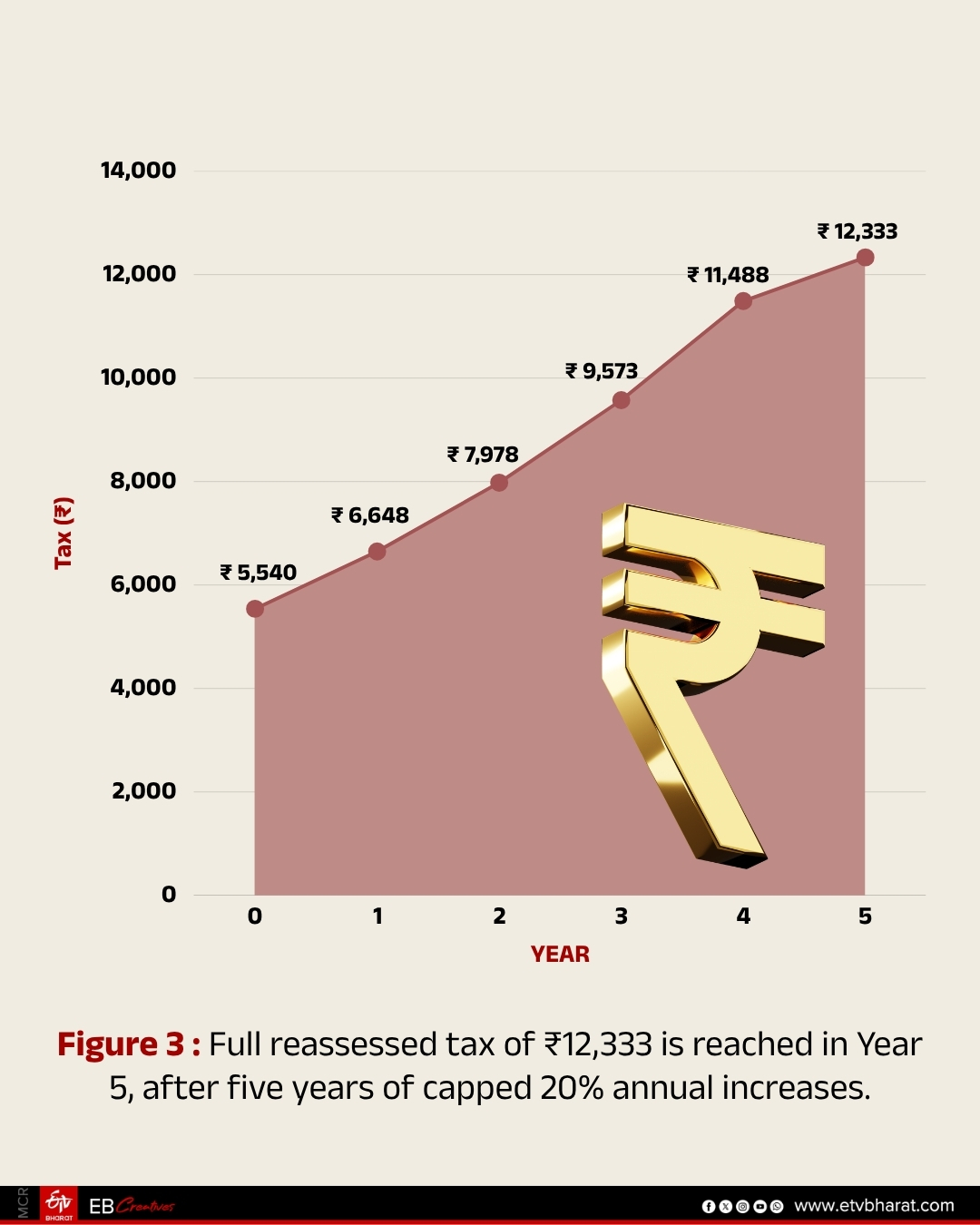
First, the increase is not designed to happen overnight. The proposed system caps annual increases for existing properties at 20 per cent of the previous year’s liability until the tax calculated under the new methodology is reached. Take a 1,000 sq ft self-occupied flat in Jubilee Hills. Its property tax today is approximately Rs 5,540 a year; under the proposed methodology, the fully reassessed tax works out to roughly Rs 12,333—a 123 per cent increase. But with the 20 per cent cap, the owner does not pay the revised tax from year-1 itself: in this example, the bill rises gradually over five years.
Second, and this is the harder half of the bargain, greater municipal revenue must be matched by radical transparency. A model for this already exists in rural local government: eGramSwaraj provides a single platform for Panchayats to track planning, physical and financial progress, accounting and assets, making it possible to follow public spending from approval to implementation. GHMC should go beyond publishing an annual budget and disclose three layers of information: fiscal transparency—what it raises, owns and owes; project transparency—the location, cost, contractor, timeline, expenditure and progress of every civic work; and service transparency—what those investments actually deliver- whether roads are completed, drainage improved, parks maintained and service standards actually met.
Transparency alone is not enough. Taxpayers should have a meaningful say in how the revenue raised from their neighbourhood is spent. This is not something CURE currently provides for- but it should. CURE should give Ward Committees the powers and resources to play that role. The Bill should be amended to give ward committees the powers and resources to play that role, with 20 per cent of the property tax revenue collected in each ward made available for neighbourhood priorities identified through the Committee. Each Ward Committee should be able to identify and prioritise neighbourhood needs, review proposed civic works and monitor whether approved works are delivered- with regular meetings, publicly available decisions and Action Taken Reports letting residents to see what was proposed, what was approved and what was actually delivered.
CURE can help modernise Hyderabad’s tax base. But its legitimacy will depend on the bargain that accompanies it: a gradual transition, a meaningful local voice and visible accountability for every rupee the city raises and spends.
(The author Vasu Saha is a Senior Associate, Public Finance Management, Janaagraha. The facts and opinions expressed in this article are those of the writer and do not reflect the views of ETV Bharat.)
Also Read: