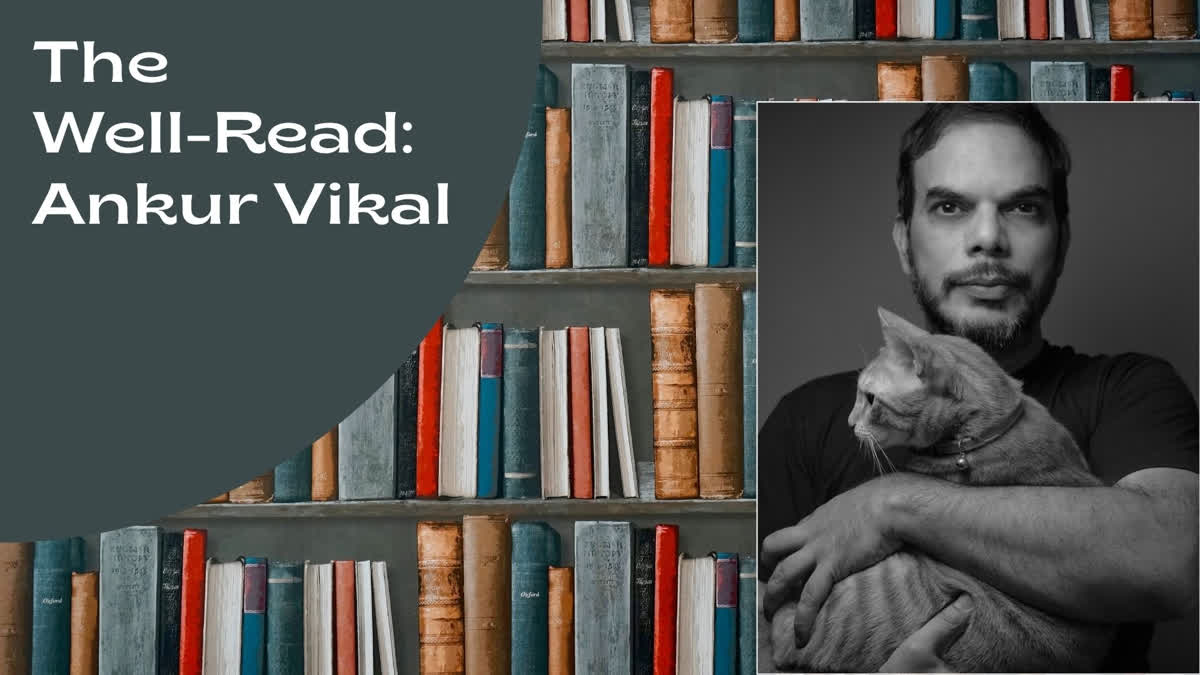
The Well-Read: Ankur Vikal, The Seasoned Actor Who Still Reads Like A Wide-Eyed Child
Celebrated Dublin-based theatre and film actor Ankur Vikal's first literary encounters were not with the solemn guardians of the canon but with Indian mythology.

Published : September 19, 2026 at 2:17 PM IST

For Ankur Vikal, reading began with mythology, comics and an older sister who understood that a child does not necessarily need to be given a book in the conventional sense in order to enter the world of books. Sometimes all you need is a comic, a speech bubble and somebody patient enough to tell you where to look.
The celebrated film and theatre actor known for his work across Indian and international cinema (Slumdog Millionaire, Maqbool, Inside Edge, Nirbhaya The Play) began reading when he was very young, growing up in a family where stories were already part of the atmosphere. His sister Arpita and brother Anup were readers before him; his grandfather, the writer and poet Vidyaratna Vikal, was a storyteller of another kind.
Before Vikal became an actor, playwright and filmmaker, before architecture and the prestigious National School of Drama, before cinema and theatre became his professional vocabulary, there was the library. And before the library, there was silence.
“I think once I started reading, there was no stopping,” he says over a Zoom call from his current home in Dublin. “I finished whatever I could find and then there was nothing else to read.” His mother eventually took him to a library called Bookmark. “And I started reading the books in that particular library,” he recalls. What drew him there was not only the abundance of books but the stillness. “What drew me to the libraries I suppose was silence,” Vikal says. “It's a difficult commodity to find often seeing as there's so many of us everywhere.”
The Promise Of Not Knowing
Then comes a phrase that best describes his relationship with reading: “The silence in the library was very alluring because it helped me find stillness and the promise of not knowing where each book could bring me.”
It is a beautiful description of reading, particularly in an age in which so much of our cultural consumption is designed to eliminate uncertainty. Algorithms predict what we will like. Trailers tell us what a film is about before we have seen it. Reviews announce what we ought to think. Social media compresses books into quotations and novels into lists of things you must read before you can have an opinion about them. The library says: here are thousands of doors. You have no idea where they lead. Open one.
The Child Who Read Everything
Vikal's first literary encounters were not with the solemn guardians of the canon but with Indian mythology. “Some of the mythology we had as children. Amar Chitra Katha, I suppose,” he says. “Our mythology was what kind of jumped out first at me.” He remembers stories such as Angulimala, along with the many other figures and narratives that populated the comics of his childhood. His sister was instrumental in teaching him how to enter those stories. “I must have been four maybe or three,” he says. “She told me, you know you can read just the bits in the bubble. The descriptions at the top are a little tough for you to figure. But you could just read the conversations in the bubbles and that'll help you understand the story.”
It is an almost perfect childhood lesson in narrative. Forget the intimidating prose at the top. Start with the people talking. Tintin appeared. Then Asterix. “I finished all these by the time I was five,” he says. “And then I moved to books.” His method was wonderfully indiscriminate. If his siblings recommended an author, he followed the recommendation to its logical extreme. “My sis or brother would tell me, 'Hey, try this writer. They're writing books for people our age.' So I would read those books. Every book by each author. Then I would finish, like I would exhaust the writer.”
Exhaust the writer tells us something about the child he was and the reader he remains. Vikal did not merely sample authors. He went after them. If the library had 30 books by a writer, he read all 30. If it had 50, presumably the 50 were not going to escape. There is something actorly about this kind of reading. An actor must inhabit a character completely before eventually stepping out of the role. Vikal's childhood reading seems to have worked in a similar fashion. He would enter a writer's universe and stay there until he had exhausted its available geography.
There was another influence at work: His grandfather. Vidya Ratna Vikal was a poet, and he had a particularly fertile imagination when telling stories to his grandson. “He used to make up stories for me with me as the protagonist,” Vikal says, “and them saving animals in the ocean and in the galaxies and going to the moon...”
The stories did more than entertain a child. “The ability to start imagining things was the seed,” he says. His siblings, meanwhile, “watered it” through their own reading habits. It is difficult to imagine a better education for an actor. First, learn to enter someone else's story. Then learn to imagine yourself inside it. Then discover that the boundaries between the two are porous.
The Library And The Vanishing Of Noise
Vikal grew up without television becoming the dominant background noise of his life. Through his teens, his 20s, and even much of his 30s, television was largely absent. He was studying architecture, living on his own, and later attending drama school. “The idea of watching some terrible TV in the common room with a bunch of yelling youngsters was never my idea of fun,” he says. Books were different, maybe because they demanded participation or because the writer wasn't physically present, shouting for attention. Vikal remembers finding writers more “sensible” than some of the people around him, whose preoccupations could seem comparatively superficial.
It is tempting to interpret this as the familiar story of the introverted child escaping into books, but Vikal's account suggests he was not merely escaping people. He was searching for a quality of attention. Books gave him that. And later, meditation would give him another version of it. Yet reading itself is not always calming for him. In fact, fiction can have almost the opposite effect. “It works me up actually,” he says when asked whether reading is meditative for him. “Fiction gets under my skin.”
Russian Literature To Indian Spirituality
Fyodor Dostoevsky occupies a particularly interesting place in Vikal's reading life. His attraction to the Russian novelist seems connected to the same curiosity that draws him to characters as an actor: "the desire to look beneath the surface." Dostoevsky's people are rarely simple. For someone who has spent his professional life stepping into other people's interior worlds, that complexity has an obvious appeal. His characters cannot be reduced to heroes and villains; they have to be understood. And understanding, rather than judgement, is often where the real work of both reading and acting begins.
Paramahansa Yogananda's Autobiography of a Yogi took Vikal somewhere entirely different. It became part of his exploration of spirituality and the larger questions that sit behind everyday life. What makes the book significant in his reading journey is not only its subject but also the fact that it represents his willingness to follow a book wherever it leads him. That curiosity extends to the work of Robert Svoboda.
Svoboda's writing brought Vikal into another world of spiritual knowledge and philosophy. It reflects something fundamental about the way he reads: he is interested not merely in stories but in systems of thought and in the accumulated knowledge through which people have tried to understand the body, the mind and the self. The actor who spends so much time observing human behaviour is also, through his reading, interested in the larger structures that shape that behaviour.
The Closure Of Fiction
“What does fiction give you that real life doesn't?” we ask him. His answer comes quickly: “Closure.” Books have some kind of closure at the end. You know things neatly get wound up and unlike life there is some closure, I suppose.” Life refuses narrative neatness. People disappear without explaining themselves. Relationships end without final conversations. Friendships dissolve for reasons that remain mysterious. A novel, by contrast, has the extraordinary courtesy of ending. Even when the ending is ambiguous, the ambiguity has been composed. Somebody decided where to put the last sentence.
Vikal understands this not only as a reader but as an actor and storyteller. He has written short stories, an animation film, plays and films since 2015. Writing has given him another perspective on the machinery behind stories. Yet he refuses to become the kind of reader who dissects everything he encounters.
The Child Must Remain
One might expect an actor who has begun writing to become more analytical about books, plays and films; to start noticing structure, dialogue, character construction, pacing, exposition. Vikal says the opposite: “I don't. And if I do, then I stop reading. If the book or play or film is not able to cater to the child in me who's just wide-eyed and like rooting for it to win or succeed, then I step out.” The child is the critic not the scholar or the acting professional. That child still wants to be surprised, and still wants the story to work. “If we've wasted two hours, why should we waste 20?” he says of abandoning books, films or plays that fail to hold him.
There is no sense that finishing a book is morally superior to abandoning it. This is probably another form of protecting attention. “I'm completely aware that our attentions are being harvested by everything on social media,” he says. As a result, he is more careful about where he spends his time. He does not automatically trust hype. “I wouldn't read a book that someone on Instagram is gushing about,” he says. Of course, he admits, none of us are entirely immune. “Advertising is such a huge part of our life these days that it's hard to not get affected by it.”
The Books That Remain
Among the books that have stayed with him are the works of Richard Bach and Khalil Gibran. He still remembers being “completely smitten” by Bach's Jonathan Livingston Seagull and Illusions, books he encountered as a child and continues to recommend. Jonathan Livingston Seagull is also the book he would be most upset to lose from his collection. The book has travelled with him through different versions of himself. It has become less an object than a memory.
His collection has changed over the years. When he moved from Bombay to Dublin a few years ago, he gave away many books. “The really sacred books are all there,” he says, referring to the books he kept in his Bombay home. The others were easier to part with.
“The books that didn't spark any joy in me, I gave away a lot of those.” A reader's library is rarely just a record of what he has read. It is a record of who he has been. Every shelf contains an earlier self. Some books belong to the person you were at 20. Others to the person you thought you would become. Some survive because you still love them. Others survive because you cannot bear to disappoint the person who once did.
When Poetry Finds You
If fiction offers Vikal closure, poetry offers something quite different. He reads Mary Oliver, Rumi, Federico García Lorca. Lorca's poems, he says, “get under my skin.” Poetry requires a different kind of attention. It does not necessarily take you from point A to point B. “If you're reading prose, you're flowing with the story,” he says. “You don't have to understand every line.” Poetry is different. “With poetry you have to look in all directions.”
Prose moves. Poetry circles. A novel carries you forward. A poem may ask you to stop and look again at the same word, the same image, the same silence between two lines. Vikal reaches for poetry when he is “lost a bit in the labyrinth.”
“I might reach for a poet as opposed to fiction,” he says, “because the poet's words would trigger my lived experiences whether he meant the same thing that I get from the words or not.” This is one of the great freedoms of poetry: the poet cannot entirely control what the poem becomes inside the reader. “Often the poem meets me where I am,” he says, “in my state of being.”
The Writer Who Refuses To Imitate
Since 2015, Vikal has increasingly written alongside his acting. Short stories, plays, films and an animation project have become part of his creative life. But he is not interested in becoming another writer. There is no particular novelist he wishes he could imitate. “No, I just haven't had that feeling even with acting,” he says. “There's no one that I envy.”
He admires writers, actors, filmmakers, documentary makers, playwrights and poets, but he doesn't want his own work to become an homage to somebody else's life. “Writing is such a magical thing that it has to stem from your own lived experiences,” he says. “And I don't think my lived experiences may overlap with anyone else on earth just seeing as how we are all so unique.” The self is not an obstacle to art. It is the raw material.
Everyone Is Me
There is an unexpected answer when we ask whether reading fiction has made him better at understanding people. “No.” Books, he says, have not made him better at understanding other people. Understanding himself has. “None of my acting involves people even if I'm playing people,” he says. “Because every person that I play is me.” That sounds, at first, like a contradiction. Actors are supposed to study people, observe behaviour, collect mannerisms, understand psychology. But Vikal's approach is inward rather than observational.
“It's what I would do in those situations,” he explains. He is interested in discovering “how I am everyone.” Or, as he puts it, “how everyone's a part of me in the universe.” This is where his ideas about acting, reading and poetry begin to converge. He is using literature to discover how much of everybody else already exists within himself. “How I feel about you makes you special to me,” he says. “Not what you feel about yourself. That has little to do with me and I don't even know how you feel about yourself. I do know how I feel about you.” It is an actor's idea of character stripped of performance. The character begins not with imitation but with recognition.
Dublin, Where The Writers Are Alive
Another favourite is Irish author James Joyce's Dubliners, which feels particularly resonant for an actor. The stories are rooted in the seemingly mundane lives of ordinary people, yet Joyce finds the drama hidden inside their routines, frustrations, desires and disappointments. That attention to the small details of human behaviour is precisely the sort of thing an actor learns to notice. Dubliners is, in that sense, a book about looking closely, and Vikal has spent much of his life doing exactly that.
Moving to Dublin changed his reading life not necessarily because the city gave him more books, but because it put him closer to people who were making them. “I'm surrounded by writers now,” he says. He has encountered writers at the National Screen Acting School of Ireland and playwrights at the National Theatre School there. He works with new writers on plays and films, and Dublin's literary history is not something confined to monuments and names in school textbooks.
The writers are still here. “I discovered quite a few authors after I came here,” he says. “Playwrights and fiction.” One of them is Cathy Sweeney, whose novel Breakdown made a particularly strong impression on him. “She kind of blew my mind,” he says. Then came one of those wonderfully Dublin coincidences: while teaching students, one of them mentioned that Sweeney had once taught them English at school. Suddenly the literary world became smaller. The writer is not a portrait hanging on the wall. She is somebody's former teacher. The playwright might be standing next to you, and the famous Irish actor is not necessarily surrounded by an entourage.
Vikal observes that the city's creative people tend to move through the world without demanding that the world stop and applaud. “They're not trying to get noticed,” he says. “No one is trying too hard.” It resembles his own relationship with art. Do the work, read the book, write the play, walk home. Don't make too much noise.
The Reader As Witness
There is a line running through Vikal's reading life, from the child reading Amar Chitra Katha comics to the adult reaching for Lorca when he is lost in a labyrinth. It is the search for stillness in which something can happen. A poem can meet you. A character can emerge. A book can take you somewhere you did not know you wanted to go. A library offers silence and possibility simultaneously. You remain physically where you are, but your imagination crosses oceans, centuries, galaxies.
Vikal's grandfather understood this before the boy could articulate it. He sent him to the moon, into galaxies, into oceans, with animals to save and adventures to survive. His sister and brother handed him comics and showed him how to read the speech bubbles. The books gave him worlds. Theatre gave him bodies and voices. Cinema gave him images. Writing gave him another way to arrange experience. The boy who once learned to read the conversations inside Amar Chitra Katha speech bubbles grew into an actor who inhabits other people's lives, a writer who creates his own, and a reader who still wants the same thing he wanted when he first entered a library: the stillness, the silence, and the promise of not knowing where the next book might take him.
(This interview is part of the column titled 'The Well-Read'. It gives a peek into the reading lives of fascinating people and the stories, authors and ideas that fuel their creativity.)
Also read:
