Steep Medical Device Markups Trigger National Call For Fair Pricing Framework
AiMeD seeks fair-pricing framework for medical devices as survey finds huge gaps between hospital procurement costs and printed MRPs, reports ETV Bharat's Gautam Debroy.

Published : September 18, 2026 at 5:04 PM IST

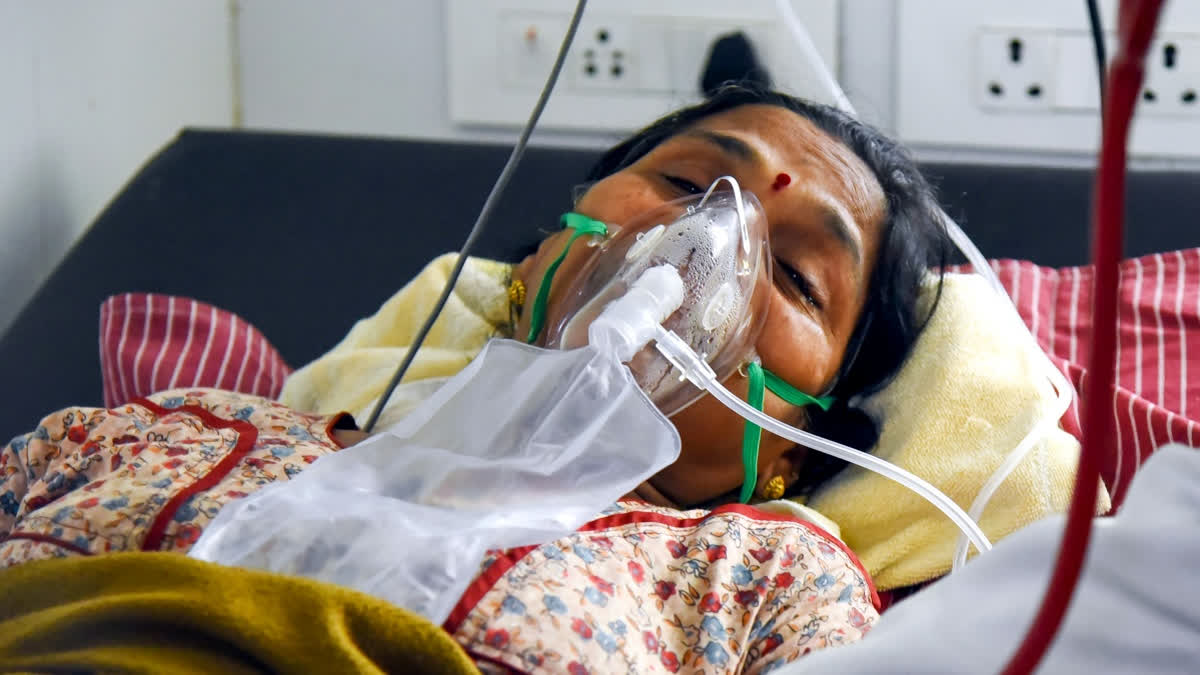
For a patient lying in a hospital bed, an IV set, syringe or catheter is not something they can compare, bargain over or choose not to buy. Yet the price printed on some basic medical consumables can be many times higher than what the hospital paid for them. A recent Maharashtra Food and Drug Administration (FDA) survey has brought this largely invisible part of hospital bills into focus.
The survey found that an IV infusion set purchased for Rs. 11.05 carried an MRP of Rs. 325, a reported markup of 2,841%. The findings have triggered a wider debate over how medical devices are priced and whether the existing regulatory framework adequately protects patients while allowing manufacturers and importers to maintain sustainable businesses.
Maharashtra FDA Commissioner Tukaram Mundhe has flagged substantial differences between procurement prices and printed MRPs of hospital consumables following a survey of hospitals in the Mumbai Metropolitan Region, Pune and Chhatrapati Sambhajinagar. FDA officials examined medical devices used for inpatients and found large price differences across several categories. Among the examples cited by the FDA, a 10-ml syringe purchased for Rs. 6.75 carried an MRP of Rs. 57.20, representing a reported difference of about 747%. A catheter procured for Rs. 29.41 had an MRP of Rs 310.
The disparity was also seen in respiratory-care products. According to details reported by the Maharashtra FDA, a nebuliser purchased for around Rs. 40 carried a retail price of Rs. 650, while an oxygen-mask-related product purchased for around Rs. 45 had an MRP of about Rs. 715. The reported differences in these cases ran into four figures.
AiMeD Calls For A Fair-Pricing Policy
The Association of Indian Medical Device Industry (AiMeD) has welcomed Mundhe's intervention, arguing that the findings highlight a structural issue in the way medical devices are priced.
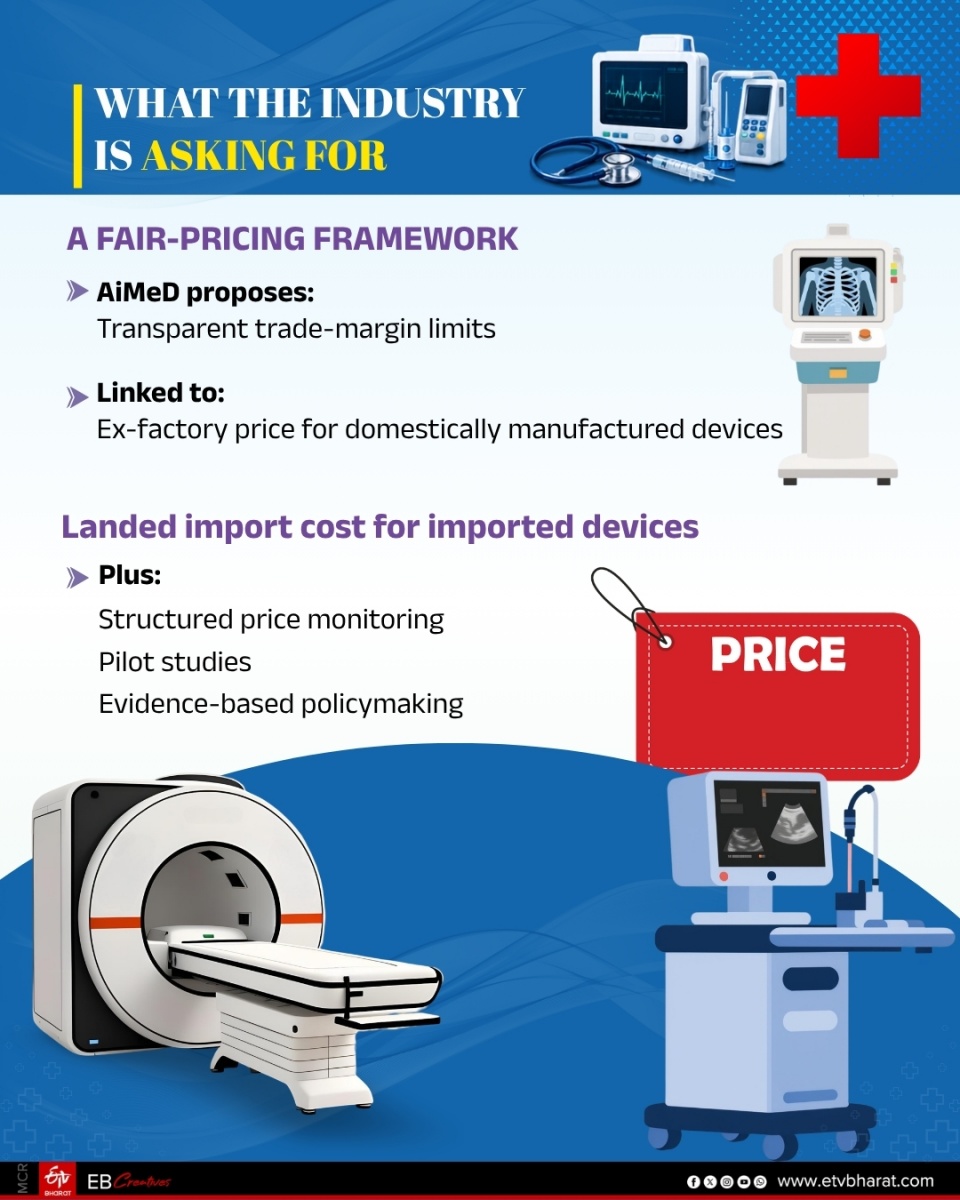
“Rational profits for any business is understandable but not irrational profiteering; it’s unfair,” said AiMeD Forum Coordinator Rajiv Nath. Speaking to ETV Bharat in New Delhi on Friday, Nath called for a fair-pricing policy specifically for medical devices, with transparent trade-margin limits linked to ex-factory prices for domestically manufactured products or landed import costs for imported devices.
“The absence of such a framework can create an uneven market. Manufacturers and importers that maintain transparent pricing can find themselves competing against a system where substantial downstream markups are possible,” Nath added.
AiMeD has also sought structured price monitoring and pilot studies based on its proposals, describing the approach as “policy making by evidence”. According to the industry body, the issue is not only about reducing patients’ bills. It also concerns the competitiveness of domestic manufacturers, investment in innovation and the broader goal of building an Indian medical-device ecosystem.
Medical-Device Market Expected To Reach $50 Billion
The pricing debate comes as India seeks to expand domestic medical-device manufacturing and reduce its dependence on imports. The medical-device sector covers a wide range of products, from electronic equipment and implants to consumables, disposables, surgical instruments and in-vitro diagnostic reagents.
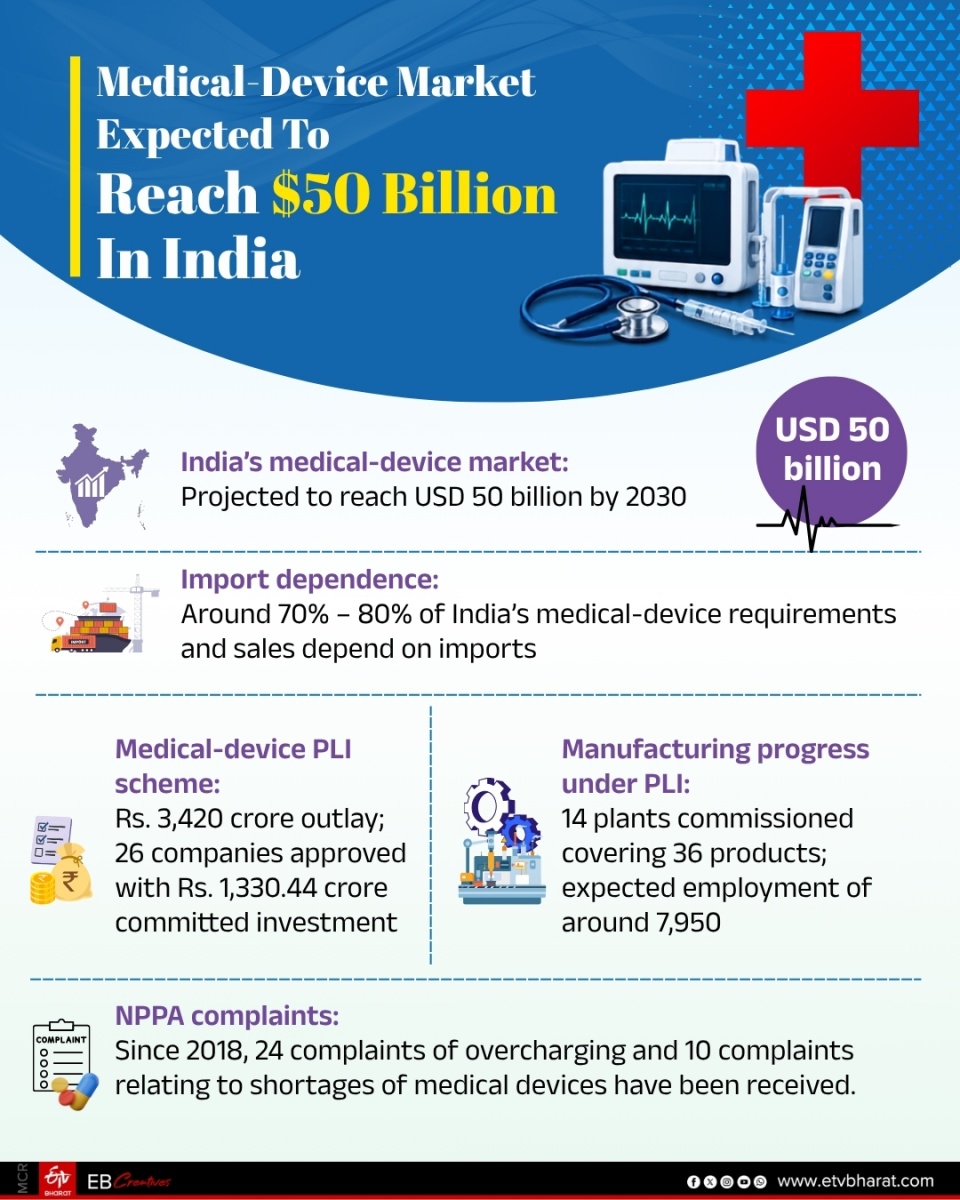
Indian manufacturers already produce products including catheters, perfusion sets, extension lines, cannulas, feeding tubes, needles, syringes, cardiac stents and orthopaedic implants. A parliamentary review noted that India's medical-device market was expected to reach around USD 50 billion by 2030, while approximately 80% of domestic sales were accounted for by imported devices at the time of the assessment. Overall, around 70%-80% of India's medical-device requirements and sales depend on imports, according to figures cited in the material.
The dependence is particularly significant in high-technology segments. Parliamentary data cited in the review showed imports of electronic equipment rising from about USD 3.647 billion in 2019-20 to USD 4.884 billion in 2022-23. Imports of surgical instruments rose from USD 180 million to USD 210 million, while imports of in-vitro diagnostic reagents increased from USD 527 million to USD 767 million during the same period. Exports were growing but remained substantially lower in these categories in 2022-23; about USD 72 million for surgical instruments, USD 1.335 billion for electronic equipment and USD 191 million for in-vitro diagnostic reagents, according to the parliamentary review.
What Does The DPCO Say About Medical Devices?
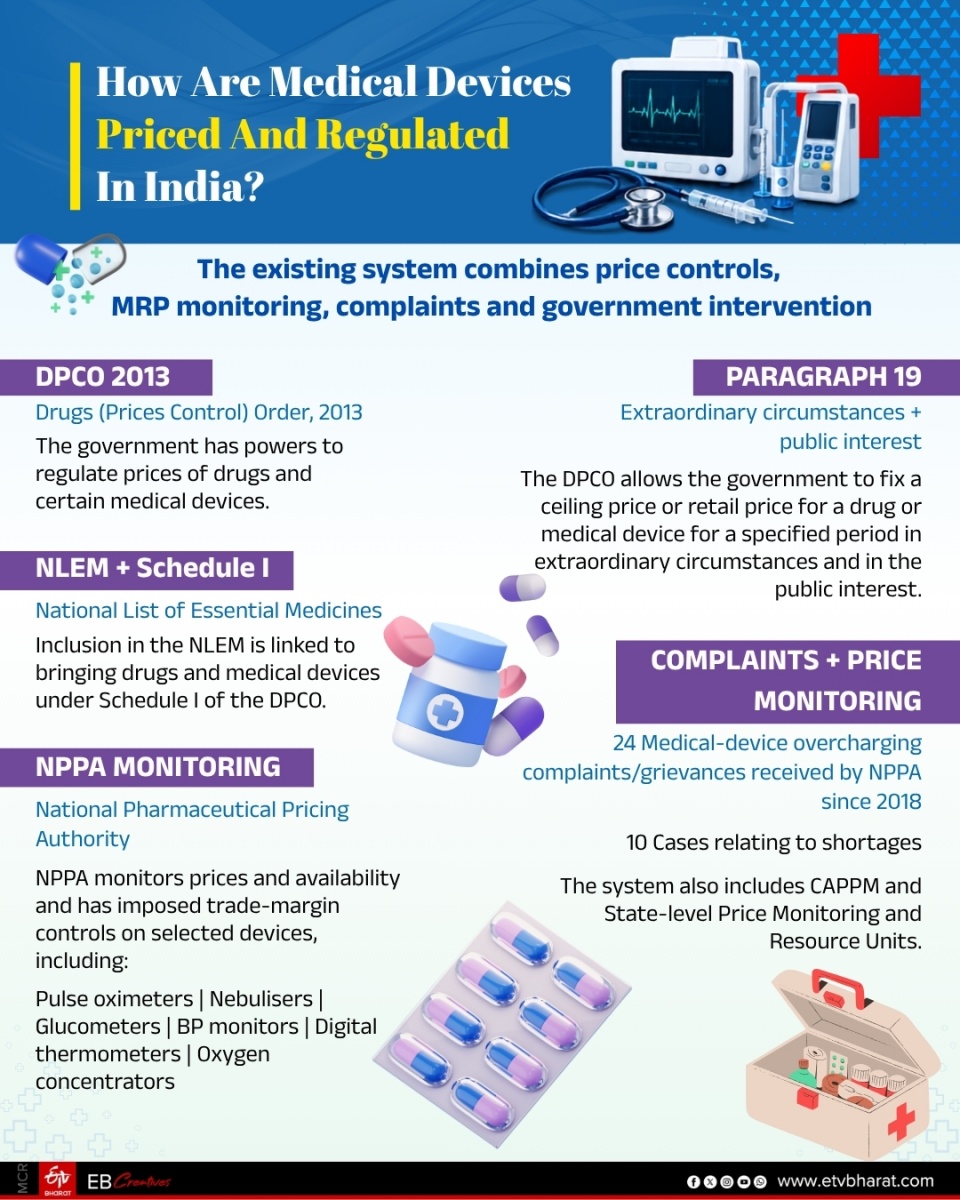
The Drugs (Prices Control) Order, 2013 (DPCO) gives the government powers to regulate the prices of drugs and certain medical devices, while the National Pharmaceutical Pricing Authority (NPPA) monitors prices and availability. Parliamentary scrutiny has previously noted that the National List of Essential Medicines (NLEM) forms the basis for bringing drugs and medical devices under Schedule I of the DPCO. Expanding price regulation to additional devices is linked to their inclusion in the NLEM. At the same time, Paragraph 19 of the DPCO gives the government powers, in extraordinary circumstances and in the public interest, to fix a ceiling price or retail price for a drug or medical device for a specified period. The provision has been used for products including oxygen concentrators and other medical devices.
NPPA has also imposed trade-margin controls on certain devices, including pulse oximeters, nebulisers, glucometers, BP monitors, digital thermometers and oxygen concentrators. Knee implants have previously been subjected to price intervention under extraordinary circumstances. For other non-scheduled medical devices notified as drugs, NPPA monitors MRP increases under the DPCO framework. However, AiMeD argues that monitoring increases in printed MRPs is different from establishing a rational relationship between procurement costs and the prices ultimately charged to patients.
NPPA Has Received 24 Overcharging Complaints
The issue is not entirely new for the price regulator. A parliamentary committee was informed that, from 2018 onwards, NPPA had received 24 complaints or grievances relating to overcharging of medical devices and 10 cases relating to shortages. The department said overcharging complaints are analysed and notices are issued where necessary, while monitoring is an ongoing process. The government has also used the Consumer Awareness, Publicity and Price Monitoring (CAPPM) mechanism, including State-level Price Monitoring and Resource Units, to create awareness about price regulation and grievance mechanisms.
“The Maharashtra findings could therefore bring renewed focus on whether the existing complaint-based system is sufficient for products that patients are required to use during hospitalisation and generally cannot independently select,” Vinod Kalani, adviser, Indian Pharmaceutical Industry Confederation told ETV Bharat.
Kalani said consumable medical devices do not have the same price controls as medicines. As a result, hospitals may bill patients according to the printed MRP, which can sometimes be substantially higher than the price charged by manufacturers for the device. He also pointed out that hospital charges extend beyond medical devices, with hospitals setting charges for the services they provide.
Government Pushes Domestic Medical-Device Manufacturing
The government has introduced several programmes aimed at reducing import dependence and strengthening domestic manufacturing. These include the Production Linked Incentive (PLI) Scheme for Promoting Domestic Manufacturing of Medical Devices, the Promotion of Medical Device Parks Scheme and assistance for common testing and laboratory infrastructure.
The medical-device PLI scheme has a financial outlay of Rs. 3,420 crore for FY 2020-21 to FY 2027-28. Under the scheme, selected companies receive incentives linked to incremental sales of eligible medical devices manufactured in India. Government data cited before Parliament said 26 companies had been approved, with committed investment of around Rs. 1,330.44 crore and expected employment generation of approximately 7,950 people. At the time of the assessment, 14 manufacturing plants had been commissioned for 36 products.
Under the Medical Device Parks scheme, financial assistance of up to Rs. 100 crore each was approved for parks in Uttar Pradesh, Tamil Nadu, Madhya Pradesh and Himachal Pradesh. The parks are intended to provide common testing and laboratory infrastructure to support domestic manufacturers.
Can Lower Import Dependence Also Help Patients?
The pricing debate is unfolding alongside a larger effort to build India's medical-device manufacturing capacity. For patients, however, the immediate question is much simpler: how much should a basic medical device cost when it appears on a hospital bill? The Maharashtra FDA findings have brought that question into the open. AiMeD is calling for a structured fair-pricing framework, while the existing system relies on a combination of price controls for selected devices, MRP monitoring, complaint mechanisms and government intervention in specified circumstances.
As India's medical-device industry expands, the debate is likely to centre on how to balance patient affordability, transparent pricing, domestic manufacturing, innovation and commercial sustainability.
Also read:
- Govt Issues Advisory To States, UTs To Regulate Stem Cell Therapy In India
- Medical Device Bodies Raise Alarm Over Criminalisation Of Technical Lapses
- Union Health Ministry Proposes Amendments To Streamline Medical Devices Licensing Rules
- It Will Take Two-Four Months For Medical Device Input Costs To Stabilise: Industry Expert
- India’s Medical Devices Industry Likely To Grow 3 Times To $50 billion By 2030: Rubix Industry Insights
