India To Host IEEE Radar Conference For The First Time In Its 47-Year History
The event will provide an international platform for researchers, industry, startups and defence institutions to exchange ideas and discuss the future of radar technology

Published : November 3, 2026 at 3:35 PM IST

Bengaluru: For the first time since it began 47 years ago, Institute of Electrical and Electronics Engineers’ (IEEE) Radar Conference will be held in India next year. IEEE is the world's premier global forum on radar technology dedicated to advancing technology for the benefit of humanity.
The event will be held in Bengaluru from May 1 to 6. The event will officially mark the first time in the conference's 47-year history that it is being hosted in India, as well as its first time anywhere in Asia.
The six-day IEEE RadarConf 2027 is expected to provide an international platform for researchers, industry representatives, startups and defence institutions to exchange ideas and discuss the future of radar technology.
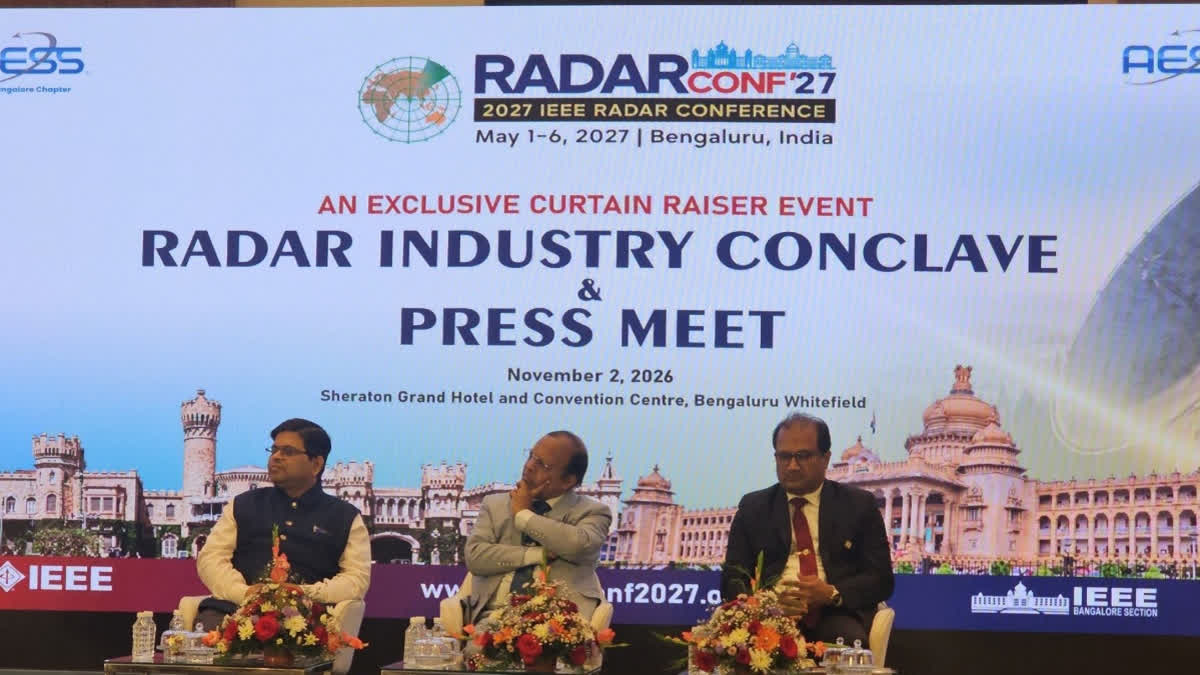
This announcement was made at ‘Radar Industry Conclave’ organised by the Bangalore Chapter of Aerospace and Electronic Systems Society (AESS) here. The event brought together representatives from the defence research community, industry and academia to discuss developments in radar technology and India's role in the global aerospace and defence sector.
BK Das, Director General (Electronics and Communications Systems) at Defence Research Development Organization (DRDO) along with M. Sheikh Althaf, Director of the Electronics and Radar Development Establishment (LRDE), highlighted the changing role of radar in modern warfare and India's growing capabilities in developing indigenous systems.
Radar technology must keep pace with changing warfare
Das said that warfare has moved beyond conventional battles involving tanks, aircraft and missiles, with drones and autonomous systems transforming the nature of conflicts. The growing use of small, low-cost drones and coordinated drone swarms has created new challenges for radar systems and defence forces.
He pointed out the economic imbalance in using expensive missiles to destroy inexpensive drones. "You can't waste a Rs 1 crore missile to neutralise a Rs 50,000 drone," he said while stressing the need for affordable and effective counter-drone technologies.
He also highlighted the difficulty in detecting the fifth and sixth-generation stealth aircrafts and called upon the radar engineers to develop systems capable of operating across different frequencies and rapidly changing transmission bands to avoid detection and attacks by anti-radiation missiles. Creating decoys and interconnected radar networks would also be important to protect installations and improve surveillance, he said.
Das disclosed that India has developed counter-drone technologies involving microwave, laser and jammer systems and advanced versions are being developed to address emerging threats.
AI and connected radar networks to shape future defence
The scientist said that artificial intelligence (AI) and machine learning would play a major role in future warfare where large volumes of information generated by multiple sensors must be processed quickly to identify threats and support decisions. He called for interconnected radar systems that can share intelligence rather than operate in isolation.
"Isolated intelligence has no value. Connected mediocre systems, but inferring together with group intelligence, have more war value than an isolated best system," he underlined while urging radar researchers and industries to prepare for future requirements including photonics, quantum and cognitive radars rather than focusing only on systems needed for present-day conflicts.
Radars can detect underground targets and objects beyond the horizon
Meanwhile, Althaf said that advances in electronics, computing and signal processing have transformed radar from conventional aerial surveillance equipment into a technology with applications across land, sea, air and space.
He said that modern radar systems can detect buried mines, underground tunnels, people moving through dense foliage and even individuals hiding behind walls by detecting subtle movements such as heartbeats. Over-the-horizon radars can track objects beyond the visible horizon, including aircraft, ballistic missiles, satellites and objects on the seabed.
He said, "The growing use of smaller, stealthier targets and increasingly congested operating environments require more computing power within radar systems. AI, multi-sensor data fusion and edge AI would help radars identify targets, adapt to changing conditions and support faster military decisions."
Althaf also stressed the importance of resilient networks that can continue functioning even if communication links are disrupted. At the same time, he called for cost-efficient radar systems as the growing complexity of smaller drone threats could make conventional high-power radar solutions increasingly expensive.
Indian radar industry has grown into a major ecosystem
Althaf recalled that when he joined DRDO in the 1990s, India had almost no supporting radar industry and even basic components such as batteries were manufactured within laboratories. Today, hundreds of Indian industries have the capability to develop and manufacture complete radar systems from modest and medium-range ones to long-range radars.
He said industries could now deliver complete systems on a turnkey basis drawing on designs and support from DRDO and LRDE. He invited the international community to explore India's radar industry ecosystem and consider Indian companies for future global programmes.
Das said India should aim to equip its fighter aircraft, submarines, ships, warships and satellites with indigenous radar systems. He called for closer collaboration among DRDO, LRDE, industry, startups and academic institutions and added that the IEEE conference should provide practical opportunities for partnerships, research and product development.
He also urged the organisers to create dedicated platforms for startups and industries to identify future radar requirements and develop solutions. Referring to the scale of demand, he said the number of radars required in India over the next decade would be beyond the capacity of industries even if they worked together.
Das said around 250 participants from the United States are expected at the event. He called on Indian companies and researchers to use the conference to showcase their capabilities and build international partnerships.
Also Read: