How Are People Across Bihar's Border Coping With Nepal's New Customs Duty Rules?
Nepal's new customs rules have increased tensions on the India-Nepal border, threatening to impact a deep, fraternal relationship. Read the ground report from Bihar.


Published : April 21, 2026 at 3:11 PM IST
|Updated : April 21, 2026 at 4:59 PM IST

Patna: In March this year, Balendra Shah was elected Prime Minister of Nepal in a landslide verdict. On April 15, his new government announced it would levy customs duty (5-80 per cent) on goods imported from India exceeding Rs 100 in value, sparking controversy.
India and Nepal share an open border spanning roughly 1,751 km, from Uttarakhand (~275 km), Uttar Pradesh (~600 km), Bihar (~700 km) to West Bengal (~100 km). For decades, especially in the seven districts each of UP and Bihar that stretch across this porous border, people of both sides have traded, shared a cultural bond and married, engendering a "Roti-Beti" relationship that has come to symbolise its depth.
But now, questions are being asked about this "cozy relationship", on both sides of the border. Increasing border restrictions, customs duty collection, and vehicle seizures have created tensions between the two countries.
Recent incidents at the Indo-Nepal border in Bihar's Sitamarhi district further highlight this changing environment. Tensions suddenly erupted near Indrawa in Sonbarsa block, when Nepali security personnel stopped vehicles belonging to Indian citizens traveling to Nepal, confiscated some of the vehicles, and in some cases, allegedly indulged in "indecent behaviour".
In protest, people on the Indian side also stopped vehicles coming from Nepal, quickly descending into a chaos, as traffic on both sides got disrupted. Eventually, India's Sashastra Seema Bal (SSB) personnel deployed at the border, intervened to get the vehicles seized by Nepal released for normalcy to be restored.
But it isn't limited to one incident, as Nepal's Balen Shah government's enforces the strict new customs regulations. This has led to a market recession in the towns of Bihar near the Nepal border.
"This will bring our business to a standstill," said Avinash Kumar, a businessman in Motihari. He added, "We used to export goods worth Rs 50,000-Rs 60,000 to Nepal daily. Duty on every item above Rs 100 is plunder! Trade has closed. We will lose our livelihood."
How The New Customs Duty Works Out
If you buy goods worth Rs 1,000 at the Raxaul border in the northeastern corner of Bihar, and then head towards Birgunj in Nepal, the price of those goods will increase after paying customs duty at the border. If the goods fall within the 15 per cent category, a customs duty of Rs 150 will be levied. A 13 per cent VAT will raise the cost by Rs 149.5. Thus, goods worth Rs 1,000 will cost you Rs 1,299.5. This is why Nepal people are not coming across the border to shop in India."
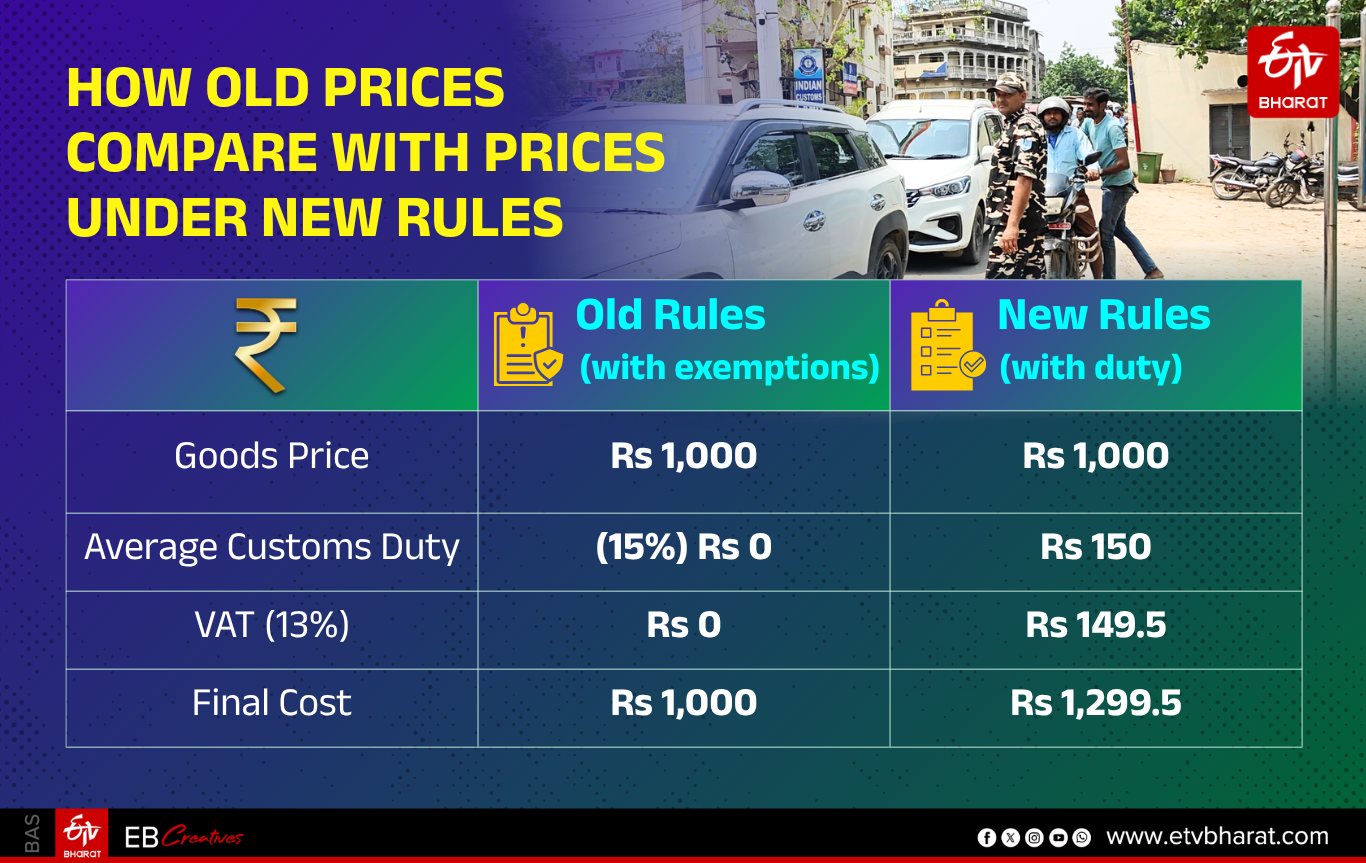
Traders across Motihari allege that the stated purpose of the Nepal government's unilateral decision — to protect local industries and increase revenue — goes against the 1950 India-Nepal trade treaty, which insists upon open trade. "We are appealing to the Central government to look into this violation of the 1950 India-Nepal treaty. If rules are not changed, there will be protests at the border. Indian goods were available for cheap in Nepal, so sales were good. If duty is imposed, and it goes up to 80 per cent, prices could double. Who will buy then?" asked a trader in Motihari.
In the northeastern corner of Bihar, similar concerns are growing among traders in Araria. Along the 28-km stretch from Jogbani to Ambari, crowds have become thinner, and frowns on the brows of traders longer.
Shopkeepers in markets along the Nepal border say most of their customers were Nepalese, who were getting goods at prices lower than in Nepal. This has now begun to hurt the livelihoods of labourers too.
All along Bihar's border with Nepal, these small traders and labourers are looking for a response from the Centre.