'Global Order Shifting Towards Multipolarity, India Must Engage All Powers': Jaishankar At Kautilya Economic Conclave
According to Jaishankar, India should avoid a black-and-white approach and deal with relationships with countries in a considered and judicious manner, writes Saurabh Shukla.

Published : October 5, 2026 at 9:16 PM IST
|Updated : October 5, 2026 at 9:23 PM IST

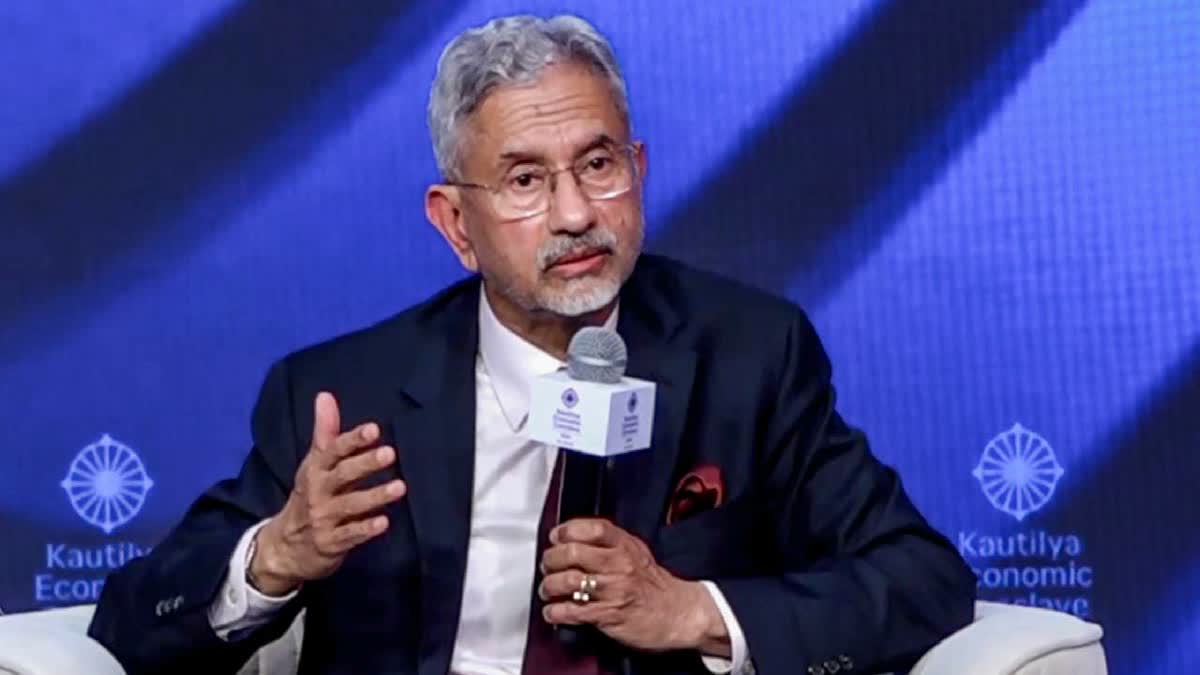
New Delhi: External Affairs Minister S Jaishankar said that India needs to engage all major powers simultaneously and stressed that progress in one relationship can help advance ties on other fronts. Speaking at the Kautilya Economic Conclave in New Delhi, Jaishankar said the US remains one of India’s principal strategic partners and described the country as India’s largest economic and trade account besides being a major critical defence partner.
India Voices Global South Concerns
He also said that India’s foreign policy is navigating an ‘age of flux’. He stressed that India should avoid a black-and-white approach and deal with each relationship in a considered and judicious manner. On changing global order, he said that the old alliance structures have loosened and the world is moving towards a multipolar system. He noted that the rise of China and other economies has created new political and strategic realities. India also has to respond to the expectations of the Global South, said Jaishankar.
Referring to his recent engagements at the UN General Assembly, he said India had highlighted issues of food, fuel, fertiliser and finance that affect many Global South countries. He added that India had increased fuel sources and fertiliser procurement during the crisis. “What I was really expressing was a larger sentiment and a larger interest of the Global South. Because the Global South does expect a country like India to go up on that stage and articulate it; somebody has to do it. And that somebody, in the eyes of many countries, is at least one of the countries like India. So, the reason why a new architecture, or as you called it, a new geometry is coming into being is that the old alliance structures have, in a way, loosened up,” he added.
Jaishankar also said that the rise of China has created new compulsions and new responses within the international system. According to him, there is already a rebalancing happening. Many other economies have risen, and rising economies naturally bring with them greater political influence.
On China, former minister of Foreign Affairs of Singapore George Yong Boon Yeo, who also spoke at the event, said China was unlikely to seek the role of a global hegemon because of its historical and social characteristics. He said India had positioned itself well among major powers and was not perceived as threatening in the same way as China. He also noted that Southeast Asian countries, Japan, Europe and the US wanted India to grow, while its large domestic market remained a major strength.
India pushes for Russia-Ukraine dialogue
On the Russia-Ukraine conflict, Jaishankar reiterated that the war was unlikely to be resolved on the battlefield and stressed that dialogue, negotiations and diplomacy remained the best pathway. He said India had consistently maintained that both Russia and Ukraine should come to the table. He also questioned the value of peace conferences on Ukraine when Russia was not present. Jaishankar said India had strongly protested to both Russia and Ukraine after attacks on civilian shipping in July resulted in the deaths and injuries of Indian sailors. Jaishankar said he personally raised the issue with the foreign ministers of both countries, with initial focus on maritime security and the safety of mariners.
Minister of External Affairs added that discussions later expanded to cargo, grain exports from the Black Sea and the possibility of facilitating grain shipments, with the issue also becoming linked to energy. Jaishankar also said that India continues to remain in touch with both sides and cautioned that there was no certainty about an outcome but said the effort was worth making.
He also stressed that any disruption to Black Sea grain exports would affect international grain markets, while disruptions to energy and fertiliser exports would disproportionately affect the Global South. Even a limited agreement between the parties, he said, would be a positive development.
On the United Nations, he said the organisation had become gridlocked and largely ineffective in dealing with major global issues. He attributed much of the problem to the deadlock in the UN Security Council, which, according to him, no longer represents the entirety of global interests. The international community needs the UN, and the objective should be to fix it rather than work around it, added Jaishankar.
Trade problems need an objective assessment
On global trade, Jaishankar said the international trading system was facing problems because substantial non-market practices had distorted the global economy. He said the conflict between market principles and non-market realities was at the heart of the current problems. He also said the global trading system cannot be addressed without the US, given its size as a major trading power and the world's biggest economy. At the same time, he rejected the idea of blaming all trade problems on the US. He said India needs to look at trade deficits in terms of market access and restrictions rather than only the size of the deficit.
India’s role in global stability
George Yong Boon Yeo argued that as US support for global institutions weakens, countries may increasingly rely on regional and plurilateral arrangements. He stressed that as global institutions come under strain, strengthening regional and plurilateral arrangements may become increasingly important. If India, China and ASEAN can find areas of cooperation, they could make a meaningful contribution to global stability.
On India’s trade strategy, Jaishankar highlighted the EU-FTA, UK-FTA, EFTA-TEPA agreements with the UAE and Oman, the proposed GCC agreement and ongoing trade negotiations with the US. He said these agreements could benefit the economy and provide a balance to India’s earlier trade arrangements.
In his closing remarks, Jaishankar said India’s foreign policy had become increasingly linked with its economic and development objectives. These include industrialisation, advanced manufacturing, a fair deal for agriculture, protection against unfair competition and wider market access, particularly in developed economies.
Read more
