IIT Bombay Researchers Bottle Summer Heat For Winter Warmth: Here's How
IIT Bombay researchers have developed a solar-powered thermochemical system using strontium bromide to store summer heat and provide cost-effective winter heating.


Published : June 24, 2025 at 2:29 PM IST

Hyderabad: Researchers from IIT Bombay have developed a novel technique that captures and stores the intense solar energy in summer to provide heat during the winter. To address seasonal heating needs, the team developed a solar-powered thermochemical heating system using strontium bromide, which would provide an environment-friendly heating system, unlike carbon-heavy machines powered by diesel.
In addition to having a thermochemical storage function, strontium bromide is also known for its high energy density, chemical stability, non-toxicity, non-explosiveness, and environmental safety, making it a suitable candidate to store heat in the form of chemical energy.
The researchers built a prototype that uses solar thermal air collectors to heat air during the summer. This hot air is then used to heat hydrated strontium bromide (hexahydrate), a chemical compound that contains water molecules within its crystal structure. When heated, the compound undergoes an endothermic dehydration reaction, absorbing the heat and releasing the water molecules. This process stores the solar energy as chemical potential in the resulting monohydrate form. In winter, when moist air is passed over this “charged” salt, a rehydration reaction occurs. This exothermic reaction reabsorbs water and releases stored heat, making it available for warming homes.
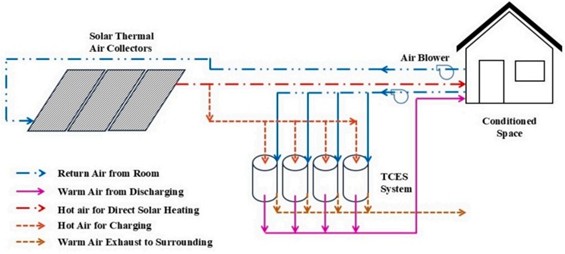
IIT Bombay researchers consider the thermochemical system a sustainable solution in Himalayan regions and have developed a portable, modular unit—about the size of two LPG cylinders—that can store up to 500 kWh of energy. It includes solar thermal collectors that heat air during summer, a reactor chamber filled with strontium bromide salt, and a small air circulation system to trigger dehydration and rehydration cycles.
The system is said to be enough to heat a small home for four months without taking up the entire room space for storage. While the upfront cost of the system is higher than diesel heaters, researchers claim that it becomes more economical over time, especially in remote regions where diesel prices are inflated due to transportation costs. Compared to diesel that costs Rs 50 to Rs 78 per unit (kWh), the Levelised Cost of Heating (LCOH) for the thermochemical system is between Rs 33 and Rs 51 per kWh.
