Atomic Tweaks, Major Impact: IISc Unlocks New Path For Drug Delivery Via Chalcogen Bonding
IISc researchers found that heavier chalcogen atoms like selenium improve cellular uptake of small molecules, offering a new strategy for drug delivery.

By Anubha Jain
Published : August 22, 2025 at 7:34 PM IST

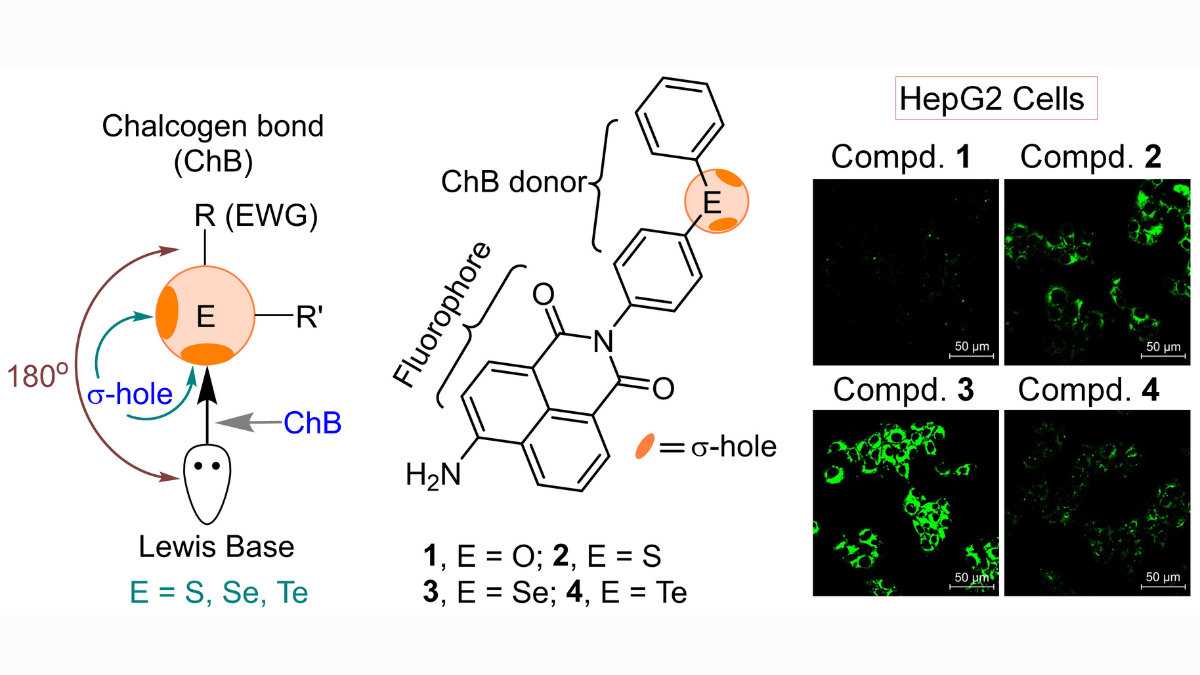
Bengaluru: A single atom change could transform how drugs enter cells. A new study by the Indian Institute of Science (IISc, Bengaluru) reveals that chalcogen bonding can help drugs slip into cells far more efficiently. Chalcogen bonding is a chemical interaction which acts as a special kind of attraction between elements of group 16 of the periodic table—oxygen, sulfur, selenium, and tellurium—and other molecules. This subtle force is important in many chemical and biological processes, such as how enzymes work or how proteins maintain their shape.
This research study, published recently in the journal Angewandte Chemie, demonstrates how a single atom change can impact the transport of small molecules across the plasma membrane. Chalcogens like Selenium participate in non-covalent interactions, meaning it does not form strong chemical or covalent bonds with cellular proteins known as receptors, but instead engage through weaker, non-covalent forces. When chalcogens participate in such non-covalent interactions, it is called a chalcogen bond.
Chalcogen bonding, though understudied in biology, was explored by the IISc team to improve how small molecules enter cells. In a conversation with ETV Bharat, the lead author of the study, G Mugesh at IISc, described the entire research work.
Research methodology
He said they tested fluorescent compounds with different chalcogen atoms to see if chalcogen bonding could help small molecules enter cells more easily. They found that molecules with heavier chalcogens—like selenium and tellurium—were absorbed far more efficiently, as these elements form stronger chalcogen bonds. The glow from the fluorophore inside cells showed how much of the compound was taken up.
This shows that a compound’s ability to have such non-covalent contacts with the cell surface can play a key role in uptake, offering a new way to boost drug delivery.
Implications of the research
Normally, only very small molecules like oxygen, carbon dioxide, or water diffuse freely across the plasma membrane, while larger ones require specific transporters, such as those used by thyroid hormones. By strategically choosing atoms like selenium or tellurium, researchers can design molecules that cross membranes more effectively and are more easily absorbed by cells.
This strategy could have wide applications, including:
- Drug delivery – helping medicines enter cells efficiently
- Biological research –developing new fluorescent probes to track biomolecules
- Targeted treatments – improving how therapies reach specific cells, such as cancer cells
He explained that the primary concern while developing a drug for specific diseases is whether it can enter the cells. A drug will only work if it enters, since cellular functions are central and need to be modified. However, cells have strict regulatory mechanisms, and a major challenge in drug discovery is that most compounds are unable to cross the plasma membrane, which acts as a protective shield against both small and large molecules. Any strategy that can enhance cellular uptake is therefore crucial for developing drugs for various diseases. Cells also have mechanisms to exclude toxic compounds, he added.
Why selenium
Mugesh further said that the strategy was to use a selenium atom. Selenium is an essential trace element, meaning the body needs it in very small amounts for proper functioning. It is a rare element in biological systems, but certain enzymes called selenoenzymes contain it in their active sites. Selenium occurs in the form of the amino acid selenocysteine, which is considered the 21st amino acid.
He said, “While the biological systems have recognised the importance of selenium for many crucial functions, the use of such an element for boosting the cellular uptake was unknown. A simple atomic modification led to a remarkable improvement in cellular uptake. We have investigated the differences among oxygen, sulfur, and selenium and found that selenium, being a heavier atom, interacts more favorably with the plasma membrane compared to oxygen or sulfur. These favourable interactions allow selenium-containing compounds to enter cells much more efficiently than those with lighter elements.”
Drugs with chalcogen bonding to improve cellular uptake
On being asked if the chalcogen bonding strategy could be applied to existing drugs to improve their delivery into cells, he said that if cellular uptake can be increased by 5- to 10-times by introducing chalcogen bond-forming ability into the existing drugs, much lower drug doses would be required, drastically reducing the overall amount used. "This can also reduce the toxicity as the amount of drugs that we take has decreased," he added.
While discussing whether the findings are consistent across different cell types and if the approach could be adapted for targeted delivery to cancer cells, Mugesh said that the findings are consistent across different cell types. "However, we don’t yet have a compound that specifically targets cancer cells. Most of our studies used cancer cells, but we haven’t compared uptake between cancer and normal cells. Our aim in this study was not to develop anti-cancer agents, but to create a strategy to improve cellular uptake of small molecules," he added.
Broader implications
Talking about the method being useful in crossing other biological barriers, like the blood-brain barrier, Mugesh said that they didn't test that. "It's not known whether such non-covalent interactions play a role in crossing the blood–brain barrier. If selenium compounds interact favorably with it, uptake could be enhanced."
Commenting on whether chalcogen bonding can be harnessed in other fields, such as diagnostics or gene delivery, Mugesh explained that when a small-molecule drug targets a protein, it usually binds at the enzyme’s active site. Facilitating such non-covalent interactions—such as chalcogen bonding—could help design more efficient enzyme inhibitors (Substances that slow down or block the activity of enzymes or other proteins, preventing them from carrying out their normal function). Many of these inhibitors are emerging as potential therapeutic agents and may be developed for clinical applications.
Safety considerations
When asked whether any toxicity or side effects were observed with tellurium- or selenium-based compounds in cells, the professor explained that they were not toxic to the cells at lower concentrations, although tellurium compounds are generally more toxic than sulfur or selenium compounds.
Future directions
The professor added that the next step is to strategically introduce heavier chalcogens into different drug molecules without affecting their therapeutic effect. This needs to be tested across various drugs, studying their uptake in different cells and evaluating their efficiency in vivo systems, which refers to research or experiments conducted within a living organism.
Mugesh said, “If this works with existing therapeutics and significantly improves their effect, then this strategy could be applied for clinical use or pharmaceutical development."
"This is the first study to use heavier chalcogen atoms to improve cellular uptake. The team hopes the scientific community will take an interest in this approach, especially since many compounds and larger peptides struggle to enter cells," he added. "As many therapeutics are protein- and peptide-based, researchers often attach cell-penetrating peptides to improve their cell permeability—but these have their own drawbacks."
The study offers a new strategy to boost the effectiveness of drugs or other useful compounds by taking advantage of natural cell processes and smart chemical design. Mugesh said that the current challenge is to determine whether introducing a heavier chalcogen atom into a peptide or protein could similarly enhance their cellular uptake.