Back To School | Cracking The Code Of Lightning & Thunderstorms: Facts We Hold, Forecasts We Can't Make
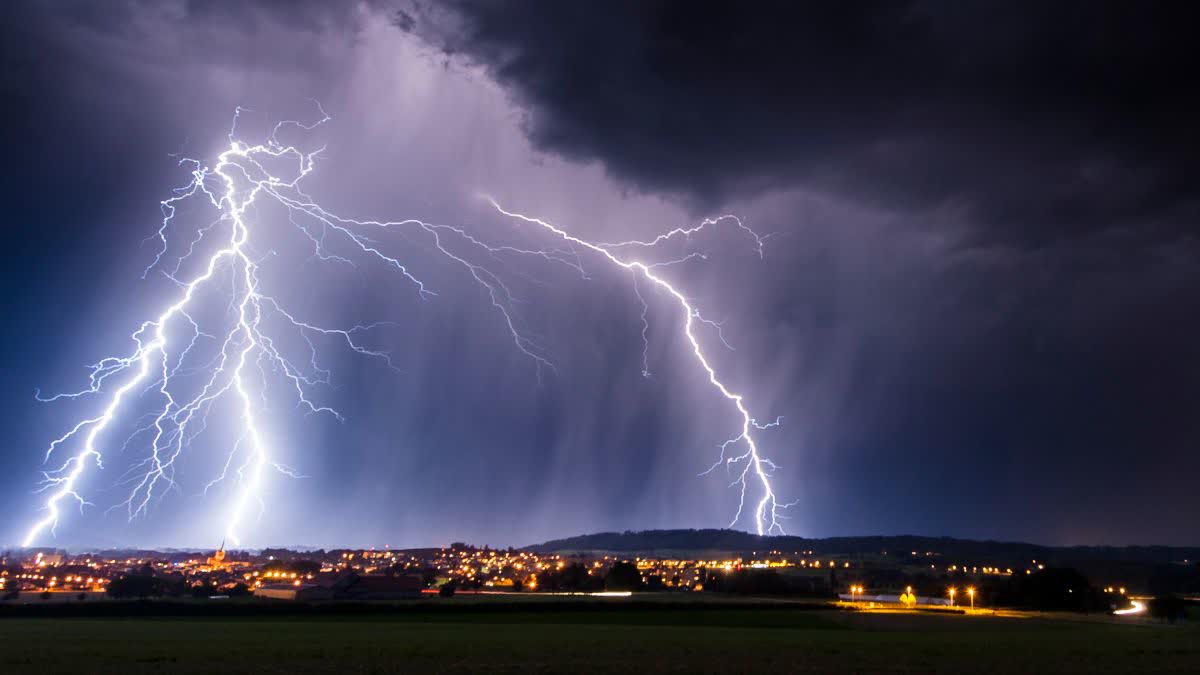
Lightning is inherently unpredictable. It's impossible to forecast exactly where and when a single strike will occur, says a scientist at the Meteorological Centre.

By Anubha Jain
Published : October 1, 2025 at 5:18 PM IST

Bengaluru: Lightning is a sudden, natural phenomenon involving a gigantic high-voltage discharge of electricity within a storm cloud, between clouds, or between a cloud and the ground. It occurs naturally in the atmosphere during thunderstorms, volcanic eruptions, and other high-energy events when opposite charges build up inside a cloud. Light, positively charged ice crystals are carried to the top of the cloud, while heavier, negatively charged particles stay near the bottom. This charge separation creates a strong electric field. When the field becomes too strong for the air to resist, electricity jumps between the charged areas (or between cloud and ground), producing the bright flash we see as lightning.
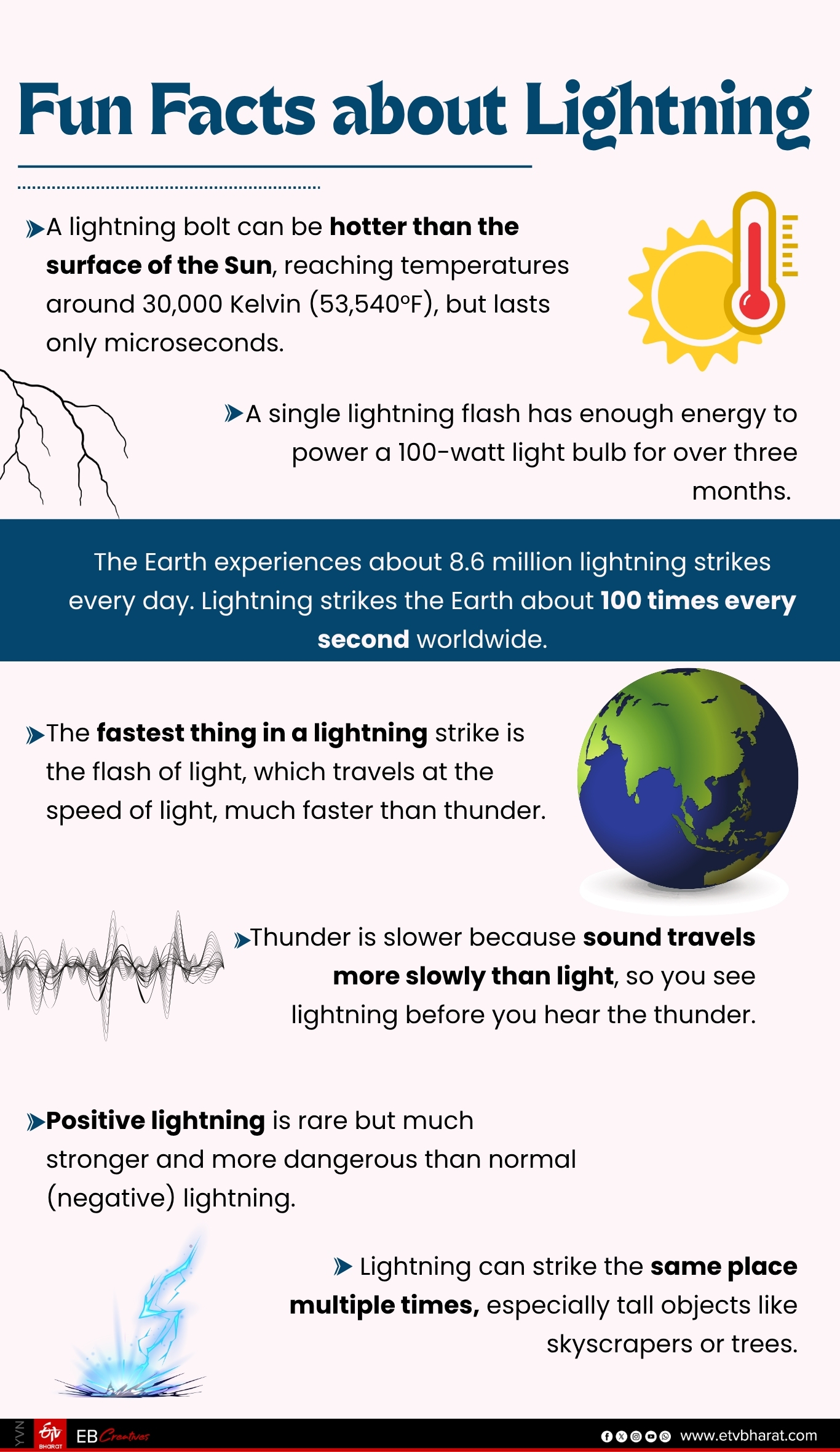
A single stroke of lightning can heat the air around it to 30,000°C (54,000°F). The intense heat produced by the discharge causes the surrounding air to expand explosively, generating a shock wave that we hear as thunder. Thunder and lightning occur at roughly the same time, although we see the flash of lightning before we hear the thunder. This is because light travels much faster than sound.
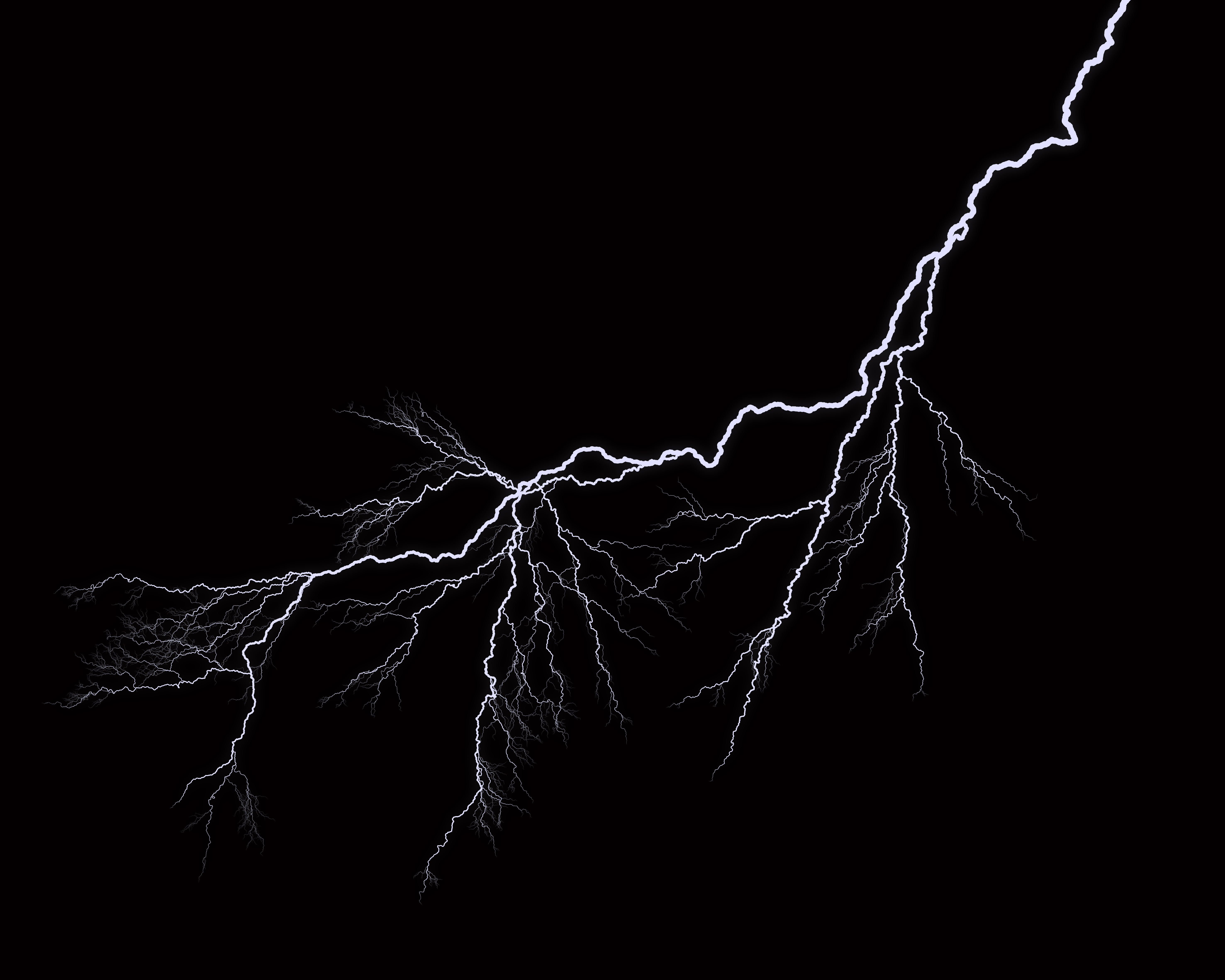
According to the National Severe Storms Laboratory, lightning can occur between opposite charges within the thunderstorm cloud (intra-cloud lightning) or between opposite charges in the cloud and on the ground (cloud-to-ground lightning).
Types of lightning
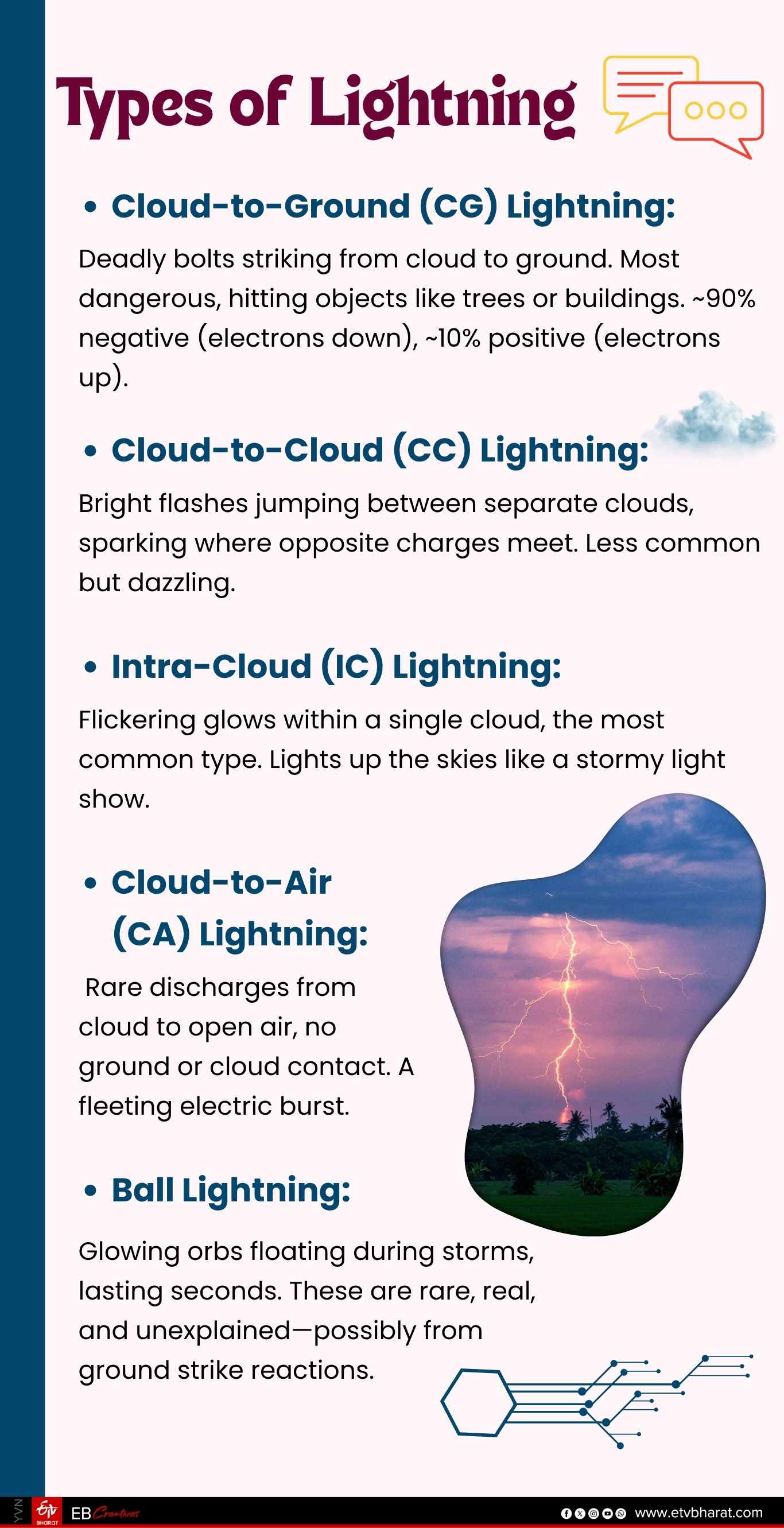
Cloud-to-ground (CG) lightning is an electrical discharge between a thundercloud and the ground, terminating on a physical object and measurable by ground instruments. Of the three main lightning types, CG lightning poses the greatest danger to life as it directly strikes the ground. It can be negative or positive, depending on the direction of current flow. Most strikes are negative, with electrons moving downward and conventional current upward. In positive CG flashes—the rarer kind, accounting for 5-10 per cent of strikes—electrons flow upward while positive charge moves downward to the ground.
Cloud-to-cloud (CC) and intra-cloud (IC) lightning discharges can also occur within or between clouds without contacting the ground. Sometimes seen as a bright flash stretching from one cloud to another. When the discharge happens between two separate clouds, it is called cloud-to-cloud (CC) or inter-cloud lightning. When it takes place between regions of differing electric potential within a single cloud, it is known as intra-cloud (IC) lightning. IC lightning is the most common type of lightning and often appears as bright flickers within a cloud.
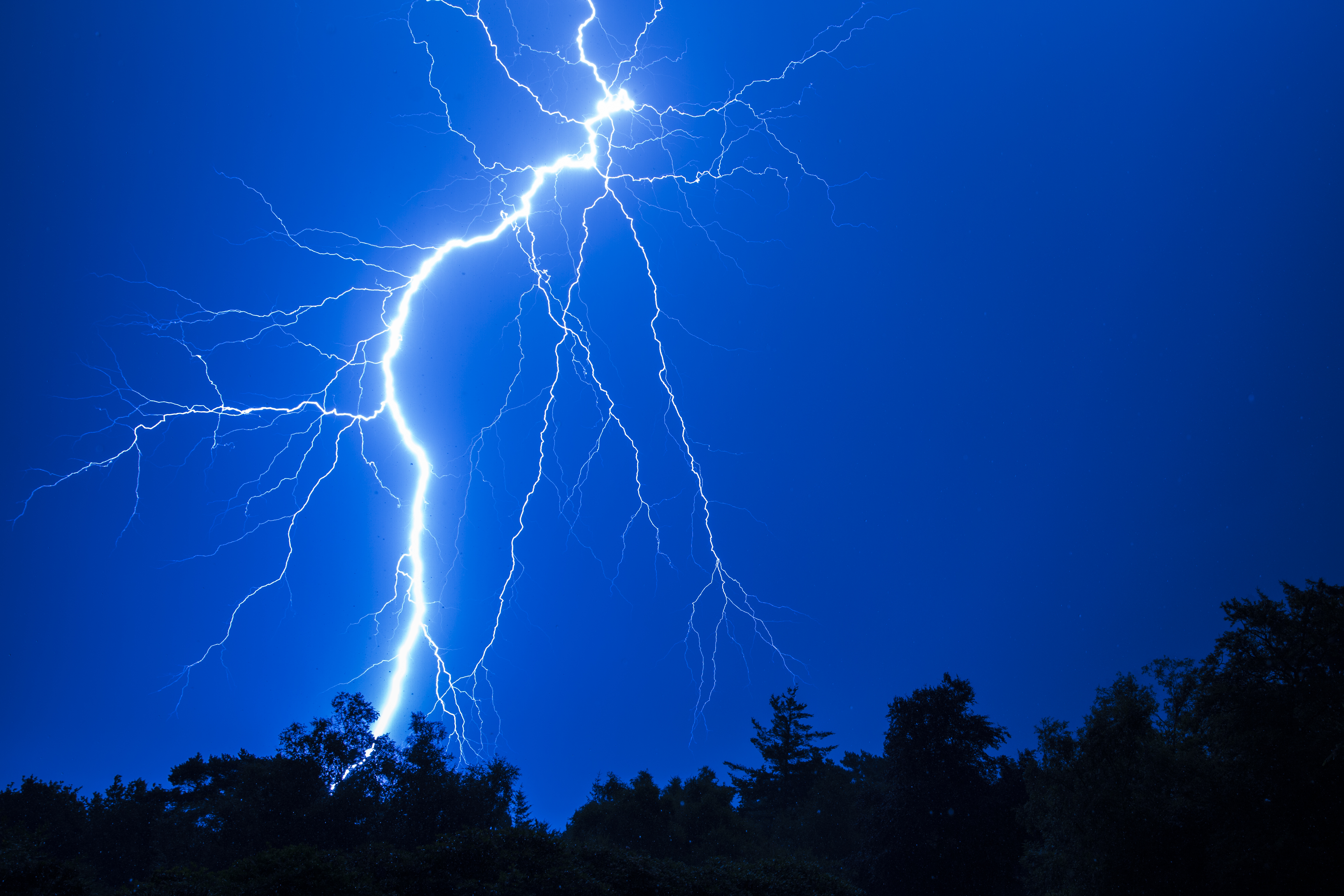
Cloud-to-Air (CA) lightning is a discharge from a cloud to the surrounding air where opposite charge exists, but no other cloud or ground contact is made.
Ball lightning is an unusual and poorly understood form of lightning that can occur during thunderstorms, according to UCAR, Centre for Science Education. Also called globe lightning, it appears as a small, glowing, floating sphere that may last for several seconds. Although rare, it has been observed often enough for scientists to consider it a real phenomenon. One leading theory is that it may result from a cloud-to-ground lightning strike triggering a chemical reaction between oxygen in the air and elements in the ground.
When asked what makes lightning strike, Professor Arun Mangalam from the Indian Institute of Astrophysics (IIA), Bengaluru, said, “Traditionally, lightning is explained as the result of static charge separation within a thundercloud. Collisions between water droplets and ice crystals create positive and negative regions. When the voltage difference becomes large enough—around 3 kV per millimetre under standard conditions— the insulating property of air breaks down and a lightning bolt is discharged.”
How thunderstorms form
Professor Mangalam explained that when sparks connect oppositely charged regions, the surrounding air heats and expands rapidly, then cools and contracts. This sudden change produces the shock wave we hear as thunder. Lightning can reach temperatures of about 30,000 K, and thunder travels roughly at the speed of sound—343 m/s at 20 °C—illustrating the immense power involved.
Thunderstorms usually develop in three stages: the developing stage, the mature stage, and the dissipating stage.
1. Developing Stage: Warm, moist air rises from the ground, forming cumulus clouds. The air can be pushed upward by mountains, weather fronts, or simply because warm air is lighter than cool air. As the air rises, water vapour condenses into droplets, and the cloud continues to grow.
2. Mature Stage: The cloud grows larger and darker as droplets get heavier. Rain begins to fall when rising air can no longer hold the droplets. Downdrafts of cool air bring rain down while updrafts push air upward, creating a cumulonimbus cloud. Air moving inside the cloud generates electric charges, producing lightning and thunder.
3. Dissipating Stage: When downdrafts overpower updrafts, the storm weakens. Rising warm air slows, cloud droplets stop forming, and the storm fades, often leaving light rain. A typical thunderstorm lasts about an hour, while severe storms like supercells can last for several hours.
Why pinpoint prediction is impossible
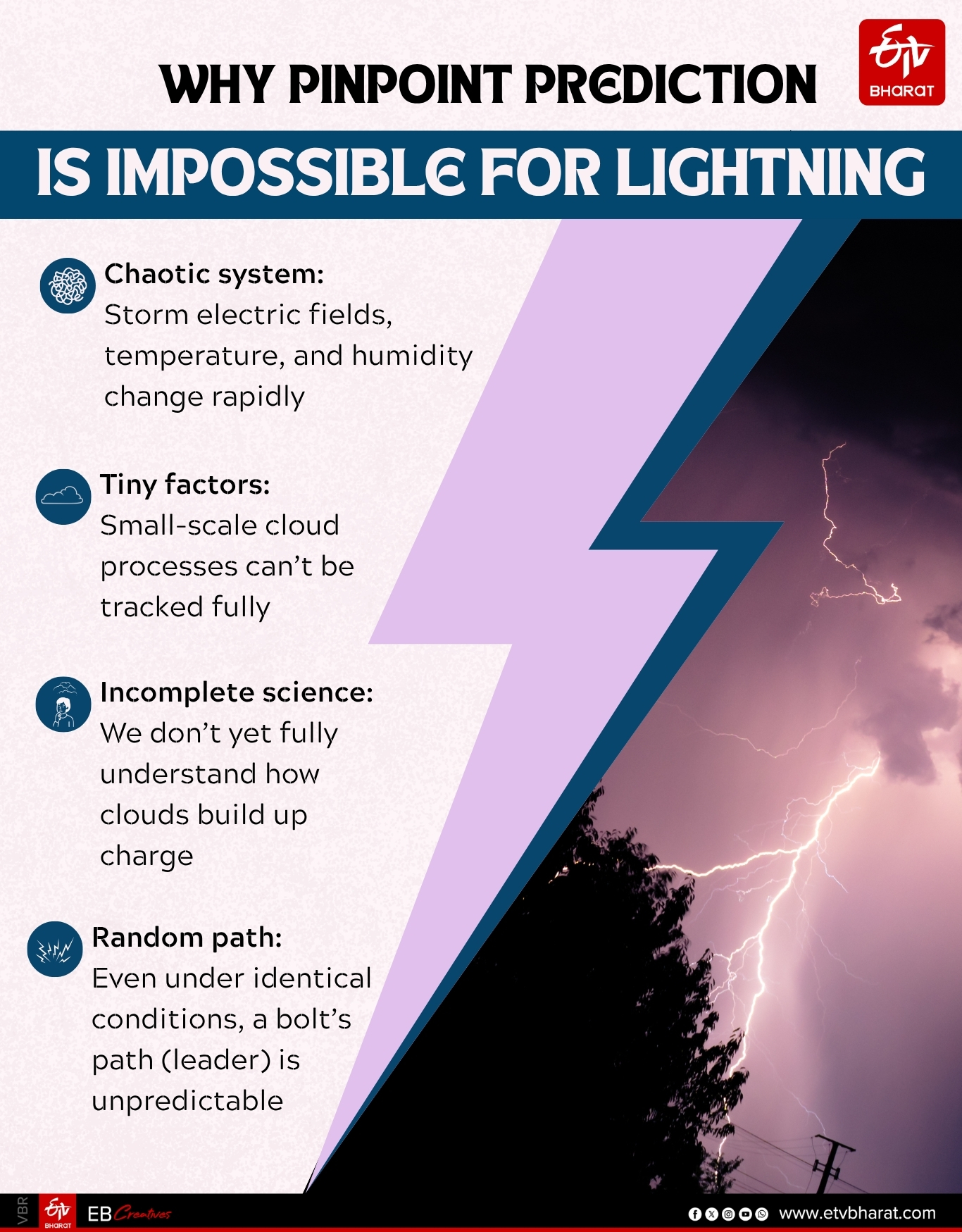
Lightning is inherently unpredictable. “It’s impossible to forecast exactly where and when a single strike will occur,” says Latha Sridhar, Scientist-D at the Meteorological Centre, Bengaluru. Several factors contribute to this challenge. Storm electric fields, temperature, and humidity change rapidly, making the system chaotic. Small-scale cloud processes are too tiny to be fully tracked. Scientific understanding is still incomplete as we don’t yet fully grasp how clouds build up electrical charge. Even under identical conditions, the path a lightning bolt takes remains random and unpredictable.
Instead of precise forecasts, technology estimates the probability of lightning in a given area. Ground networks use sensors to detect radio waves emitted by lightning strikes and can locate them within approximately 100 meters. Satellites are equipped with instruments that spot lightning flashes from space and monitor the growth of storms. Machine learning models analyse satellite and weather data to provide short-term forecasts, typically up to one hour in advance.
Latha Sridhar further said that for practical safety, it’s crucial to distinguish between lightning detection and prediction. Describing lightning detection and prediction, she said, lightning detection provides real-time data on where strikes are happening now; it’s robust and underpins reliable public alert systems. Lightning prediction attempts to forecast future strikes by sensing ambient electric fields, but it’s prone to inaccuracies and false alarms from rain, static electricity, and other interference.
Did you know?
Until the late 18th century, it was believed that ringing church bells could repel lightning. During storms, bell ringers would climb towers to ring the bells—ironically, the tall towers with metal bells were extremely dangerous. Between 1753 and 1786 in France, 103 bell ringers were killed by lightning, leading to the practice being banned.
Lake Maracaibo in Venezuela is known as the world's lightning capital, sometimes experiencing numerous storms with intense lightning each year.
Recent research from the Met Office revealed that helicopters can cause an isolated lightning strike. While flying, the helicopter acquires a negative charge, so if it flies close to an area that is positively charged, it can trigger a lightning strike.
The United States sees about 25 million lightning flashes each year—each one a potential killer. Although fatalities have declined over the past three decades, lightning remains one of the nation’s deadliest weather hazards, injuring far more people than it kills and often causing lasting health problems.