Women Labelled As 'Dayan' Narrate Chilling Tales: How Witch-Hunting Continues To Plague Bihar's Most Vulnerable
Believe it or not, a 2023 survey reveals that around 70,000 to 80,000 women in Bihar were facing torture after being labelled as witches.

By Dev Raj
Published : September 16, 2025 at 5:50 PM IST
|Updated : September 17, 2025 at 10:04 AM IST

Patna: Veena Devi of Rohua village under Sonbarsa block in Sitamarhi district of Bihar was branded a ‘dayan’ (a woman believed to possess evil magical powers or a witch) after her husband died around a decade ago. The villagers heaped abuse on her, and to top it, her children also shunned her.
Today, in her 60s, the Mahadalit (the most downtrodden among the Dalits) lives in a makeshift shanty beside a government school and survives on the free ration provided by the public distribution system (PDS) and is helped by a couple of civil society organisations.
"I still do not get any work in the village as people do not want to hire me. Sometimes it isn't easy to get food. No public representative, including the mukhiya (panchayat head), helped me," Veena said.
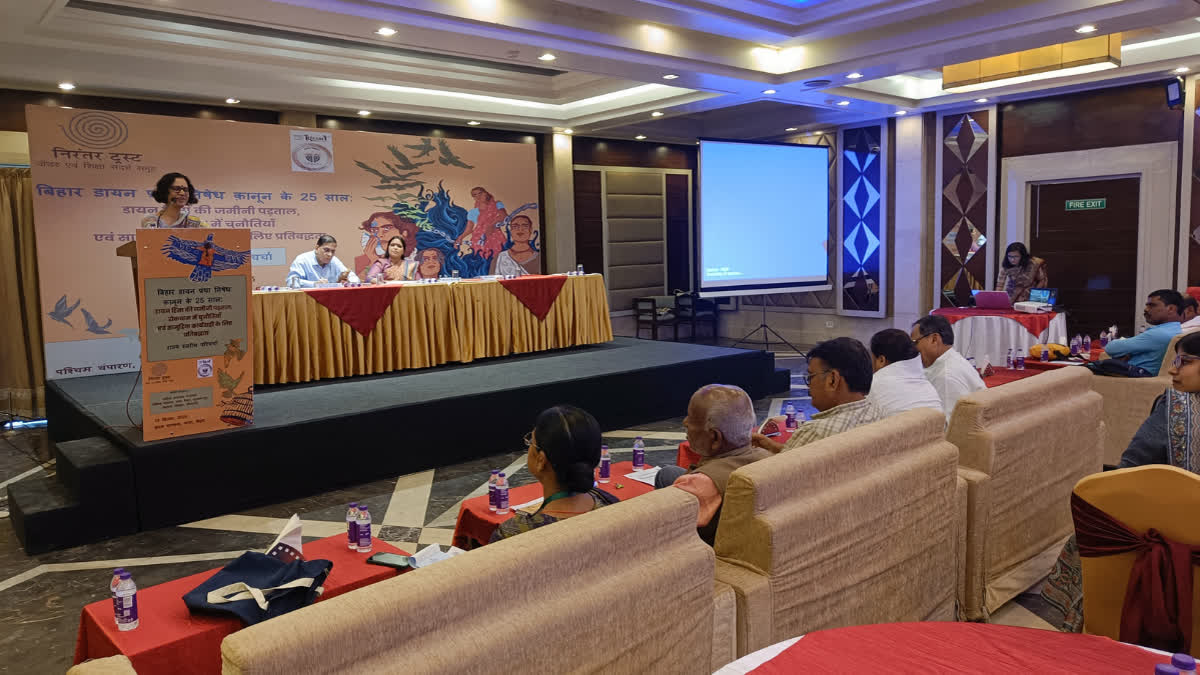
She was among the victims of witch-hunting, who narrated their experiences at a state-level consultation organised by the Nirantar Trust, Gender Resource Centre of the Chanakya National Law University (CNLU), and other organisations in the state capital on Tuesday.
It was organised to assess the impact of ‘The Bihar Prevention of Witch (Daain) Practices Act, 1999’ in curbing witch-hunt violence, and advancing collective action in this regard. Bihar was the first state in the country to pass such a law. Other states emulated it in the coming years.
Another woman, Savitri Munda, had come from Kochbong village of Namkum block in Jharkhand and presented the ordeal faced by her family at the hands of her distant relatives after a few deaths in their families.
“They first labelled my father-in-law a witch and tortured and insulted him for years. He was made to spend a large amount of money on rituals. After he passed away, I was branded a witch, tortured and asked to undertake rituals, which would have cost over Rs 1.20 lakh,” Savitri said.
The lean but gutsy woman decided to fight. She approached the police station, but the men in khaki refused to protect her. She somehow managed to get in touch with a civil society organisation that guided her.
“I am still fighting and continue doing so. I got help and survived; otherwise, I do not know where I would have been,” she said with a choked voice in front of a large number of delegates.
Take a look at the numbers first. Over 170 women were branded as ‘dayan’ (witch) in Bihar this year so far and faced various forms of violence, including murder, thrashing, physical torture, disrobing, and being forced to eat human excreta or drink urine.
The figure includes five members of a family being burnt alive in Purnea district in July, and a murderous attack on a couple in Nawada district in July, in which the husband was killed while his wife was seriously injured.
The Bihar Police pegged the incidents of violence against women in the name of witchcraft at 621 in 2024 and 629 in 2023 in the state.
A survey done by a civil society organisation, Nirantar Trust, which works in the field of women empowerment and against witch-hunting, in 2023, revealed that around 70,000 to 80,000 women in Bihar were facing torture after being labelled as witches. A majority of them hailed from the Dalit, tribal and deprived sections of the society.
CNLU vice-chancellor Faizan Mustafa related the problem to gender issues and traced its origin to religions, their myths and traditions in which women were shown to be inferior to men, and having been brought to the world to serve them.
“Men have done such atrocities on women that their forgiveness is impossible. We are aiming to become ‘Vishwa Guru’ (Preceptor of the world) by 2047. We are a 5 trillion-dollar economy and a power in the world, but there are 73 incidents of crime across the country every hour,” Mustafa said.
“Around 20 women face dowry-related violence daily in the country, and 15 women face domestic violence every hour. There are 217 cases of kidnapping of women and 86 rapes every day. We should feel ashamed over this. We seek blessings from Durga, Saraswati, and Lakshmi, but cannot give equal status to women,” he added.
The CNLU vice-chancellor asserted that making the law is good and the easier part, but it is a weak component of social change.
“How does the law work on the ground is the main thing to be considered. If a woman’s husband or son dies, people say that she has devoured them. Progress is not just GDP growth if our society is not changing. India cannot become a developed country until it aspires as the Scandinavian countries (in matters of gender equality). Only equality before law is of no use if there is no equality in the society,” the vice-chancellor added.
Pointing out that atrocities and sexual violence against women were being done across the world, and even the number of women among the CEOs of top companies in the US was much less, Mustafa asserted that it was going to be a long fight and “women should march together with confidence and sensitise men.”
Several women who have faced atrocities in the name of witch-hunting narrated their experiences on the occasion and how they managed to survive.
Speaking on the occasion, State Commission for Women, Bihar chairperson and professor Apsara (goes by one name) narrated her own experience in which one of her grandmothers-in-law, who was childless, was considered a witch.
“Not having children, becoming a widow, and staying unmarried are some of the reasons over which women are labelled as a witch. Such incidents are more prevalent in rural areas in comparison to urban areas due to the lack of education,” Apsara said and professed support of the commission in the campaign against witch-hunting.
Nirantar’s director, Archana Dwivedi, added that the impact of the laws prohibiting witch-hunting was less because the opinions and views of society do not change easily, and her organisation was working to change the perception of males towards women and witch-hunting. She added that the road ahead was a tough one despite unparalleled growth in women's empowerment.
Bihar Scheduled Caste Commission chairperson Dhananjay Kumar also said that the institution will provide full support in the fight against witch-hunting practices.
Several social and women activists, advocates, police officials and other participants also presented their views. Santosh Sharma of Nirantar, who convened and facilitated the event, stressed the need for a concerted effort from different sections of society and the government to check witch-hunting.
Also Read