Love Knows No Boundaries | Review Of Lōal Kashmir: Love and Longing In A Torn Land By Mehak Jamal
What does it mean to love someone in the times of communication clampdown and uncertainty? Mehak Jamal explores this aspect in her debut book.

Published : August 3, 2025 at 10:15 AM IST

After the 7 October 2023 attack, as Israel started bombing Palestine relentlessly, Laila and Mehdi’s home, like thousands, was also destroyed. They lost at least thirty members of their extended family, with many others injured and displaced.
Laila (Kashmiri woman) and Mehdi (Palestinian man), as Mehak Jamal writes in her book, Lōal Kashmir: Love and Longing In A Torn Land were forced to leave Palestine. However, like their love, they are surviving with resilience.
As early as 1990, when the political unrest started in Kashmir, Laila moved to Delhi to study, where she met Mehdi during her college days. They fell in love and eventually got married.
She felt a keen sense of kinship with the Palestinian people and the land. Their resilience gave her strength to survive, writes Mehak, in the chapter, Kashmir in Gaza. However, her family in Kashmir were not happy with her decision. There still remains some bitterness that she married a Palestinian.
Lōal Kashmir, a collection of real stories of love and longing spanning more than three decades from the valley, is the new addition to the literature from Kashmir that captures everyday life in a region that has witnessed decades of conflict.
The book seeks to answer the question: What happens when you cannot communicate your longing to your beloved?
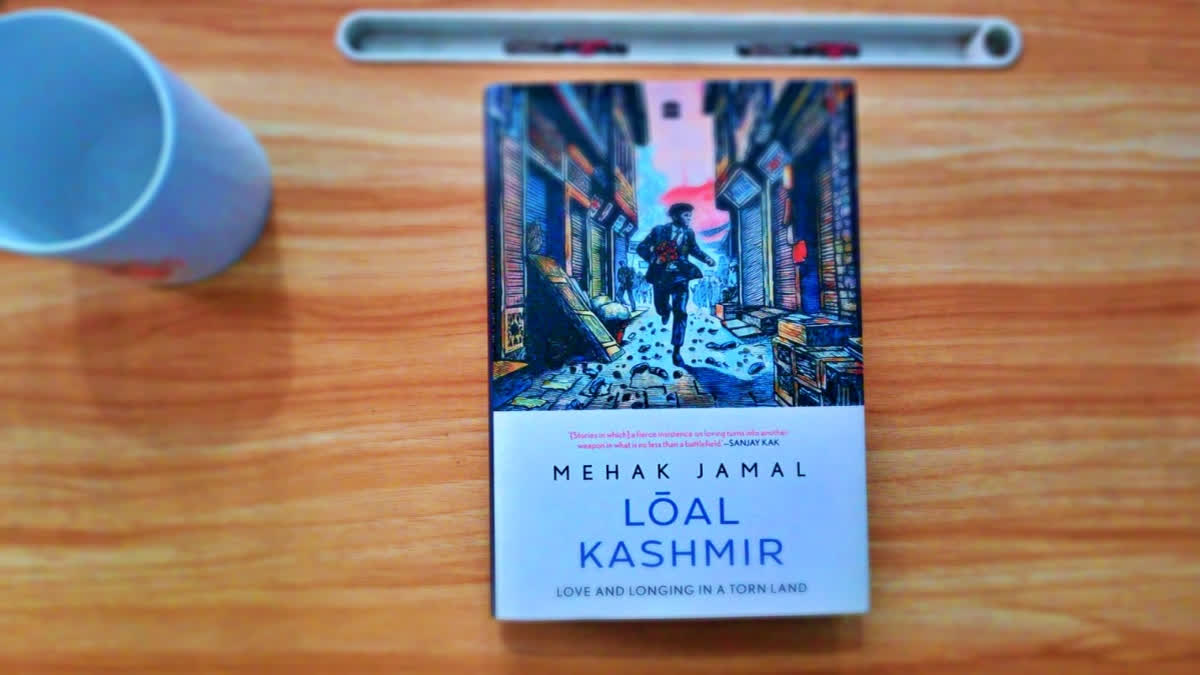
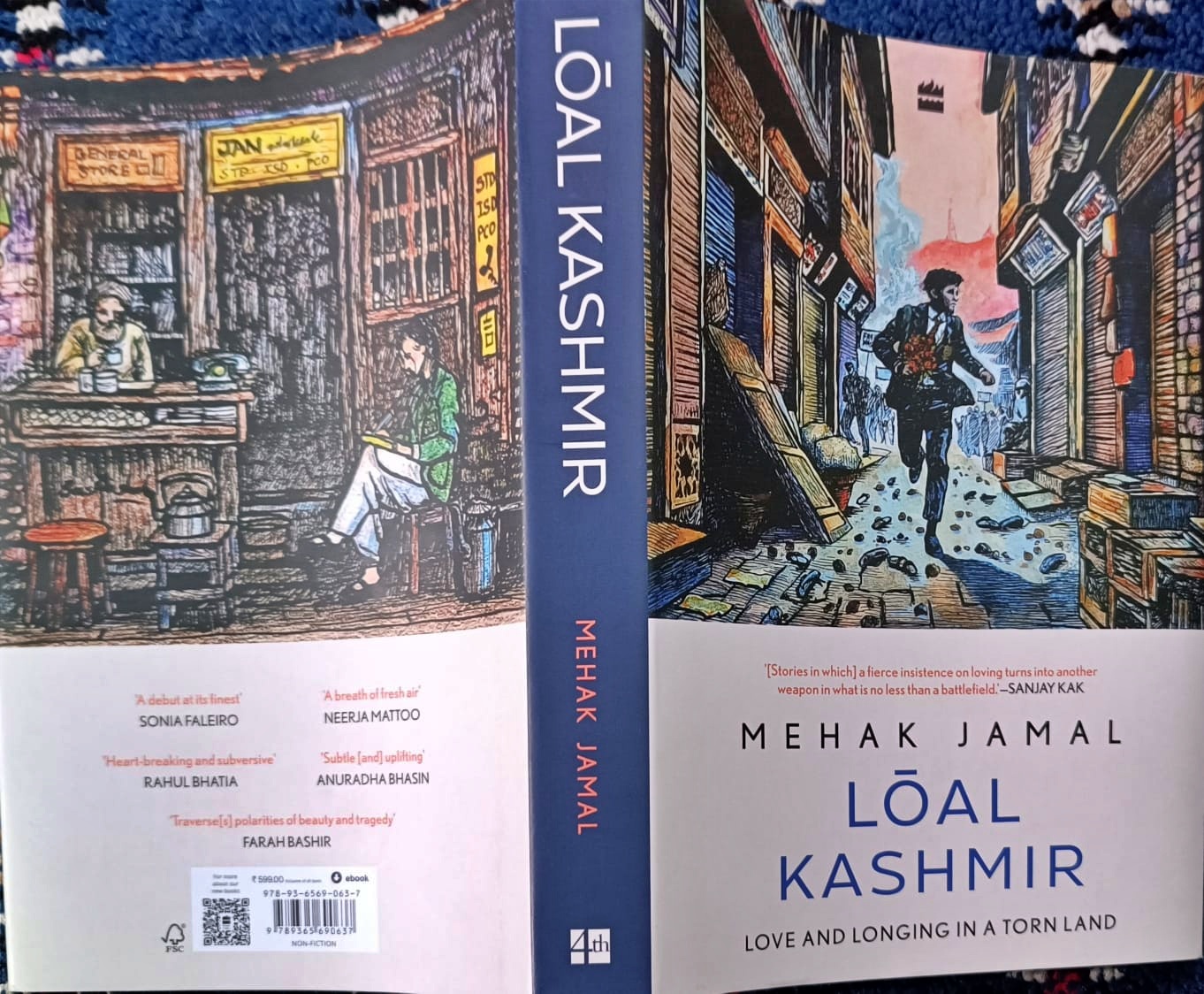
When one opens Lōal Kashmir, the attention-grabbing cover, designed by Basita Shah, tells its own story. As faint blood seems to drape the sky, as protestors hold placards, a tense boy with a bouquet in hand is running amidst a shuttered market through an alley littered with stones as his eyes search for someone.
Who doesn’t want to love and feel loved back by someone in the universe?
Lōal is the Kashmiri word for love and affection. Mehak Jamal’s compendium Lōal Kashmir is stratified into three chambers of timelines from the heart of lovers: Otru (day before yesterday), Rath (Yesterday), and Az (Today).
Mehak, a filmmaker and writer born and raised in Srinagar, focuses her lens towards Kashmir. has knitted different generations of Kashmiris who have witnessed different political events in their teenage years and negotiated, rescued, survived, found and lost their love amidst challenges. But the questions remain: Is it difficult to love in Kashmir, where uncertainty is the only certainty? When love and conflict crisscross, what happens?
Even though there are a plethora of books about Kashmir and its history, Mehak's storytelling is an attempt to fill the void of the invisible lived experiences of lovers. Her stories infuse a fresh departure as she foregrounds the human experiences. These common human experiences are also mentally agonising and shaped by the political, social and religious dogmas.
The love stories are wedged between political uncertainties and personal agonies. Unlike parachuted narrators, Mehak belongs to Kashmir and understands the place and its people. Her personal experiences intertwine with these intimate, authentic and on-ground stories. They create a new pattern of narrative about Kashmir: there is love, longing and resilience and a desire to communicate, especially when the place is blindfolded and shut off from itself and the world.
Even when painfully cultivated hopes are callously snuffed out, the heart of hope continues to beat. It is Mehak who has put her ears to the beats of hearts beating beneath conflict-torn lives to bring out real-life accounts.
The book is woven with tapestries of diverse stories reflecting dynamic socio-demographic profiles across decades. As stories span decades, they are not confined to one religion, culture, caste, sexual orientation, or gender. These diverse stories create multiple perspectives while surmounting their love and longing.
The idea, according to her, for the book came during the communication clampdown following the abrogation of Articles 370 and 35A in August 2019. Unprecedented as it was at least for the new digital-dependent generation, it is during that time she learnt how Kashmiris reached out to each other.
The book’s timeline deals with love communicated via letters, as was the norm before the arrival of the internet and digital devices. The political uncertainty forced many to use traditional methods of communication.
There are stories of forbidden love dealing with diverse subjects, including interfaith relations and sexual orientation. Similarly, there are stories which got snuffed due to societal caveats but survived while fulfilling the criteria of familial and societal norms.
@mehakjamal describes Loal Kashmir as unfolding in three passages—not just to mark the passage of time, but to reflect the enduring uncertainty in the Valley, and how love seeks expression within it.
— HarperCollins (@HarperCollinsIN) July 28, 2025
From delayed reunions and stolen moments to silent searches behind windows,… pic.twitter.com/goRXwp0FdI
There is a love story that brewed between two teenagers, Sagar, a Pandit boy of the 90s and Aalmeen, a Muslim girl. It is relatable to any teenager or lover in retrospect. There is a story of Laila and Mahdi, who carry the baggage of the history of their land as they fall in love.
The story is laced with an aversion to cross-cultural marriage. Some do not just face communication clampdown, but physical, bureaucratic barriers. Other stories are common love stories where the family pressures and societal expectations to be ‘marriage material’ separate them or join them. There are stories of long-distance relationships, especially enforced by political uncertainties across countries and challenged by communication clampdowns.
The book also has a story of displaced Bushra, who comes from the part of Kashmir on the other side of the border. Her story is a reflection of how politics, history, deception and abandonment shatter the lives of common people and create the agonies of displacement. However, there are also stories which induce hope. They survive amidst surmounting challenges of enforced separation. The love stories transcend gender and sexual orientation as they voice the struggle of people.
As two characters, Nadiya and Shahid got married after facing the hurdles of communication clampdown, recalling their line in the last chapter of the book, Agli hartal, wo sab ka nahi pata. Lekin agli hartal se pehle tujhe le jaa raha hoon main.
Besides love stories running in the foreground, the political uncertainties dictating everyday life keep chugging the narrative of love stories in Kashmir. Mostly in other places, lovers are separated by families to societies, but in Kashmir, the challenges of lovers are different.
Besides communication restrictions, there are physical lockdowns. Amidst the societal expectations of different genders, there is a curfew, surveillance, indefinite communication and physical clampdown which lead to mental health deterioration.
As love and memory are the unifying forces, the stories offer a glimpse into different textures of emotions. As the author has chronologically woven the narrative, it lends a holistic understanding of the different phases of unrest in Kashmir and its changing societal and political contours and modes of communication.
The anthology explores one of the aspects of life in Kashmir, but does not and cannot summarise the other lived experiences which have left deeper scars. These tales cannot be conflated as the ultimate reality and create illusions of normalcy.
Amid prolonged separations, the stories reflect human endurance. The prose is natural. The author has frequently interspersed the English text with Kashmiri words to lend the story a reflection of Kashmiri life and language and create a sense of belonging and understanding.
The book closes with nostalgic symbols of Kashmiri life, like the STD/ISD booth, which Gen Z may have never come across, as it brings nostalgia and reflects a calm life contrary to the chaos on the cover.
Mehak Jamal has woven stories that are personal as well as political. During uncertain times, she brings to the fore the role of rumours and how they are perceived in the public imagination, how communication clampdown changed the rituals surrounding marriages, and how everyday life changed in Kashmir.
Sometimes, like everyday life in lockdown, the chapters felt banal. Even though the book is focused on different love stories, in the larger context of a place like Kashmir, they seem superficial, with characters obsessed and self-centred about their love.
The book, however, can reshape the perception of non-Kashmiri audiences. It can make them understand that people can live without phones and the internet, even in this century, even in this country. The book can convey to the world that even Kashmiris have a heart, the heart that is shattered but has a lot of Lōal in it.
Lōal Kashmir: Love and Longing in a Torn Land
Author: Mehak Jamal
Publisher: HarperCollins India
Pages: 364
Price: Rs 599
(Disclaimer: The opinions expressed in this article are those of the writer. The facts and opinions expressed here do not reflect the views of ETV Bharat)