Theaterisation Of India's Defence Forces? Why It Matters, Why It Is Hard, And What Comes Next
Theaterisation means integrating the command structure of the three forces to optimise decision-making and resource utilisation during future wars and operations

Published : September 3, 2025 at 11:11 AM IST

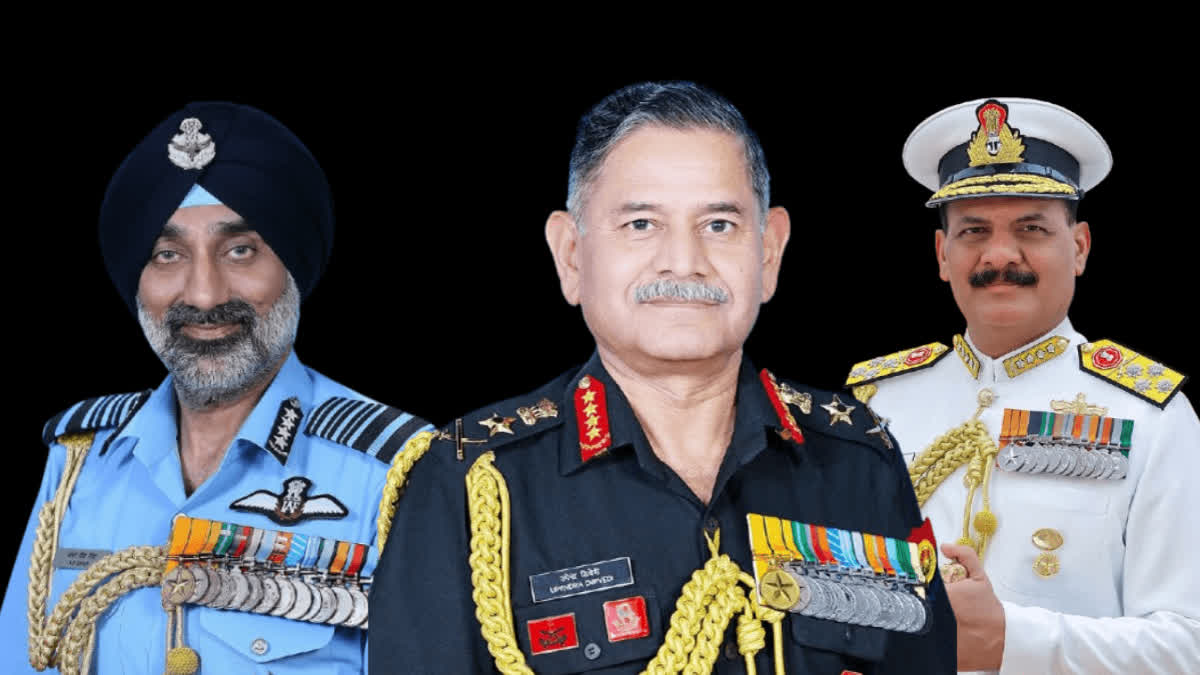
Last month, India's military brass convened at the Army War College conclave Ran Samwad to debate the country’s most consequential defence reform in decades: Theatre Commands. While the Army and Navy signalled readiness for reforms to restructure the existing command and control system, the Chief of the Air Staff, Air Chief Marshal A.P. Singh, PVSM, AVSM urged caution. Instead, he proposed an interim step, a Joint Planning and Coordination hub in New Delhi under the Chiefs of Staff Committee.
The Navy chief, Admiral Dinesh K. Tripathi, PVSM, AVSM, NM on the other hand, reiterated the Navy’s commitment to tri-service synergy with theaterisation as the “ultimate goal.” Responding to the dissonance India's Chief of Defence Staff (CDS), General Anil Chauhan, PVSM, UYSM, AVSM, SM, VSM acknowledged that differences over joint structures would be resolved with "openness". Together, these views suggest a difference of opinion among the top military leadership on the proposed "Theater Commands".
This debate about how to reorganise India's approximately 1.4 million-strong armed forces for future wars is not new, nor is the anxiety within the services about losing turf, resources, or identity. But today, with a volatile security environment, the question is no longer whether India should have theater commands, but what shape they should take.
What Theaterisation Means and Why India Wants It
Theaterisation would merge India's 17 single-service commands into three or four integrated theaters. One for the Western front with Pakistan, one for the Northern borders with China, and one for the seas, with supporting functional commands for areas such as air defence, cyber, and space. Each theater command would have under it all the Army, Navy, and Air Force assets needed for the mission. The aim is synergy of command, faster decisions, fewer overlaps, and joint planning and operations, especially for multi-domain conflict.
This model is not unique. The United States operates through Unified Combatant Commands, consolidated after the Goldwater-Nichols Act of 1986. China in 2015-16 restructured its seven military regions into five joint theater commands, cutting 300,000 soldiers focusing on integration. Russia’s military districts function as theater-like structures; the UK created Strategic Command to drive integration across domains. Regardless of model, the common logic is joint command authority, joint planning, and integrated logistics under one roof.
Nineteen Commands, Scattered Strength
For India, which faces the prospect of a two-front conflict, the rational is promising. As the former Chief of the Naval Staff, Admiral Arun Prakash, PVSM, AVSM, VrC, VSM (retd), puts it; “Today India’s military strength is divided amongst 19 Commands (including the tri-services Andaman and Nicobar Command, and Strategic Forces Command) scattered across the continent. To mount an operation, you need to pull forces from everywhere. The purpose of theaterisation is to merge these into a small number of commands so that our assets can be optimally deployed, in a timely and efficient manner.”
The Navy is especially supportive, having seen the Andaman & Nicobar Command function successfully as a “miniature theater” since 2001. “Proof of the pudding has already been proved,” Admiral Prakash notes.
Defence analysts argue that India’s geography demands theaterisation. There are a few countries that face a "two-front" challenge, the way India does. Pakistan to the West remains volatile, while China to the North is aggressive. The Line of Actual Control (LAC) is hot, with Chinese infrastructure and continuous troop build-up. Adding to this is the vast maritime domain in the Indian Ocean, where China's naval presence is growing. Analysts say that without theaterisation, India risks fighting future wars with past structures.
Warfare in the Cyber Age
Modern warfare is no longer confined to land, air, or sea. It plays out simultaneously in space, cyber networks, and electronic domains. For instance, a drone launched from across the border could require simultaneous action from the Air Force to neutralise it, the Army to protect assets, and cyber units to disable control systems. "Only a joint command can respond at the required speed," opines Admiral Prakash.
On the other hand, Wing Commander C M Jaywant, SC (retd), a decorated IAF officer counters and supports the proposal of the IAF Chief of Joint Planning and Coordination hub instead of theaterisation. "If you have senior commanders of all three services in an Operations Room, decision-making is centralised. All resources will then be used based on decisions taken, keeping in mind the entire war effort. When you have limited resources, you have to retain flexibility to use assets optimally and switch them from one war zone to another easily," opines Wing Commander Jaywant.
The idea sounds simple. Instead of three forces utilising their resources from their respective service, communication, and logistics chains, theaterisation would create unified commands, each headed by a single Theater Commander, with assets drawn from all three services. A Western Theater Command, for instance, would handle the Pakistan border. An Eastern Command would focus on China. A Maritime Command would cover the Indian Ocean. But following the debate in Mhow, it seems nothing about this proposal is simple.
Lessons That Demand Jointness
The Army wants it yesterday, the Navy is cautiously optimistic, and the Air Force has reservations. The political leadership, on the other hand, wants to speed up the proposal, but the services desire further clarity on the matter. And looming behind this debate is the shadow of China's People's Liberation Army, PLA, which reorganised itself into five theater commands in 2016. It has the Western Theater Command that stares directly across the Himalayas at Ladakh, which is an immediate threat to India.
Admiral Prakash believes that theaterisation will help build synergy in the three forces. "Right from independence, we’ve had a system of 'single service' command and control, with the Chiefs of Staff Committee (COSC) attempting inter-service cooperation and coordination - with limited success. Therefore, in all our conflicts - 1962, 1965, 1971, and 1999 Kargil, etc, we have suffered from a lack of inter-service synergy as well as joint planning and executions," says the former Flag Officer.
He further adds that in most cases, we have been lucky to achieve operational success, but often, we have also paid a price. For instance, he shares, during the peace-keeping Operation Pawan in Sri Lanka, the joint force put together by the Chiefs of Staff Committee, COSC, and placed under a Joint Force Commander, quickly fell apart because there was no synergy between the services, and each wanted to operate independently.
"In Kargil, there was confusion and a lack of coordination between the Army and Air Force at the outset. Later, we recovered only because of the bravery of our pilots and soldiers, but Kargil was a near-disaster that came as a wake-up call," states Admiral Prakash.
This prompted the government to constitute, first, the Kargil Review Committee in 1999, and then the Group of Ministers (GoM) to examine the flaws in our national security and higher defence systems. Admiral Prakash, who was one of the Task Forces, shares that the GoM concluded that the Chiefs of Staff Committee system, with the three service chiefs sitting together and taking decisions, by consensus, was inadequate and had failed. They recommended a Chief of Defence Staff, CDS, a Vice CDS, and the creation of joint structures as well as Theater Commands. "But political indecision, bureaucratic inertia, and internal opposition stalled it. Apart from the IDS, the Strategic Forces Command, and the Andaman & Nicobar Command, none of the numerous other recommendations was implemented," says Admiral Prakash.
A Post Meant to Change Everything
A decade later, the then Congress government convened another committee called the Naresh Chandra Committee in 2011 to look into national security reforms. They also recommended that India needs a Chief of Defence Staff, and it needs jointness and joint commands. Nothing happened for the next 10 years. Then in 2020, the present government took one of the most historic decisions on national security, which was to create the post of Chief of Defence Staff, CDS. The CDS was charged by the government of India with two things: to create jointness amongst the armed forces by various measures, and through jointness, create a theater command. Five years have passed. Very little has happened. "I presume because of the same political indecision, bureaucratic inertia, and opposition from within the service," notes the Admiral.
The real push to implement the theaterisation model came after 2019, when General Bipin Rawat was appointed as India's first CDS. He spoke openly about reorganising 17 single-service commands into four or five theater commands. General Rawat had argued that future wars would be "short, swift, and intense." His untimely death in 2021 slowed the process, but the idea remained alive. In July this year, Defence Minister Rajnath Singh declared that India must move toward theaterisation "without delay."
Why The Resistance
Despite the push, there is resistance from within the armed forces, particularly the Air Force. Its leaders worry that scarce assets, as India has barely 31 combat squadrons against an assessed need for 42 squadrons, could be locked into regional theater, which will reduce flexibility. Wing Commander Jaywant explains that the aim is to use resources for the best result. But if resources are permanently allocated to theaters, reallocating them in a crisis will be slow.
"Each theater commander will guard his assets because he will be judged by his own success. Air power, which has a wide range and can strike deep into enemy territory, must remain flexible. If we lock it into silos, it will not be optimally used," says the officer. He also warns against blindly copying America or China and points out India's vision and primary focus. "The US has global ambitions. China seeks influence in the South China Sea and beyond. India’s aims are presently limited to safeguarding its borders. With limited resources, we need flexibility, not rigid theaters. Before reorganising, we must have clarity on scenarios and strategy. Otherwise, we risk creating structure without purpose," says Wing Commander Jaywant.
Part of the Air Force's defensiveness comes from comments by the late CDS General Rawat, who called the Air Force a "support arm." Admiral Prakash agrees and sees this as a misunderstanding. "General Rawat perhaps slipped in his choice of words. He should have used the term ‘air power’, which is indeed a support force for all three services. Wherever air power is required, it will come, do its task, and go back. There is not going to be any division of air power in the theater command paradigm. Moreover, there will be 2/3 star IAF officers on the theater command staff who will be responsible for deploying air power," clears the officer.
The Navy, too, has raised questions, though in a softer tone. It supports Maritime Theater Command, but seeks clarity on whether coastal defence will remain with it. Additionally, there's also a chatter about the budget when it comes to the theaterisation model like China and the US. Admiral Prakash clarifies that the budget will not be a restricting factor. "The budget is meant for buying equipment and paying salaries. We are re-organising and re-deploying the same equipment and the same manpower in a different manner. We are going to just reorganise, so the question of budget enhancement doesn't arise. In fact, there may be some savings, because jointness will eliminate much of duplication and redundancy," says the officer.
Wing Commander Jaywant, on the other hand, says the real risk is premature reform. India spends barely a fraction of what the US or China does on defence. We should first build financial and military strength, broaden our interests, and let inter-service postings build familiarity over time. Maybe 10–15 years from now, when our economy and military are stronger, theaterisation will make sense.” This opinion also seconds the argument of the Chief of the Air Staff.
The Army, on the other hand, has been the strongest advocate. Given that it faces the brunt of land-based threats from both Pakistan and China, the Army sees theaterisation as essential for faster coordination and joint warfighting. Many retired Army chiefs have publicly backed the idea. "Theaterisation will streamline joint ops; a mature plan has been readied for government consideration," General Upendra Dwivedi said earlier this year.
The Way Ahead
There are many challenges, including the intricate differences within the doctrines followed by each service. This needs to be overcome before a final structure map can be worked out. A major hurdle of the theaterisation proposal is the decision of hierarchy in the new TC-based formations.
Many policymakers recommend that we take inspiration from the US Theatre Command playbook to overcome these challenges. The US Theatre Command has four-star officers as theatre commanders, but a better idea for India would be to continue with our current structure of three-star officers of the C in C grade to lead the Theatre Commands. This structure will ensure that they are lower than the Service Chiefs and the CDS but higher than the Corps Commanders. While this stands true, India also needs to overcome shortfall of resources within the services, and modernise the existing armed forces by taking up requisite technological advancements to keep pace with modern times.
Read More:
- Kargil Vijay Diwas 2025: Love, War, And Letters, A Memoir Of A Soldier's Wife Waiting For The Call That Said 'The War Is Over'
- Exclusive | Indian Navy Has A Huge Amount Of Edge With Regard To Combat Power Compared To Pakistan: Commodore Srikant Kesnur (retd)
- Operation Sindoor: Indian Armed Forces' 'Balanced And Measured' Blow On Pakistan's Terror Camps; Conflict Continues, What's Next?
