Commemorative Stamp Released On 125th Anniversary Of Kodaikanal Solar Observatory
Operated by the Indian Institute of Astrophysics, the Kodaikanal Solar Observatory has one of the longest continuous daily records of the Sun in the world.
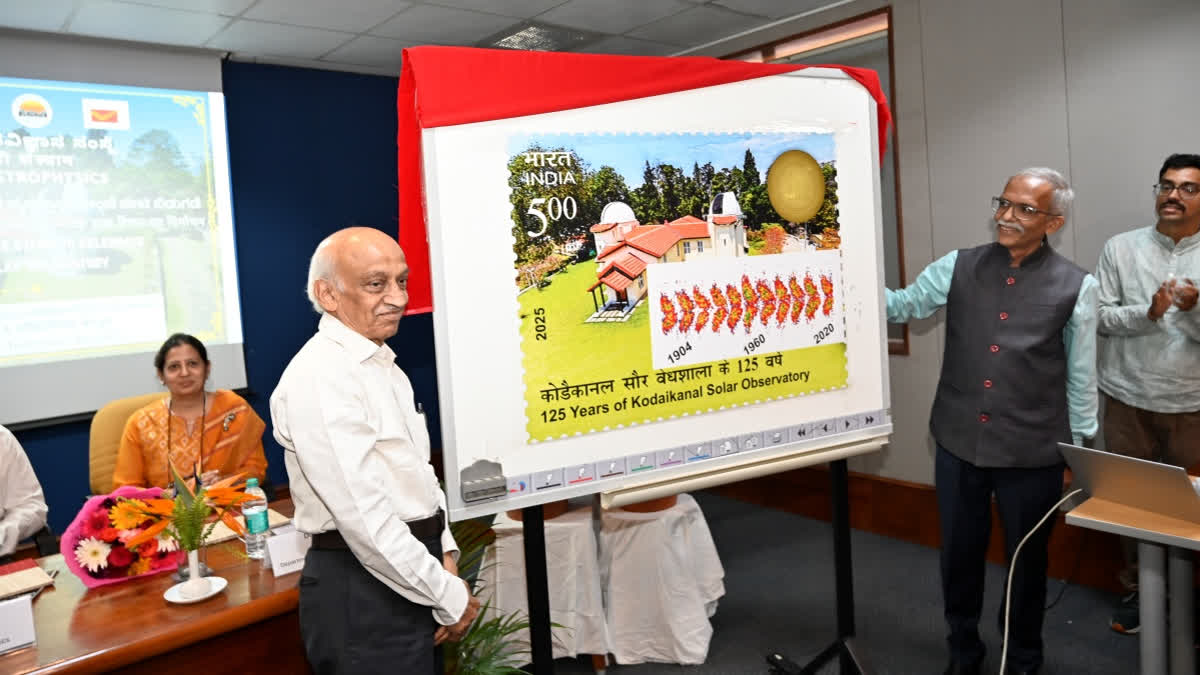

By Anubha Jain
Published : May 16, 2025 at 7:54 PM IST

Bengaluru: A postal stamp was released on Friday at the Indian Institute of Astrophysics here by the Department of Posts to commemorate the 125th anniversary of the Kodaikanal Solar Observatory. Established on April 1,1899, the observatory has been a cradle of research in solar astrophysics ever since, with a number of path breaking discoveries to its credit. The quasquicentennial was celebrated for a year, starting from April 1 2024, and it is a fitting tribute to this scientific institution that a stamp has been issued in its honour.
Operated by the Indian Institute of Astrophysics, the Kodaikanal Solar Observatory has one of the longest continuous daily records of the Sun in the world, and this unique database has been digitised and is publicly available for astronomers from across the globe.
A stamp commemorating this glorious history and legacy was issued along with the stamps album, the first day cover, and official brochure by A.S. Kiran Kumar, the former Chairman ISRO and current chairperson of the Governing Council of IIA, and S. Rajendra Kumar, Chief Post Master General, Karnataka Circle. They were joined by Dr. Usha Dixit from the Department of Science and Technology, Govt of India, Prof. Ramanath Cowsik and Prof. S. Sirajul Hasan, former Directors of IIA, and Prof. Annapurni Subramaniam, Director of IIA.
On the occasion, S. Rajendra Kumar, Chief Post Master General of the Karnataka Circle, reflected on the natural curiosity of humankind. He highlighted the vital role of observatories as institutions that empower us to explore and understand the Universe. Recalling a significant moment, he spoke of the 2008 commemorative stamp issued by the Department of Posts to mark the centenary of the discovery of the Evershed Effect at Kodaikanal.
A.S Kiran Kumar, former Chairman of ISRO, reminisced about how he was an avid collector of stamps and first-day covers in his childhood. He went on to emphasize humanity’s enduring quest to look beyond the visible, highlighting ISRO’s Aditya-L1 mission as a remarkable step in studying the Sun. He praised the Indian Institute of Astrophysics (IIA) for its longstanding legacy of solar and celestial observation, commending the leadership of its successive Directors in guiding this journey. He also underscored the immense value of the 125 years of archival data from the Kodaikanal Solar Observatory, pointing to its vast potential for future astronomical research and discovery.
Prof. Annapurni Subramaniam, Director of IIA, marked the appropriateness of releasing the stamp today, on the International Day of Light, and spoke of the passion and dedication of generations of people at the Kodaikanal Solar Observatory who have made its growth possible over more than a century. She spoke of how IIA has expanded its research domain from the Sun outwards, and acknowledged the continued support by the Department of Science and Technology for enabling this journey. She also explained how the various elements of the stamp have the story of the Observatory embedded inside it.
Prof. Annapurni told ETV Bharat that releasing a postal stamp is like etching a moment into the nation's history. The commemorative stamp of the solar observatory symbolises a relentless quest for knowledge and the perseverance to uncover the mysteries of science and the universe we inhabit. She emphasized that in the vastness of space, Kodaikanal holds a unique place—it is like a window to study the star we live with. The Sun, after all, is a star, and understanding it is crucial, especially given the potential damage solar eruptions can cause to space-based infrastructure. Reflecting on the long journey of scientific discovery, Prof. Annapurni noted that the seeds of knowledge sown 125 years ago have flourished significantly and expanded into multiple domains. In recent years, India has taken a bold step further by launching the Aditya L1 mission to study the Sun in greater depth. At the heart of this enduring journey lies the Sun—central to both our solar system and our scientific pursuit.
The stamp prominently features the iconic building of the Kodaikanal Solar Observatory, which has two domes. The dome on the right hosts the 6-inch telescope which was installed at the Madras Observatory as early as 1850, remodelled in 1898, and installed at Kodaikanal in 1900 by the then Director, Michie Smith. The dome on the left hosts the 8-inch telescope that was installed at the Madras Observatory in 1866, and brought to Kodaikanal in 1930. This telescope is now used for public outreach for visitors. The stamp also features an H-alpha image of the Sun taken at the Kodaikanal Solar Observatory on 6 May 2024, as well as the IIA logo. In addition, a colourful inset in the stamp is the famous ‘Butterfly Diagram’, which is a plot of the solar latitude of sunspots versus year. This plot was generated using data taken from the Observatory between 1904 and 2020.
Prof. B. Ravindra, the lead scientist in charge of the Kodaikanal Solar Observatory, highlighted the significance of the observatory during a conversation with ETV Bharat. He noted that the observatory, established 125 years ago, continues to play a crucial role in solar research. Remarkably, the same single telescope has been in use since its inception, consistently providing reliable data with minimal calibration issues.
Prof. Ravindra recalled that around 15 years ago, there was a significant debate regarding the cause of global warming—whether it was driven by solar activity or human actions. Today, it is well established that global warming is indeed man-made. Nevertheless, he pointed out that solar activity has shown an increasing trend over the past century. In this context, he emphasized the critical importance of the long-term data collected at the Kodaikanal Solar Observatory. This invaluable archive helps scientists study and understand various aspects of solar behaviour and its potential influence on Earth.