At IISc Event, Indian Scientist Revisits Story Of Forgotten Virologist Who Had First Discovered Human Coronavirus Strain
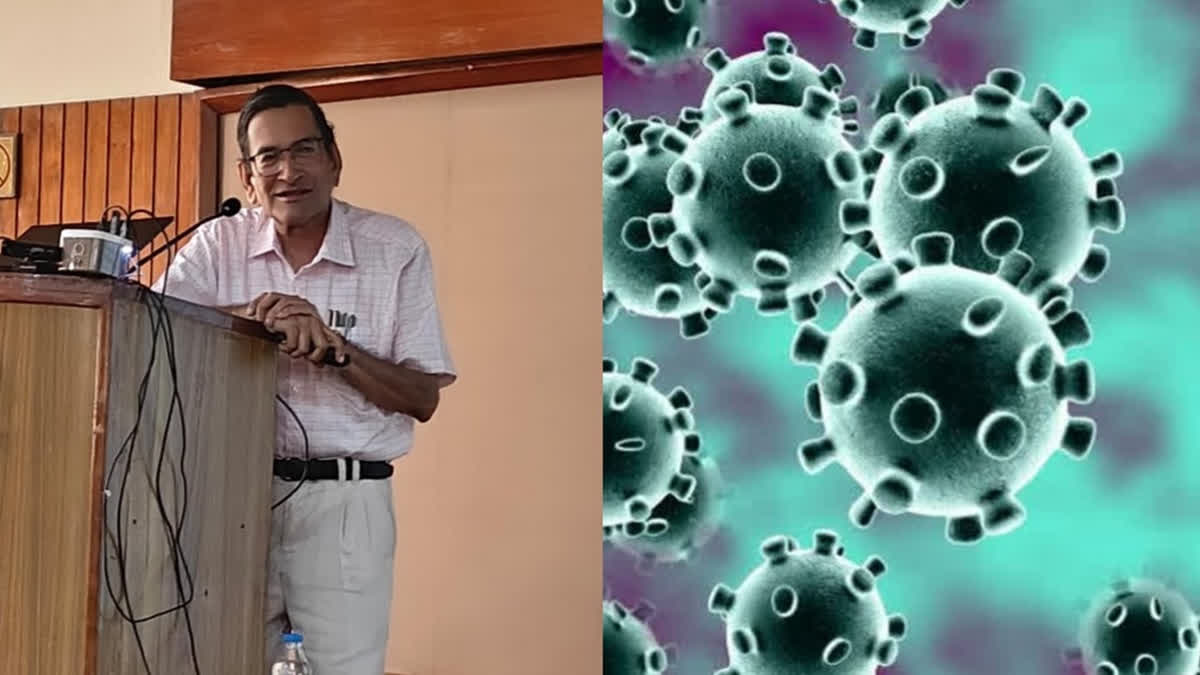
During Women's Day conference at IISc, Prof Balaram revisited the story Dr Dorothy Hamre, the woman virologist who first isolated the human coronavirus strain 229E.

By Anubha Jain
Published : April 5, 2025 at 8:08 PM IST

Bengaluru: "Whenever I discuss something with my students, I always like to put a picture and a brief history of whatever we are talking about." That's how Prof Padmanabhan Balaram started his keynote address at the recent Women's Day conference at IISc, Bengaluru, in what turned out to be gripping session for everyone present at the event.
The conference, organised by the IISc (Indian Institute of Science) Alumni Association, was held on the theme 'Spectrum of Creativity: Gender, Culture, Innovation'. And former director of IISc Prof Balaram, a Padma Shri and Padma Bhushan recipient and eminent Indian scientist, found it an apt moment to revisit the story of a woman scientist Dr Dorothy Hamre, the virologist who first isolated the human coronavirus strain 229E.
When the pandemic struck in 2020, while delving into the origins of the coronavirus, Prof Balaram discovered an important historical paper from 1967. It was titled "The Morphology of Three Previously Uncharacterized Human Respiratory Viruses that Grow in Organ Culture" by June D Almeida, which first described the coronavirus. Using a powerful electron microscope, Almeida captured an image of a mysterious pathogen — the first known coronavirus to cause human disease. The discovery made waves in publications such as National Geographic and The New York Times, acknowledging Almeida as the person who identified the coronavirus. Almeida was working in the lab of biologist David Tyrrell, where they studied human respiratory viruses 229E and B814.
While June Almeida is largely being credited for capturing the first image of the virus through electron microscopy, Prof Balaram cited that the virus sample used in Almeida's 1967 paper was actually provided by Dr Dorothy Hamre.
"What intrigued me was a passing reference in the paper by June and Tyrrell, and an acknowledgement that Dr Dorothy Hamre had provided the virus sample from which the electron micrograph was taken," Prof Balaram said.
I tried to find a picture of Dr Hamre for my presentation, but wasn't able to, he said. Instead, what I came across was 40 publications from 1943 to 1972 by her name on Google, the Indian scientist added.
He continued, "My search led me to the archives of Northern Arizona State University’s library, where, under Hamre's husband Alexander Brownlee Collections, now titled the Dorothy Hamre and Kenneth Alexander Brownlee Photographs, I finally found what I had been looking for."
The archives contained a small biography of Dr Hamre, stating that she had been trained in bacteriology and biology and had completed her PhD in Colorado. However, most photographs in the archive were of landscapes in the southwestern United States, with only a few images featuring small, unclear figures that did not appear to resemble a biologist who had discovered the coronavirus.
Through his research, Prof Balaram concluded that Dr Hamre was a scientist who had done fundamental work at the University of Chicago on rhinoviruses, the cause of the common cold. This background helped her identify coronaviruses. Prof Balaram got to know that she was born in 1915, retired from the University of Chicago as a research associate, and died on April 19, 1989.
In recognition of her contributions, Prof Balaram later published his findings and the work of Dr Dorothy Hamre in The Frontline Magazine in 2022.
In his keynote address at the IISc event, Prof Balaram also reflected on the significant contributions of women in science, particularly in the 20th century. He shared insights from his journey as the youngest faculty member at IISc in 1975, when the IISc Alumni Association was formed.
He also emphasised the contributions of pioneering women scientists, such as Lise Meitner, who played a critical role in the discovery of nuclear fission, and Marie Curie, who won two Nobel Prizes in Physics and Chemistry in 1903 and 1911. Prof Balaram pointed out that women in science were rare at the time, but over the years, their numbers and influence grew. He highlighted the achievements of Dorothy Crowfoot Hodgkin, who won the Nobel Prize in Chemistry in 1964 for her work in X-ray crystallography, which led to the determination of the structures of vital biochemical substances like penicillin, insulin, and vitamin B12. Hodgkin’s pioneering work also contributed to understanding cholesterol, as she was the first to determine its complete molecular structure.
Prof Balaram also highlighted the importance of Rosalind Franklin's contribution to understanding DNA's structure. Franklin's groundbreaking X-ray diffraction work, particularly her famous 'Photo 51', was instrumental in revealing the double-helix shape of DNA, laying the foundation for Watson and Crick's model.
Read More
AI For Weather Forecast: IISc Develops AI-Powered Model For Heat Stress Predictions
