
Hyderabad: Artificial Intelligence startup TypeSafe AI recently launched an AI model, Jev, joining the ranks of well-known chatbots such as OpenAI's ChatGPT, Anthropic's Claude, and Google's Gemini. However, it is fundamentally different from the competition. Unlike typical AI chatbots, Jev is not a standard large language model (LLM). Instead of generating conversational text, it gives what the company calls "calibrated decisions" based on set probabilities.
Developers Rush To AI That Doesn't Chat: Could Jev Challenge ChatGPT For Software Automation?
TypeSafe AI has launched Jev, an AI model that gives calibrated decisions instead of text, cutting hallucinations and costs.
Ex-OpenAI researcher launched Jev, an AI that makes decisions instead of text conversation (Getty Images)
Published : September 21, 2026 at 11:40 AM IST
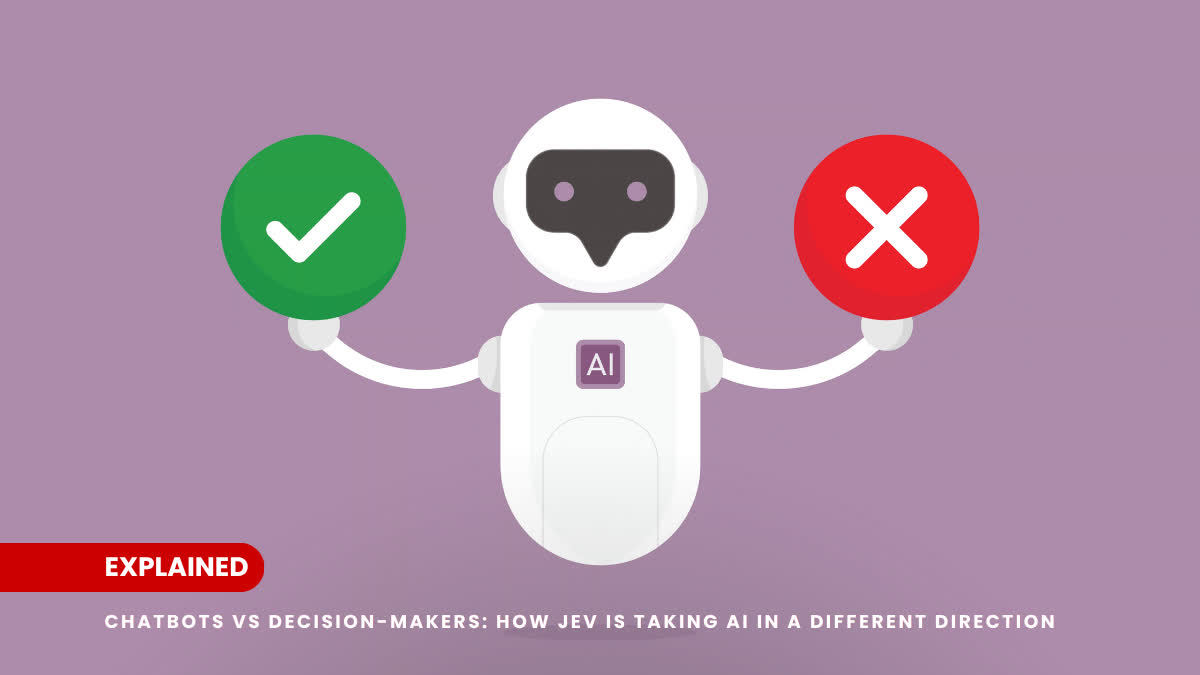
To put it in simple terms, if ChatGPT and other popular chatbots act as writers and talk to humans, Jev leans more towards being a referee and making instant choices for computers—expected to make business software much faster and cheaper to run.
While other models think token by token to write a long, human-like response while explaining things, TypeSafe's product doesn't write sentences and instead gives a solution, instantly flashing a signal like Yes/No or a score from 1 to 10. This also means Jev is cheaper, as it doesn't burn through tokens like the mainstream models since its 'writing cost' is virtually zero, in addition to requiring much less computer brainpower to run. Additionally, as Jev's answers come from a fixed set of outputs, the company claims it makes fewer mistakes and works faster.
Jev costs $0.042 per million input tokens and free output tokens, as TypeSafe AI says it's "too cheap to metre".
TypeSafe AI launched the new AI model on September 15, 2026, under its System One Model, which is a new class of frontier models built to make fast, structured decisions for software automation. Developers have already shown strong interest in Jev for software automation. Demand has been so high that TypeSafe AI's API was temporarily closed to new users. Companies such as Vercel, Cloudflare, LangChain, and Langfuse added Jev to their stacks within three days of its launch.
Praneet Sharma, a software engineer at Vercel, said his company had earlier used an OpenAI model to run a command safety classifier. After switching to Jev, he said results came back 5 to 18 times faster, with better accuracy.
Will Jev doom ChatGPT and other conventional AI chatbots?
Talking to ETV Bharat, Jaspreet Bindra, Co-founder & CEO, AI & Beyond, said, "Jev is interesting not because it is another competitor to ChatGPT, but because it questions an assumption that has shaped the AI industry so far: that more capable AI necessarily means better language generation."
"The real significance of Jev is its focus on making decisions rather than generating text. If AI is increasingly going to operate inside software and autonomous workflows, we may need models that are fast, structured, predictable and able to communicate confidence, rather than models that are simply very good at conversation," he added.
While the AI industry is contemplating whether Jev will replace ChatGPT or other existing LLMs, at least for automation tasks, Bindra believes that the more likely direction is an ecosystem where different models perform different jobs. LLMs can handle reasoning, language and open-ended tasks, while specialised models such as Jev could handle high-volume decisions, classification and routing much more efficiently.
"What Jev is really testing is whether the next phase of AI will be defined not just by how intelligently a model can talk to us, but by how reliably and efficiently it can act inside the systems we already use," he explained.
Pointing towards the adoption of Jev, says that it is not a lab experiment and already sits inside production software. Abhishek Agarwal, President, Judge India & Global Delivery, The Judge Group, says that while the speed claim of Jev, which is said to be 20 to 200 times faster than conventional chat models, is hard to ignore, he is more impressed by the pricing and adoption from Vercel, Cloudflare, LangChain and Langfuse within three days of its launch. "This isn't a lab experiment. It's already sitting inside production software," he told ETV Bharat.
Pointing towards the rapid adoption of Jev, Abhishek Agarwal, President of Judge India & Global Delivery at The Judge Group, noted that the technology is far beyond a conceptual test. While Jev's reported speed—said to be 20 to 200 times faster than conventional chat models—is hard to ignore, Agarwal emphasised that its pricing and swift uptake by Vercel, Cloudflare, LangChain, and Langfuse within three days of launch are even more impressive.
"This isn't a lab experiment. It's already sitting inside production software," he told ETV Bharat. However, he also believes that Jev will not replace already existing AI tools but provide an add-on for specific needs.
"From where I sit, watching enterprises hire and build AI capability, this signals something specific rather than apocalyptic. Jev isn't trying to replace ChatGPT in conversation. It skips language generation entirely, returning a yes or no, a ranked choice, or a confidence score instead of a sentence, which makes it suited to high-volume automated decisions rather than open-ended reasoning. That's a narrower job, done far cheaper," Agarwal added.
"So will it doom OpenAI's models? I doubt it, and I don't think that's actually the right question," Agarwal said. Highlighting that Jev was built specifically because conversational models, despite their power, were poorly suited to software automation at scale, he added, "That's a gap, not a takeover."
"What it does signal is a coming split in enterprise AI hiring and architecture decisions. Businesses will increasingly need talent who can decide which workflows genuinely need a reasoning model like GPT or Claude, and which just need Jev's kind of fast, calibrated judgment running quietly in the background. That distinction is where I expect real disruption to land, not in chatbots losing users, but in how enterprises staff and structure their AI stacks going forward. The winners will be the organisations that build that judgment early, rather than defaulting to one model type for every job," Agarwal added.
Made by former OpenAI researcher
TypeSafe AI is led by Diogo Almeida, a former OpenAI researcher who helped build ChatGPT. At OpenAI, Almeida was a co-creator of Reinforcement Learning from Human Feedback (RLHF), a method used to train ChatGPT. Despite AI's growing power, Almeida felt current models were not very effective for automation tasks. This dissatisfaction led him to leave OpenAI and start TypeSafe AI to solve the problem.
TypeSafe AI says the model is named after economist William Stanley Jevons, known for the Jevons Paradox. This theory suggests that when a resource becomes cheaper, people often use more of it rather than less. The company believes the same pattern could apply to AI as it becomes more efficient and widely used.
How does Jev work?
When a user types a query on their automated software, Jev receives two things: the State and the Typed Question. The State is the raw background information, like a customer email, financial data, and medical log, while the Typed Question is the specific thing that the user wants Jev to evaluate based on the State.
Instead of reading the background information as text and thinking about it conversationally, Jev analyses the information to answer users' questions simultaneously. This is because Jev does not generate a sentence word by word like a typical chatbot. Instead, it scans the data and calculates the answer in a quick, single go. Jev entirely skips the conversational text and puts the output in clean, structured data points, which are shown in three ways: Noul, Choice, and Score.
- Noul presentation shows the answers in a Yes/No percentage format.
- Choice displays a selected option from a predefined list.
- Score presents the answer in a numerical rating based on a set scale.
TypeSafe AI says it trained the System One and Jev using a technique called Reinforcement Learning for Calibrated Decisions. Using this technique, the company says the AI model's confidence level matches its actual accuracy. This means that when confidence is high, the system can act on its own, but when confidence is low, it can pass the decision to a human instead.