India Celebrates 10 Years Of UVIT, Its First Space UV Telescope
UVIT has observed 1,451 celestial objects, which have led to about 300 research papers and 19 PhD theses.

By Anubha Jain
Published : December 6, 2025 at 9:05 PM IST
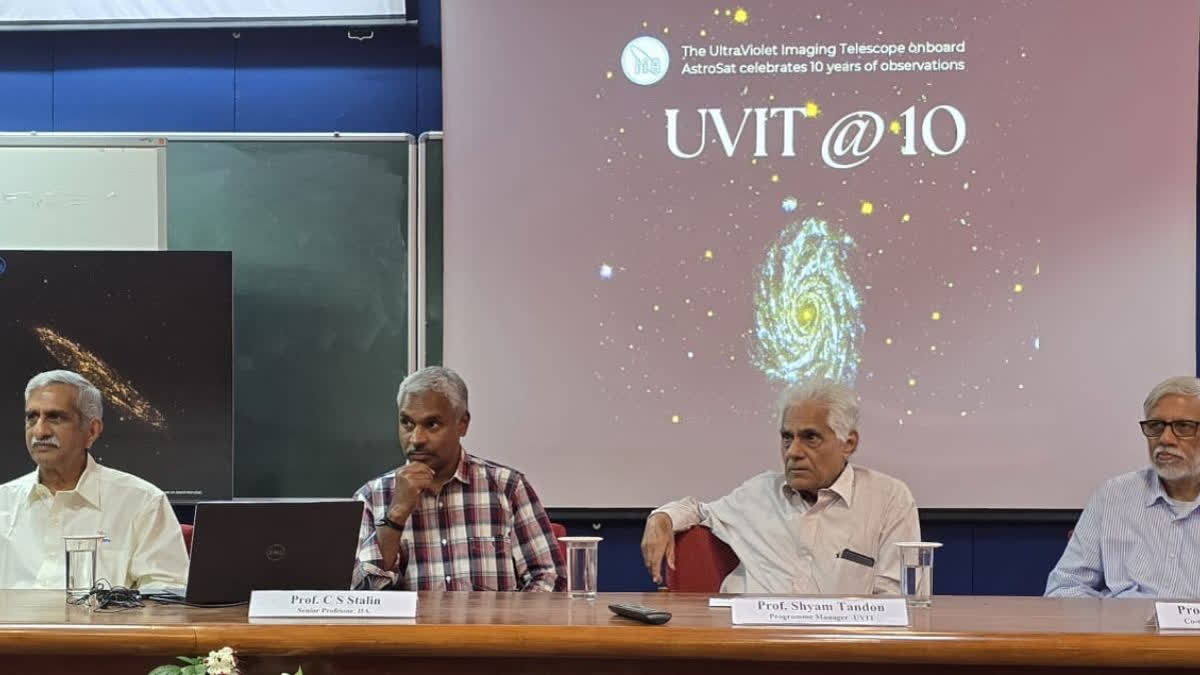
Bengaluru:The Indian Institute of Astrophysics (IIA) celebrated 10 years of India’s first space-based Ultraviolet Imaging Telescope (UVIT). It is the main payload on AstroSat— India’s first dedicated multi-wavelength space observatory— which was launched by the Indian Space Research Organisation (ISRO) on September 28, 2015.
The UVIT payload was designed, assembled, and tested at IIA’s Hosakote campus. The payload is part of AstroSat’s suite of five instruments that observe the universe in ultraviolet (UV), visible, and X-ray light. The UVIT was developed in collaboration with the Inter-University Centre for Astronomy and Astrophysics (IUCAA) - Pune,Tata Institute of Fundamental Research (TIFR) - Mumbai, multiple ISRO centres, and the Canadian Space Agency (CSA). To mark the anniversary, IIA held a one‑day workshop highlighting UVIT’s scientific achievements and India’s future in UV astronomy.
What makes UVIT special?
C.S. Stalin, in charge of the UVIT Payload Operation Centre, said, "UVIT is a twin-telescope system covering near-UV, far-UV, and visible wavelengths. Its wide field of view and spatial resolution better than 1.5 arcseconds make it globally unique."
In an exclusive interview with ETV Bharat, Former ISRO Chairman, A.S. Kiran Kumar, highlightedthat space missions like UVIT strengthen India's scientific ecosystem and create opportunities for both academia and private entities in space research.
"UVIT continues to offer the highest angular resolution and sensitivity in its specific UV wavelength range among any operational space telescope that has a large field of view. In this band, it provides information that complements what facilities like Hubble or JWST can deliver," he noted.
Kumar pointed out that AstroSat is a unique satellite because it carries instruments that study UV, visible, and X‑ray light together, which provides scientists with a complete view of the universe. Its archived data is open, so astronomers worldwide can keep making discoveries.
When he was asked whether ISRO plans to build larger-aperture UV telescopes to match upcoming global missions such as NASA's ULTRASAT or ESA's planned UV observatories, Kumar said that larger UV telescopes may be built if they serve the broader scientific community. He emphasises that India’s current focus is on human spaceflight, a space station, and missions to the Moon and Venus. Apart from these, follow‑on projects like UVSat, next-generation UV observations, and exoplanet studies are already being planned.
When discussing the synergy between AstroSat and Aditya‑L1, Kumar explained how both differed from each other. AstroSat surveys faint stars and galaxies, while Aditya-L1 watches the Sun. Both show India’s growing skill in aiming telescopes precisely in space.
UVIT: Achievements and data
Over a decade, UVIT has observed 1,451 celestial objects, which have led to about 300 research papers and 19 PhD theses. Discoveries using the UVIT payload include:
- Hot companions of Be stars
- Blue Straggler Stars in clusters
- Extended ultraviolet disks in dwarf galaxies
- Novae in the Andromeda galaxy
- Emissions from distant galaxies up to redshift 1.42
Science‑ready UVIT data continues to be uploaded by IIA to ISRO’s PRADAN archive, which is freely available to astronomers worldwide.
Building the Telescope
IIA Director and UVIT Calibration Scientist, Annapurni Subramaniam,in an exclusive interview with ETV Bharat,explained that UV astronomy was new for India, as the country had long focused on ground-based optical and infrared observatories. "UV observations are impossible from the ground, so we depend entirely on space." To develop this capability, ISRO and IIA were required to build a specialised infrastructure that required clean rooms, no power breakdown, and strict contamination control.
"UV photons must reach the detector without being absorbed, which demands precise design, specialised materials, and strict contamination control. Since Earth’s atmosphere, especially ozone, blocks UV light, every component of UVIT had to be engineered to function efficiently in space," she said.
She added that India initially lacked this expertise but developed it in‑house, successfully transferring the technology to ISRO.
Yet the scientific value was clear, as UV observations are crucial for understanding key physical processes in the cosmos. UVIT, launched in 2015, embodies this progress and continues to perform exceptionally well even after a decade. UVIT is India's first UV space telescope and the only operational far-UV facility apart from the Hubble Space Telescope.
She noted that a special clean-room laboratory—MGK Menon Laboratory—was established at the CREST campus to handle sensitive components, and an international collaboration was set up with Canada for UV expertise. Post-launch, IIA also established the UVIT Payload Operation Centre for generating science-ready data, monitoring the telescope, evaluating proposals, and upgrading onboard software.
Asked about the key technical innovations developed by IIA for UVIT, Annapurni Subramaniam explained that detecting UV photons—imperceptible to the human eye—requires highly sensitive cameras and detectors. "UV photons must reach the detector without being absorbed, which demands precise design, specialised materials, and strict contamination control. Since Earth's atmosphere, especially ozone, blocks UV light, every component of UVIT had to be engineered to function efficiently in space," she said. Much of this expertise was new to India, but IIA's team developed the required techniques in-house, mastered the technology, and successfully transferred it to ISRO without compromise. UVIT's successful completion stands as a strong testament to the capabilities India has built in space technology, marking a significant milestone in the nation's growing space astronomy expertise, she added.
Annapurni Subramaniam noted that the scientific insights and data from UVIT can be used to support India's next space-based UV mission.
Discussing AstroSat, Dr Koteswara Rao, former Scientific Secretary ISRO, former Director of LEOS/ISRO and Project Director of AstroSat, informed that creating a truly unique Indian space observatory was the main challenge.
"The scientific community, led by Dr Kasturirangan, recommended observing the sky across multiple wavelengths—from far-UV to gamma rays—to ensure its uniqueness. This vision shaped AstroSat's design and development," he explained. The mission became a multi-institutional effort, bringing together all payloads into a single, integrated observatory. Beyond imaging, a key feature of AstroSat is its capability to measure X-ray polarisation," he added.
Dr Rao concluded that for AstroSat, collaborating scientists were granted observation time without financial exchange, making it a unique and inclusive experience. Typically, ISRO engages the scientific community through formal announcements of opportunities for upcoming space missions.
Prof. Shyam Tandon, Program Manager UVIT, IUCAA Pune, noted that, unlike ground-based telescopes, UVIT is highly robust, though in-space repairs are extremely challenging. Capturing images of the moving sky posed difficulties, which ISRO addressed using techniques such as short exposures. On contamination, he explained that even a single molecular layer can block UV light, necessitating a specialised clean-room laboratory. "We developed and mastered methods to prevent contamination, carefully monitoring molecular deposits. Ten years on, UVIT shows no signs of contamination—a remarkable achievement and one of the most challenging aspects of the mission," he said.
Prof. Swarna K. Ghosh, Co-ordinator, Data Analysis–UVIT, TIFR Mumbai, emphasised that UVIT is the world's first multiwavelength astronomy mission of its kind.
"The data flow from the spacecraft to end users is entirely new, with critical information specific to each experiment. Integrating and correlating these diverse data streams on the ground posed significant challenges, which have since been addressed for future missions," he said.
Prof. Ghosh explained that, since celestial targets are not imaged perfectly steadily as seen through a space telescope, the data processing pipeline must track their movement and apply corrections. The mapping of the sky is not one-to-one; distortions exist and are calibrated using in-space measurements. While there are limits to corrections, the pipeline ensures that the final data delivered to astronomers is in a standard, usable form. Over time, many new techniques have been learned by the team, and the pipeline is continually revised to improve accuracy and usability, he added.
In its decade of operation, UVIT has observed 1,451 celestial targets, contributing to about 300 research papers and 19 PhD theses. Its observations have uncovered hot companions of Be stars, Blue Straggler Stars in clusters, extended UV disks in dwarf galaxies, novae in the Andromeda galaxy, and emissions from distant galaxies up to redshift 1.42. Science-ready UVIT data continues to be uploaded by IIA to ISRO's PRADAN archive for global access. At the workshop, astronomers also discussed the next major step—INSIST (Indian Spectroscopic and Imaging Space Telescope), a proposed larger UV space mission building on UVIT's decade-long legacy.